Goats are intelligent livestock animals that can learn unfamiliar tasks, remember solutions for months, recognize important herd companions, and respond to cues from people. Their curiosity is more than a farmyard stereotype: controlled experiments have demonstrated several distinct abilities in domestic goats. Intelligence does not mean every goat learns at the same speed, however, or that an animal which opens a gate understands how the latch was designed.
For a farmer, goat cognition matters because animals remember rewarding opportunities, navigate changing environments, and respond to the way people and other goats behave. Understanding those abilities makes it easier to interpret a herd’s actions without mistaking curiosity for misbehavior or assuming that every difficult behavior is a sign of exceptional intelligence.
What Does Intelligence Mean in Goats?
Animal intelligence is best assessed through specific abilities rather than a single ranking. A goat can learn an association between an action and a reward, remember where resources have been available, adjust its response when circumstances change, or distinguish one familiar animal from another. Those are different capacities, and success at one task does not establish superiority at every other task.
Domestic goats live in social groups and have a flexible feeding strategy. Finding suitable leaves and shoots in changing surroundings requires exploration and choices; moving within a herd requires attention to other animals. A review of goat behavior and dairy management connects those ecological demands with research on learning, memory, discrimination, and social recognition. This does not prove that every ordinary movement involves deliberate planning. It explains why researchers test goats with food puzzles, recognition experiments, and changes in familiar routines.
Can Goats Solve New Problems?
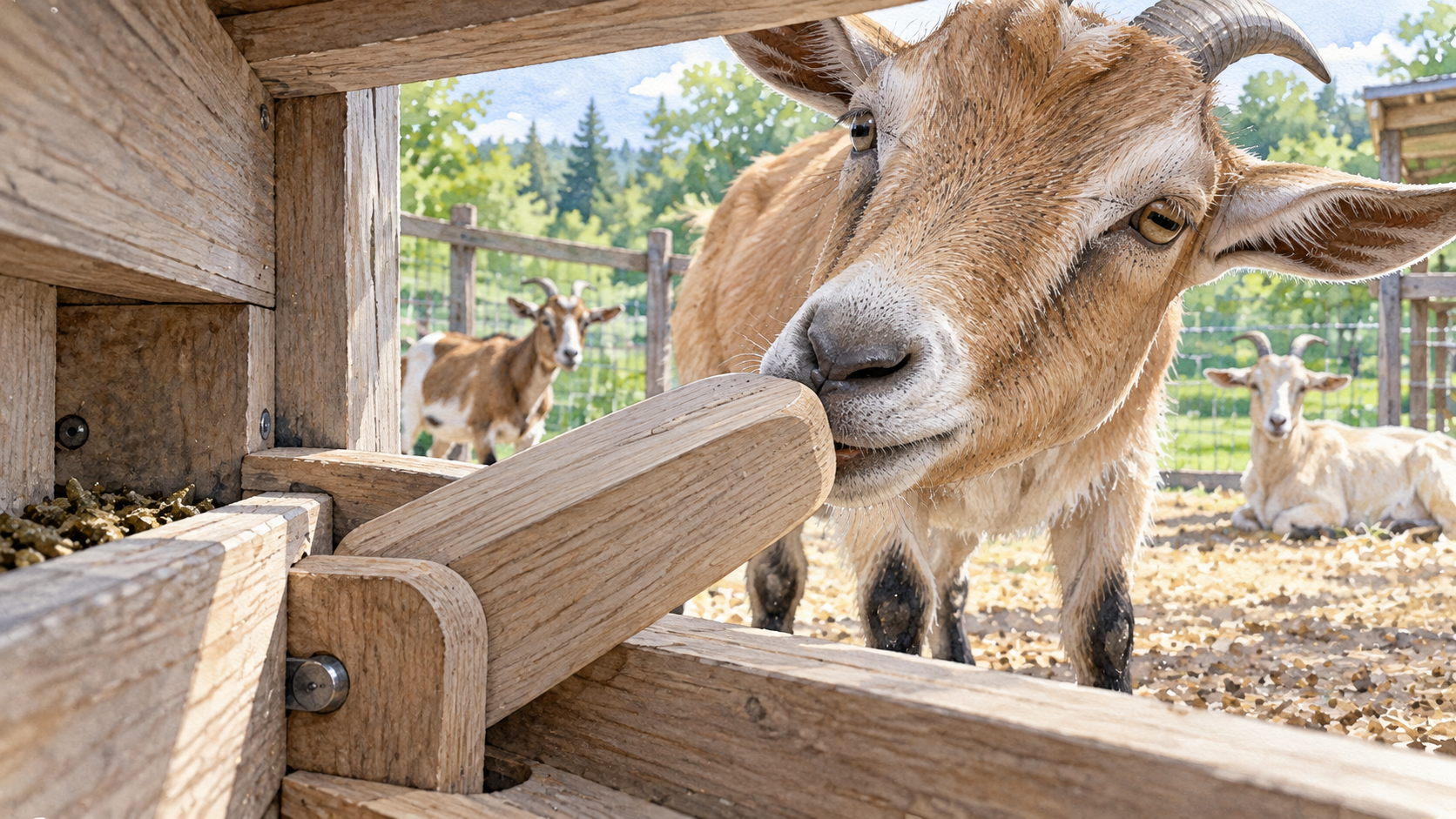
Goats can learn surprisingly complex physical tasks when a clear reward is available. In a 2014 food-box experiment, goats had to pull a lever with the mouth and then lift it to release food. Nine of the twelve animals originally trained learned the sequence, taking between eight and twenty-two trials to reach the study’s criterion. Three did not complete the training successfully, an important reminder that performance varies even within one small group.
The task tested more than pushing something until food appeared. The animals had to carry out two actions in the appropriate order, which made it useful for examining learning and retention. It would be an exaggeration to conclude from this experiment that goats can solve every kind of mechanical puzzle. What it establishes is that some goats can acquire an unfamiliar sequence through experience and later perform it efficiently.
More broadly, goats have been studied in tasks involving choices between possible food locations and the use of incomplete information. A 2022 investigation of reasoning by exclusion in sheep and goats found evidence that individuals of both species could meet strict criteria for inference in certain tests. Such findings are intriguing, but researchers use carefully designed controls because animals may sometimes arrive at the correct choice through simpler strategies.
How Long Can Goats Remember What They Have Learned?
Some learned information can last for many months. When the successful goats from the food-box experiment were retested after intervals extending to ten months, they solved the task in less than two minutes. Their rapid performance was evidence of long-term retention of that particular two-step solution, not proof that goats remember everything they encounter for ten months.
Goats also retain socially important information. In a study of mother–kid vocal recognition, mothers heard recordings of their own previous kids and familiar kids from other does. The recordings were tested seven to thirteen months after weaning. Mothers responded more strongly to their own former kids’ calls than to the other familiar calls, indicating that recognition could persist long after the young animals had been separated.
These two experiments reveal different forms of memory: one concerns a learned physical sequence, while the other concerns the identity of a socially important individual. Together they make a stronger case for goat memory than an anecdote about an animal returning to a familiar feeder. They do not establish a universal memory span, and results from trained research goats cannot be transferred unchanged to every age, breed, or farming system.
Can Goats Recognize Other Goats?
Familiarity within the herd involves more than responding whenever another animal calls. Goats can distinguish particularly familiar partners and, in some circumstances, connect the sound of a call with the animal making it. In a 2017 recognition experiment, goats heard a recorded call while looking at two herd members. When one was a close stablemate, subjects tended to look toward the actual caller sooner and for longer. The same clear response was not found when both choices were less closely associated herd members.
That difference matters: recognition may depend on the relationship, not simply on membership of the same group. The mother–kid findings likewise show that a voice can carry information about a specific animal over time. For a farm herd, social familiarity is relevant when groups are reorganized or companions are separated, although the studies do not prescribe a particular grouping system or guarantee that two familiar goats will remain compatible.
Do Goats Learn by Watching Others?
A goat can acquire information through its own attempts, but observing someone else does not always improve performance. In the 2014 food-box experiment, watching another goat carry out the task did not make the learners reach the training criterion faster. The result points to individual exploration as an effective learning route in that particular task, not a complete absence of social learning in goats.
A different experiment found a contrasting outcome. When goats faced a food reward behind a V-shaped barrier, one demonstration by a person helped them navigate a difficult detour faster. Eight of nine goats that received the demonstration took the same route as the human demonstrator on the following trial. These findings should not be flattened into either “goats always imitate” or “goats never learn from watching.” The task, demonstrator, and setting influence what can be learned.
For farmers, this is a reason to be cautious about assuming that one herd member will automatically teach the rest. Some goats may independently discover an accessible latch or feed opening; others may respond to observed actions. A single incident does not tell you which learning process took place.
What Do Goats Understand About People?
Goats pay attention to human behavior, including whether a person is facing them and certain facial expressions. In an unsolvable food-container experiment, goats directed their gaze toward a nearby forward-facing person sooner and for longer than toward a person facing away. They also alternated their gaze between the person and the problem. This suggests sensitivity to human attention; it does not show that a goat can explain its difficulty to a person.
Facial-expression research adds another piece. In a 2018 experiment with photographs of unfamiliar people, goats were more likely to approach happy rather than angry faces under certain presentation conditions. The preference was especially evident when the happy face appeared on the right, and it was not consistent across positions. The result supports discrimination between those images, but not a broad claim that goats always know how a person feels.
Recognizing a particular person across different cues is a harder question. A 2025 study involving 26 goats presented photographs and recordings of familiar people, sometimes matched and sometimes mismatched. Some physiological responses differed, but the primary measures of looking behavior did not show the predicted effect. The authors concluded that more evidence is needed to establish whether goats can match a familiar person’s face and voice. This distinction keeps the evidence for human-directed attention separate from an unproven claim of human identity recognition across senses.
Why Goat Intelligence Matters on a Farm
A goat’s ability to learn and remember has practical implications without requiring farmers to turn their animals into performers. Repeatedly rewarding an unwanted action, for instance by leaving feed accessible through a poorly secured gate, may make the action more likely to recur. Exploring objects, searching for varied forage, and maintaining familiar social relationships are also meaningful parts of goat behavior.
A review focused on cognitive enrichment for goats argues that housing should offer suitable opportunities to investigate, choose, and interact with a varied environment. This is a welfare-oriented interpretation of the evidence, not proof that one specific puzzle or toy increases milk yield or eliminates boredom. On a small farm, reasonable opportunities might include access to safe browsing material, space to move, secure elevated areas designed for goats, and appropriate herd companionship. All must be compatible with feed safety, stable footing, secure structures, and the animals’ age and condition.
It is equally important to avoid using intelligence as an excuse for unsafe facilities. Goats that investigate gaps and latches still need proper containment. A timid or slower-learning animal still needs unobstructed access to forage, water, and resting space. The ability to solve a test says little about an individual’s health, comfort, or standing within the herd.
Can Science Rank How Smart Goats Are?
There is no scientifically established goat IQ score or reliable universal ranking placing goats above dogs, sheep, cattle, or other farm animals. Different species are adapted to different challenges, and research tasks can favor the abilities and experiences of the animals being tested. Even within goat studies, success rates and sample sizes differ, and the same animal may excel at one problem but not another.
A sensible reading of the evidence separates three statements: goats can learn, some goats can retain particular solutions for months, and certain goats respond to specific social and human cues. Each has experimental support. Claims that goats understand every human instruction, possess human-style reasoning, or are invariably smarter than another species go beyond what those experiments establish.
For livestock management, the useful conclusion is that goats are active learners whose environment and experiences matter. Providing clear, consistent routines and opportunities for species-typical behavior is more defensible than relying on a simplistic intelligence label.
Questions Farmers Ask About Goat Intelligence
Can goats remember a person who regularly feeds them?
Goats can learn from repeated interactions with people and pay attention to human behavior. Research also shows long-term memory in other contexts. However, the exact duration and mechanisms of recognizing individual human caretakers have not been established as a universal rule, and the 2025 face-and-voice experiment did not conclusively demonstrate cross-modal identification.
Are young goats as good at solving problems as adults?
Learning depends on experience, development, and the task involved. The adult-goat studies described here cannot establish that kids perform equally well on the same problems. Curious play or exploration by a kid is not, by itself, a standardized intelligence test.
Does opening a latch prove a goat is unusually smart?
A goat that repeatedly opens a latch has likely learned something about the actions that make it open. That observation can be useful for improving farm security, but it does not reveal whether the animal used trial and error, copied another animal, or understood the mechanism. A reliable latch and safe enclosure matter more than assigning the goat an intelligence score.