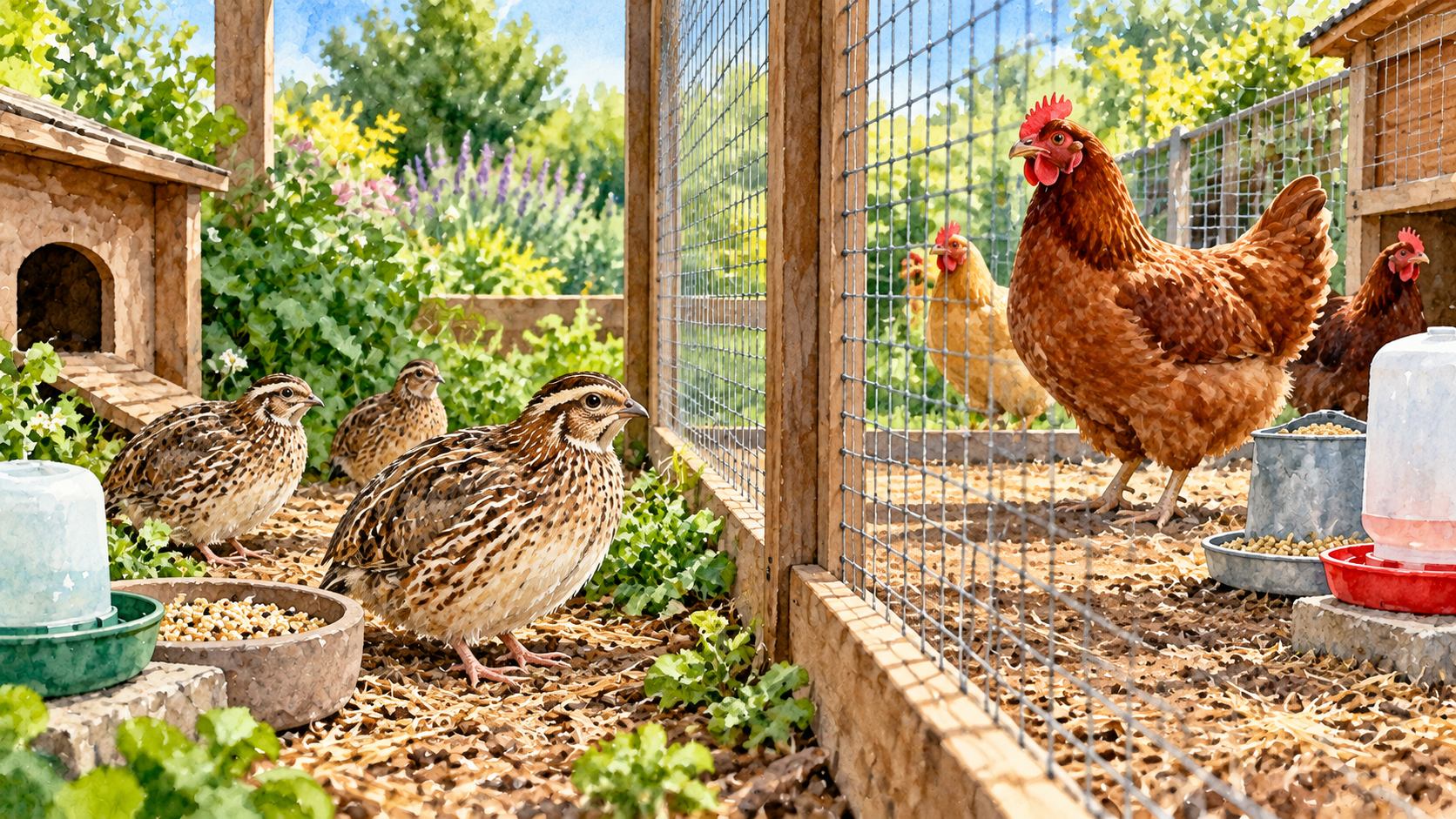
Quail and chickens cannot normally produce offspring through natural mating, but rare chicken–quail hybrids have been created through artificial insemination under experimental conditions. Researchers have successfully crossed male domestic chickens (Gallus gallus domesticus) with female Japanese quail (Coturnix japonica). However, most resulting embryos fail to develop normally, very few hatch, and the surviving hybrids documented in these experiments have been sterile males.
For ordinary poultry keepers, this means that keeping chickens and quail near one another will not produce a dependable hybrid breeding population. Their reproductive differences are substantial, even though both belong to the pheasant family, Phasianidae. Reports of unusual-looking birds should not be accepted as evidence of chicken–quail ancestry without reliable genetic or breeding records.
Are Chickens and Quail Closely Related Enough to Breed?
Chickens and Japanese quail belong to the same bird family, Phasianidae, but they are members of different genera. Domestic chickens belong to Gallus, while Japanese quail belong to Coturnix. Their shared ancestry gives them certain anatomical, reproductive, and genetic similarities without making them ordinary breeding partners.
The difference is important because belonging to the same family does not guarantee that two species can produce viable offspring. Reproductive compatibility depends on sperm reaching and fertilizing an egg, normal embryo development, and the resulting offspring surviving to maturity.
The evolutionary separation and chromosome differences between chickens and Japanese quail create reproductive barriers despite their relatively close relationship among poultry species. Their reproductive systems are similar enough for fertilization to occur under specialized circumstances, but not sufficiently compatible for reliable hybrid production.
Have Scientists Ever Created a Chicken–Quail Hybrid?
Yes. Chicken–quail hybrids are real, although they are rare experimental animals rather than an established farm breed.
In 1963, artificial insemination experiments produced chicken–quail hybrids, demonstrating that reproductive compatibility was not completely absent. Subsequent studies examined how often hybrid eggs developed, which parental combinations were successful, and why so many embryos failed.
A later experiment involving semen from several chicken breeds produced 36 hybrids from 2,370 Japanese quail eggs. The surviving offspring displayed inherited characteristics associated with their chicken fathers, confirming that genuine genetic crosses had occurred.
These results establish that hybridization is biologically possible in a narrow experimental setting. They do not establish that chickens and quail can reproduce successfully through ordinary farm mating.
Can a Rooster Mate With a Female Quail?
A rooster may show sexual interest in a quail or attempt to mount one, but an attempted mating does not establish that successful fertilization is possible.
The substantial difference in body size creates an immediate concern. An adult chicken rooster is generally much larger and heavier than a Japanese quail hen. A mounting attempt could injure the smaller bird, especially if she is restrained or unable to escape.
In successful scientific crosses, the male chicken’s semen was introduced into the female quail through artificial insemination. This bypassed the physical and behavioural barriers that normally prevent the species from reproducing together.
Such findings should not be interpreted as encouragement to place the birds together for mating. A rooster’s interest in a quail is not evidence of a compatible breeding relationship, and the risk of physical harm makes deliberate attempts at natural crossing inappropriate.
Can a Male Quail Fertilize a Chicken Hen?
The reverse combination—male Japanese quail with female chicken—has not been shown to produce successfully hatched hybrids in the established research.
The direction of the cross matters. Experimental success with chicken semen and a Japanese quail egg does not mean that Japanese quail semen will produce the same outcome in a chicken hen.
Investigations involving reciprocal chicken–quail crosses explored reproductive compatibility between the two species. Nevertheless, viable offspring have been documented primarily from the male-chicken and female-Japanese-quail combination.
This asymmetry is common in hybridization biology. Differences in reproductive physiology, egg development, and interactions between maternal and paternal genetic material can make one cross behave very differently from its reverse.
Why Can’t Quail and Chickens Normally Reproduce Together?
Several barriers interfere with successful reproduction.
The first involves physical and behavioural compatibility. Chickens and quail differ substantially in body size, courtship, and normal mating interactions. Their reproductive behaviours are adapted to members of their own species, not to each other.
Even if sperm reaches an egg, fertilization is only the beginning. The developing embryo must coordinate genetic instructions inherited from two different species. When those instructions are incompatible, cell division, tissue development, and normal growth may fail.
Chicken–Japanese quail hybrid embryos frequently stop developing during the earliest embryonic stages. These developmental failures show that the major obstacle is not simply whether sperm can enter an egg. Most fertilized hybrid eggs never produce living chicks.
Do Chickens and Quail Have the Same Number of Chromosomes?
Yes. Domestic chickens and Japanese quail both have 78 chromosomes in their ordinary body cells, or 39 pairs.
However, having the same chromosome count does not mean two species can breed successfully. Chromosomes also differ in their internal organization, gene sequences, structural arrangements, and interactions during reproduction.
Although chicken and Japanese quail chromosomes are broadly similar, several contain substantial structural inversions. Such differences may complicate normal development and reproduction in hybrid offspring.
Consequently, chromosome number alone cannot establish reproductive compatibility. Two species may possess matching counts while remaining separated by powerful biological barriers.
Why Do Most Chicken–Quail Hybrid Embryos Die?
Most chicken–Japanese quail hybrid embryos experience developmental problems before they reach the stage at which a chick could hatch.
A major period of failure occurs early in embryonic development, when cells must establish the basic structures of the growing bird. Hybrid embryos show delayed development and unusually high mortality before the circulatory system becomes established.
Additional experiments identified abnormal regulation of genes inherited from the two parental species. This provides evidence that genetic incompatibility affects how early embryos develop, rather than merely influencing the appearance of the surviving birds.
Some embryos progress further before failing, and a small number have hatched under experimental conditions. However, the overall survival rate is too low to support ordinary breeding or the development of a dependable hybrid livestock population.
What Do Chicken–Quail Hybrids Look Like?
The appearance of a chicken–quail hybrid depends partly on the chicken breed involved and the characteristics inherited from each parent. Experimental hybrids have displayed combinations of plumage traits rather than one uniform appearance.
For example, genes associated with white plumage, barred feathers, and slow feathering in chickens were expressed in experimentally produced hybrids. Their body weights also varied according to the chicken breeds used.
However, there is no established chicken–quail hybrid breed with standardized colour, body shape, or production characteristics. Photographs of unusually marked chickens or oversized quail are not sufficient to demonstrate hybrid ancestry.
A bird would need credible breeding documentation or suitable genetic testing before its appearance could be interpreted as evidence of a true cross.
Are Chicken–Quail Hybrids Fertile?
The successfully hatched chicken–Japanese quail hybrids documented in the principal studies have been sterile males.
Sterility means that an adult hybrid cannot successfully produce offspring through normal reproduction. Consequently, even when a rare hybrid survives, it cannot establish a self-sustaining breeding line by mating with another hybrid or either parent species.
Research examining the development and survival of first-generation chicken–quail hybrids found that female embryos were disproportionately lost during development, while the surviving hatched birds were male.
This creates two major barriers to producing a stable hybrid population: very few embryos hatch, and the resulting birds cannot reproduce successfully. The existence of an occasional live hybrid therefore does not imply that fertile generations could follow.
Why Are the Surviving Chicken–Quail Hybrids Male?
Birds use a sex-chromosome system in which males ordinarily have ZZ chromosomes and females have ZW chromosomes.
In experimental chicken–quail crosses, female hybrid embryos have shown particularly poor survival. As development progresses, the proportion of surviving male embryos becomes increasingly high.
Female chicken–quail hybrid embryos can survive beyond the earliest developmental stages but generally fail before hatching. The surviving hatched hybrids reported in these experiments have therefore been male.
This result is consistent with a broader pattern seen in some interspecies crosses, where the sex with two different sex chromosomes experiences greater reproductive incompatibility. However, that principle alone does not explain every molecular cause of mortality in chicken–quail embryos.
Can Bobwhite, California, or Other Quail Breed With Chickens?
The best-documented chicken–quail hybrid experiments involve Japanese quail. Those findings should not automatically be extended to northern bobwhites, California quail, Gambel’s quail, king quail, or every other bird commonly called a quail.
These birds are not all equally closely related. Japanese quail belong to an Old World quail lineage, while northern bobwhites and California quail belong to New World quail groups with a different evolutionary history.
The different species and lineages commonly grouped under the name quail cannot be treated as genetically interchangeable.
There is no established ordinary breeding method by which farm keepers can produce viable chicken hybrids from these other quail species. Reports involving one species do not establish compatibility across the entire group.
Can a Chicken Lay a Quail Hybrid Egg?
The egg’s species appearance is determined primarily by the female producing it. If a female Japanese quail is artificially inseminated with chicken semen, she continues laying eggs produced by her own reproductive system.
Those eggs retain the general shell characteristics of Japanese quail eggs, even when fertilization has involved chicken sperm. The potential hybrid develops inside the egg; the egg itself does not become a half-chicken, half-quail shell.
Likewise, successfully fertilizing an egg does not change the species of the hen that laid it. Reproductive compatibility concerns the developing embryo, not the external identity of the egg.
A speckled egg found near chickens is therefore not evidence of hybridization. Egg colour and size should not be used to infer unusual parentage without further evidence.
Can Chickens and Quail Produce a New Farm Breed?
No established, fertile chicken–quail livestock breed exists.
Developing a true-breeding line requires offspring that survive, reach reproductive maturity, and successfully reproduce over subsequent generations. Chicken–Japanese quail experiments have not overcome these requirements.
The documented sterility of surviving hybrid males prevents ordinary selective breeding from producing additional generations. Their severe developmental problems also make hybridization an impractical route for combining desirable characteristics such as egg production or meat yield.
The successful crosses remain scientifically interesting because they help researchers investigate reproductive isolation, chromosome behaviour, and embryonic development. They are not a practical method of developing new farm poultry.
Are Online Photos of Chicken–Quail Hybrids Reliable?
Not necessarily. Photographs may be misidentified, digitally altered, or show ordinary chickens or quail with unusual colour patterns.
Some genuine experimental chicken–quail hybrids have been documented in scientific publications. However, those records do not validate every image shared under the same label.
A convincing identification would require a credible history of the cross or genetic evidence. Appearance alone is particularly unreliable because chicken breeds and domestic quail varieties already display substantial variation.
The range of domesticated quail colours and markings can produce birds that look unusual without having any chicken ancestry. Similarly, unfamiliar chicken varieties may resemble gamebirds in certain physical features.
Should You Try to Breed Chickens and Quail Together?
Deliberately attempting a natural cross is not advisable. The species differ substantially in size and mating behaviour, creating a risk of injury without a realistic prospect of producing healthy, fertile offspring.
The rare hybrids described in research were produced using specialized methods under experimental conditions. Their very low survival and sterility mean there is no practical breeding benefit for an ordinary farm.
The normal reproductive behaviour of quail is adapted to compatible partners of their own species, while the pairing and breeding relationships among quail vary within the group itself.
The welfare of the birds should take priority over attempts to reproduce unusual crosses that are unlikely to succeed.
Common Questions About Chicken–Quail Hybrids
Can a rooster fertilize a quail egg? Chicken semen has successfully fertilized Japanese quail eggs through artificial insemination. However, most hybrid embryos fail to develop, and normal mating is not a dependable method of producing hybrids.
Has a chicken–quail hybrid ever hatched? Yes. Rare hybrids have hatched in experimental breeding programs, but survival is very low and the documented surviving birds have been sterile males.
Can a male quail breed with a chicken hen? No successfully hatched offspring from the reverse Japanese-quail-male and chicken-female cross have been established in the principal research. Successful crosses have primarily involved male chickens and female Japanese quail.
Are chicken–quail hybrids able to reproduce? The hatched hybrids documented in scientific experiments have been sterile males, so they cannot establish a continuing breeding population.