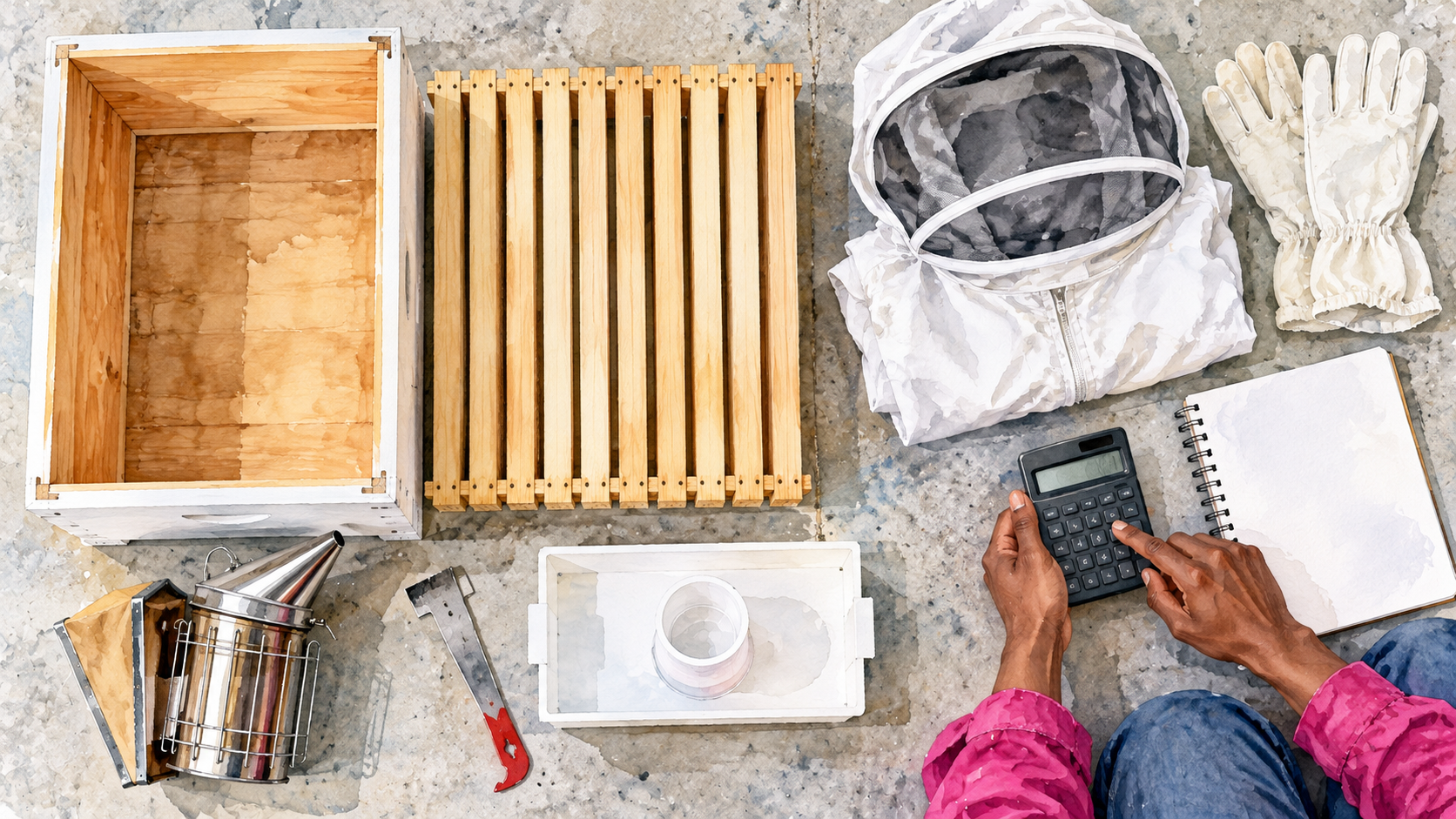
Starting beekeeping on a small US farm can require roughly $1,200–$1,500 for one well-equipped colony, or about $2,150–$2,650 for two, before shipping, sales tax, paid courses and honey-extraction equipment. Those figures are derived from a detailed July 2026 equipment and colony price list, not an average of all American suppliers. A more limited initial setup may cost less, while a new beekeeper who buys every possible accessory and a honey extractor can spend substantially more.
The cost of the bees themselves is only part of the first-year investment. A usable budget also provides room for compatible hive boxes and frames, protective clothing, inspection tools, feeding supplies and Varroa mite monitoring and control. What you buy before the bees arrive, what you reserve for their first season and what can wait until a harvest are three different questions. Separating them makes it easier to avoid both unnecessary purchases and shortcuts that jeopardize a colony.
What Should a First-Year Beekeeping Budget Actually Include?
Start with the number of colonies you intend to manage and a particular hive system. The calculations below assume one or two new 10-frame Langstroth hives, purchased in the United States, equipped with new assembled and painted boxes, and stocked with spring packages of honey bees. They are intended for a farm starting a small apiary, not an operation buying pallets of equipment or providing paid crop-pollination services.
The main categories are live bees; a complete home for each colony; protective gear and shared tools; feeders and seasonal supplies; mite-monitoring materials and suitable treatments; learning costs; and any registration or site preparation required locally. Some items are one-time purchases, while bees, feed and treatments are purchases tied to an individual colony or season. Initial purchases of consumables belong in a first-year startup budget even though later replenishment becomes an ongoing expense. The separate guide to annual beehive maintenance costs handles spending after the establishment year.
A July 2026 breakdown of beekeeping equipment costs provides the primary numerical baseline for this article. Its recommended equipment package is relatively complete: it budgets three deep boxes, multiple honey supers, some winter equipment, both a suit and hat-and-veil option, and several health-related items. A beekeeper in a milder climate or someone buying equipment gradually may not need every piece immediately. Conversely, unusually expensive freight, a bear-resistant fence or other property improvements could raise the bill. Check the contents of any kit instead of treating the word complete as proof that everything needed for the first year is included.
Price the Beehive and Frames Before Comparing Starter Kits
A hive is a collection of compatible components, not a single wooden box. At minimum, a Langstroth purchase must account for a suitable bottom, brood housing with frames and foundation, covers, and an entrance arrangement, with room to expand as the colony develops. A stand, feeder and additional boxes may be purchased together or separately. Buying boxes without the correct frame size, or buying a kit that includes only one brood box and no expansion space, can make a seemingly inexpensive offer misleading.
A 2026 example shows why a low starter price is not a full-season budget. Mann Lake’s assembled 10-frame hive combo lists at $226.99–$236.99 and contains one deep box, one medium super, frames, covers and a bottom board, but no bees. A Pennsylvania supplier’s 2026 nucleus colony was listed at $225 for spring pickup. The lower-priced kit plus that nuc totals $451.99 before a stand, feeder, protective clothing, smoker, tools, mite monitoring, seasonal supplies, additional housing as needed, travel and tax. This is a transparent illustration from two separate vendors, not a bundled offer or a claim that those sold-out seasonal bees are currently available. The fully provisioned table below deliberately budgets a wider set of first-year needs.
For the July 2026 reference budget, three assembled and painted 10-frame deep hive bodies with 30 frames cost $270, a bottom board with entrance reducer $30, inner and telescoping covers $56, and a stand $20. Two to four medium honey supers with frames are listed at $166–$322. The same list also allows for a feeder, moisture board, winter cover, feeder-protection box and a queen excluder. These are specific planning inputs, not universal prices or instructions to install every box at once. A colony may begin in fewer boxes and need more space as conditions and growth warrant.
Before ordering, compare what is included: assembled versus unassembled woodwork, painted versus unfinished boxes, foundation in every frame, covers, feeder, stand and the number of brood and honey boxes. Freight can matter because hive components are bulky. An unassembled kit may save on its sticker price but will also need suitable assembly and finishing. See the equipment checklist for what each part does and the different beehive systems for the consequences of choosing a different design. The price comparisons in this article should not be transferred unchanged to top-bar, Warré or other hives.
Budget for Bees, Pickup and the Real Purchase Price
The 2026 baseline lists a two- or three-pound package of bees at $188–$200. That amount already appears in its per-colony total, so do not add a package price a second time when using the budget table below. If you plan to buy a nucleus colony, or nuc, substitute the actual supplier quote for the package price rather than adding the entire nuc price to your total.
As a concrete supplier example, a 2026 five-frame nuc listing was priced at $245, with local pickup by appointment. Compared with the reference package allowance, that is an extra $45–$57 per colony, before differences in travel, delivery, deposits or equipment. This is one US seller’s 2026 listing, not a national price range. A nuc also comes with frames and comb, so check frame size, whether a transport box is included and whether the seller requires it returned. Avoid counting the nuc’s frames as entirely extra if the full-size hive kit already contains every frame it will need.
Bee availability is seasonal. A supplier’s listed price may refer to a past spring season, a deposit rather than the full balance, pickup rather than shipping, or a date when stock has sold out. Ask for the total payable amount, expected collection date, what happens if weather delays the order and what health information the seller can provide. The article on packages, nucs and established colonies covers the tradeoffs between purchasing formats; a budget only needs to reflect the option actually chosen. Use the healthy-bee purchasing checks before treating the lowest quoted price as the best purchase.
Allow for Protective Clothing and Tools You Can Reuse
Protective clothing and basic inspection tools are purchases that generally do not need to be repeated for each colony. The July 2026 reference lists a smoker at $35, hive tool at $11, suit at $126, hat and veil at $30, and leather gloves at $20, plus smaller allowances for smoker fuel and leg straps. Its overall $261–$286 general-needs category also includes an illustrative $10 permit and $10–$35 association membership. The general total includes several optional clothing items, so a beginner does not necessarily have to purchase both a complete suit and a separate hat-and-veil assembly.
Properly fitted face and eye protection should be available before handling a colony, and a beginning beekeeper should have a dependable protective-clothing arrangement suited to their comfort and exposure risk. Clothing savings are not useful if the veil fits poorly, gaps are left exposed or the wearer cannot work safely. Practical recommendations for beekeeping clothing address fit and protection rather than prices alone. A smoker and hive tool should also be ready before the first planned inspection, even if the seller includes a cheap version in a kit.
Price a starter bundle against its component list. A bundle with one veil, smoker and hive tool may be good value for a single beekeeper, but a second identical bundle may duplicate tools unnecessarily when adding a second hive. Extra gloves or a spare veil may be useful for a second person helping with inspections; these are staff-safety purchases, not automatic per-hive charges. Washable reusable equipment still needs appropriate cleaning between colonies to reduce disease transmission.
Set Money Aside for Feeding and Varroa Control From the Start
A first-year budget that stops at bees, boxes and a suit is incomplete. Newly established colonies may require supplemental feed depending on local nectar availability and colony condition. The 2026 reference includes $20–$28 for sugar and $15 for a two-pound pollen substitute allowance per colony. These are budget examples, not an instruction that every colony should receive those exact quantities or that all colonies need pollen supplement. The cost of feed depends on how the bees develop, local forage and management decisions.
Health spending deserves its own line. The same list allocates $40 for mite-testing equipment and $53–$112 for three Varroa treatment purchases per colony, contributing to a $128–$195 first-year health category per colony once feed is included. This is a financial inventory rather than a treatment schedule. Monitoring results, colony condition, temperatures, honey-super status and current product directions determine whether and how a registered treatment can be used. Federal guidance on Varroa-control products requires registered products to be used according to their labels, and state requirements may add restrictions. Do not substitute improvised chemical treatments simply to fit a smaller budget.
The durable testing equipment can potentially be shared between two hives if it is properly maintained and cleaned, while sample consumables and actual treatments must be budgeted for each colony as appropriate. The detailed Varroa management article owns the management decisions, not this price guide. Someone who cannot afford suitable monitoring and colony care should delay buying live bees rather than purchasing them with no plan for their health.
One Hive Versus Two: A Reproducible 2026 Startup Budget
The following example uses the July 2026 US equipment price list linked above, with no invented national average. It assumes new assembled 10-frame Langstroth equipment, a spring bee package for each hive, the relatively complete set of brood and honey boxes and winter accessories included in that list, one set of personal equipment, and a health allowance for each colony. The two-colony version counts the $40 reusable mite-testing kit once, not twice. All figures are US dollars.
| Startup category | One hive | Two hives |
|---|---|---|
| Shared gear, tools, example permit and club membership | $261–$286 | $261–$286 |
| Hive equipment including package bees | $840–$1,008 | $1,680–$2,016 |
| First-year feeding, mite supplies and monitoring | $128–$195 | $216–$350 |
| Total before honey extraction, freight, tax or a paid course | $1,229–$1,489 | $2,157–$2,652 |
The arithmetic is transparent. For one colony, add $261 + $840 + $128 to get $1,229 at the lower end; $286 + $1,008 + $195 gives $1,489 at the upper end. For two, double the hive-with-bees amount, share the general gear, and calculate the health allowance as $40 for the testing kit plus twice the remaining $88–$155 in per-colony health supplies. That produces $216–$350 for the two-colony health line. Sharing that durable testing kit is a budgeting assumption, not a suggestion to reuse contaminated sampling materials between hives.
These totals are fully provisioned examples, not minimum legal or biological equipment requirements. They include several items that some beekeepers may defer or never need in the stated form, including particular winter accessories and multiple supers. The list also includes a flat $10 permit allowance even though actual local registration fees can be zero, different or inapplicable. The purpose is to show a reproducible complete scenario, not imply that every US beekeeper pays the same amount. For an intentionally limited example, an April 2026 beginner-beekeeping guide provides an $836 two-colony equipment subtotal based on 2025 supplier prices; that much narrower basket does not incorporate the additional health, feeding and expansion allowances in the table here. Comparing the two figures as if they covered the same items would mislead readers.
A reader who wants an extra cushion can choose a 15% reserve, explicitly as a personal planning assumption rather than a published cost statistic. That adds about $184–$223 to the one-hive baseline, or $324–$398 to the two-hive baseline. With a hypothetical $50 local course, the resulting planning amounts are approximately $1,463–$1,762 for one hive or $2,531–$3,100 for two, still before actual shipping and sales tax. The reserve is not guaranteed to cover every surprise; calculate freight and any required farm-site improvements separately. If deciding how many colonies to manage, use the beginner hive-count guide rather than treating the cheaper one-hive figure as the sole deciding factor.
Remember Training, Local Registration and Farm-Site Expenses
Instruction is a worthwhile item to price even when a family member or an experienced beekeeper can help. Course fees vary widely with format and location. For documented US examples, a 2026 four-session beginner course in Davidson County, North Carolina cost $50, with a separate free introductory session, while the University of Minnesota’s online northern-climate beekeeping course lists $175 per person for its 2026 registration. These are specific offerings with different formats, not a nationwide course-price range. Local associations, field classes, mentoring and books may be available separately or bundled. Confirm what a course includes before paying for duplicate materials or memberships.
Registration fees are another place where a national estimate fails. Florida’s published apiary registration schedule lists $10 for one to five colonies, with registration required and annual renewal. This does not establish the rules for any other state. Local zoning, agricultural classification, inspections and any requirements for keeping hives near neighbors must be checked separately. The beekeeping permits and registration guide owns those jurisdiction-specific checks; for budgeting purposes, use the actual fee your state or locality requires, not an assumed universal $10 charge.
Farm-specific infrastructure can be a significant exception to a simple hive-and-bees budget. Where livestock can approach the hives, a secure boundary may be necessary. Bear-prone areas may require an appropriate electric exclusion fence; stable stands, access paths and safe water provision may also need materials or labor. These costs vary too much with the property to support a single universal price. Inspect the candidate site and quote any necessary work before buying colonies. The separate farm beehive-location guide addresses the suitability criteria, not a generic charge for fencing every farm.
Why Honey-Harvesting Equipment Changes the Total So Much
A budget described as starting beekeeping sometimes includes the equipment to extract, strain and bottle honey, even though a new colony may produce no harvestable surplus in its first season. The July 2026 university example prices an extensive harvesting and extraction set at $688–$2,758, including an extractor priced from $130 to $2,200. Adding that whole category is how its larger published $1,917–$4,247 one-colony first-year total is reached. The difference from the $1,229–$1,489 colony-care subtotal is equipment scope, not evidence that one source is necessarily wrong.
For most new colonies, planning on a first-year harvest to recover expenses is unwise. A 2026 beginner guide focused on colony establishment advises putting colony health and winter preparation ahead of extracting honey. There may be years and places with surplus honey, but the bees’ food needs must be assessed before taking any. If you have no harvest to process, you do not need a personal extractor sitting unused in a shed.
Before purchasing harvesting machinery, ask whether a local association offers equipment rental, a shared extraction day or a paid extraction service. The 2026 startup equipment guidance explicitly notes renting or hiring extraction as an option. A first-season budget can set money aside for this eventuality while postponing the purchase until a genuine need exists. Compare service costs, sanitation arrangements and availability when the time comes rather than declaring borrowing or buying cheaper in every situation.
Save Money by Deferring Extras, Not Essential Bee Care
There are reasonable ways to spend less than the fully provisioned example without simply shifting hidden costs into an emergency. Start with a compatible standard system, check which frames and covers a bundle contains, and buy from a supplier that can explain its products. Purchase enough capacity for the colony to expand when needed, but avoid buying a large honey-processing setup before the colony has produced surplus. An organized local association may make equipment borrowing or group purchasing possible, though availability is not guaranteed.
Be cautious with secondhand bee equipment. Guidance for new colony equipment advises against used hive materials, particularly old wax comb, because of disease and pesticide-residue concerns. Used extraction equipment is a different category when it is suitable for food contact, sound and properly cleaned. Saving a little on potentially contaminated brood frames is not the same as buying a clean secondhand stainless extractor after inspecting it.
Do not economize by omitting a sound veil, leaving hives open to livestock, buying bees without credible source information, or foregoing Varroa monitoring and a suitable management plan. Also avoid buying a supposed bargain colony that will require incompatible frames or a long, unplanned pickup journey. An inexpensive product is only inexpensive if it safely performs the function the colony and beekeeper require. For the wider sequence of preparing a farm for bees, the beginner beekeeping roadmap covers the work that must accompany the spending.
Build a Quote-Based Budget Before You Order Live Bees
Use the worked table as a benchmark, then replace its numbers with your own quotations. Make one line for each hive and one separate column for equipment shared by the beekeeper. Quote the exact hive system, supplier, assembly level, colony pickup or freight, PPE sizing, monitoring supplies, any location-specific registration cost and training. Add expected sales tax and shipping as actual amounts when the checkout or supplier provides them, and put farm fencing or other site preparation in a separate line so it does not disappear inside a generic contingency.
Before paying a deposit for live bees, confirm that the site is appropriate, the core equipment is compatible and ready, and the money for first-season feeding and mite management is still available after the purchase. The result is a budget designed around a healthy colony and safe handling, rather than an optimistic total based on the cheapest boxes and a promise of honey sales. Recheck quotations for your region and intended purchase season because the examples here reflect US price evidence reviewed in October 2026, with the central detailed price list dated July 2026.