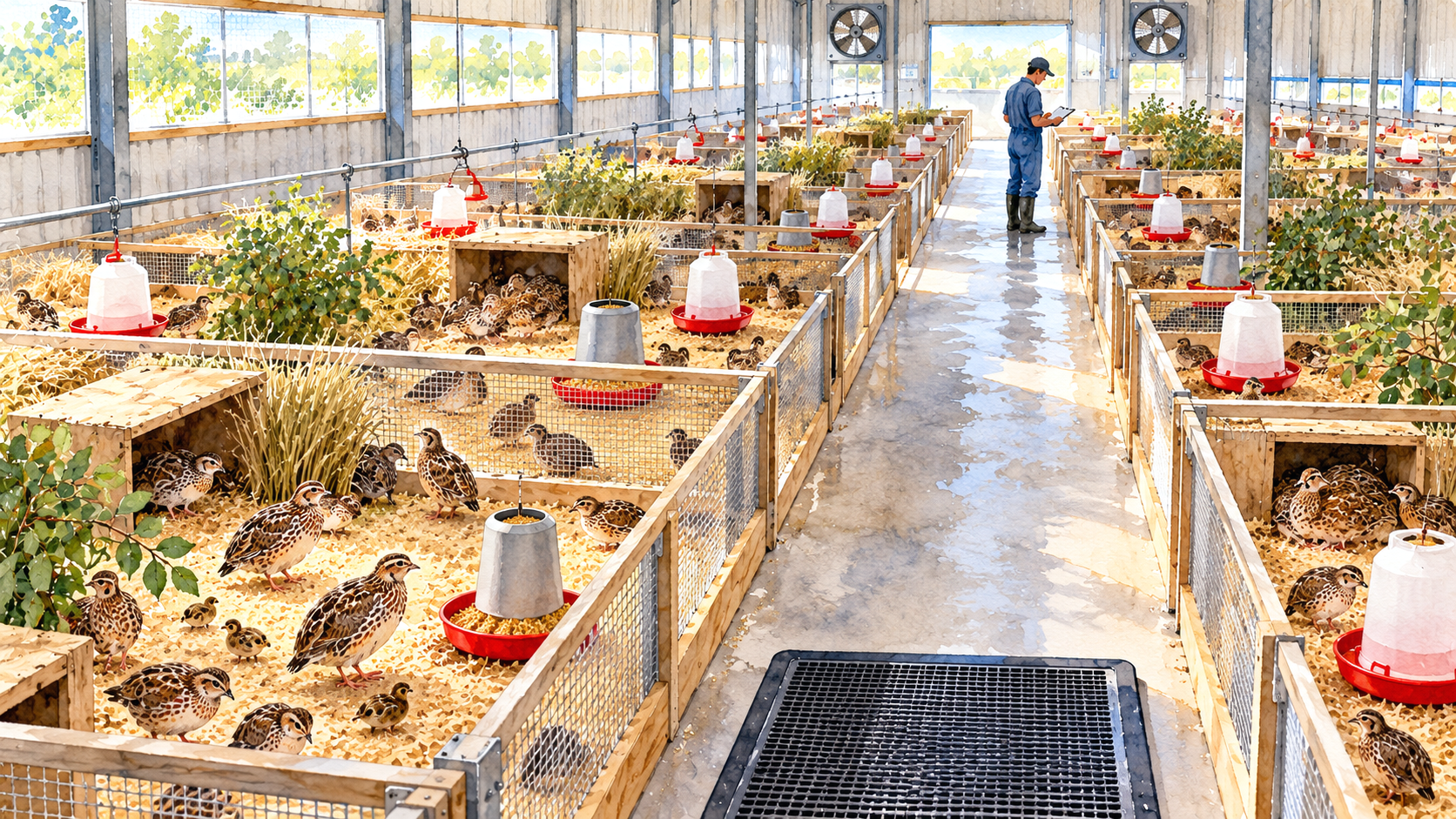
Starting a commercial quail farm requires a defined product, dependable buyers, suitable facilities, consistent production workflows, biosecurity, and applicable food-safety compliance. Domestic Japanese Coturnix mature quickly, but commercial capacity should follow demonstrated demand rather than the maximum number of birds a building can hold.
1. Choose a Commercial Production Model
Eggs, meat, and breeding stock create different work schedules, facilities, and customer requirements. Domestic Japanese quail are used for eggs and meat, but the market for either product varies considerably by location.
| Model | Product | Operational priority |
|---|---|---|
| Table eggs | Edible quail eggs | Collection, inspection, storage, repeat customers |
| Meat | Finished birds | Batch scheduling, lawful processing, refrigeration |
| Breeding stock | Fertile eggs, chicks, adults | Records, breeder health, fulfillment |
| Combined | Multiple products | Separate workstreams and coordinated inventory |
2. Confirm Customers Before Setting Farm Size
Ask prospective household, restaurant, and retailer buyers which products they want, how often they order, their required packaging and handling standards, and the price they will actually pay. Research on commercial Japanese quail operations has identified marketing and meat-processing difficulties as constraints on growth. Expressions of interest are not equivalent to reliable purchase commitments.
3. Plan Around Saleable Production
For illustration, 200 hens averaging 20 collected eggs per month yield 4,000 eggs. If 5% are retained or rejected, about 3,800 eggs, or 317 dozen, are available for sale. These are hypothetical figures, not performance guarantees. The annual laying output of Coturnix varies with strain, age, feed, environmental conditions, and health. Capacity plans must account for unsold stock and production interruptions.
4. Select an Appropriate Commercial Site
Check zoning, delivery access, water, electricity, drainage, wastewater management, wildlife exposure, expansion options, and practical access to processors or buyers before investing. A property suitable for a small backyard flock is not necessarily suitable for commercial traffic, equipment, or waste volumes.
5. Design Housing to Support Workflows
Commercial housing needs appropriate space, ventilation, safe flooring, secure containment, reliable feed and water access, and predator protection. The suitable shelter arrangements for quail and space requirements of the flock should determine the layout rather than a maximum stocking target.
Organize separate or clearly defined areas for bird accommodation, feed storage, cleaning, egg collection and packing, chilled product storage, young birds when applicable, isolation, and waste handling. Ventilation must control moisture, dust, and ammonia without harmful drafts. Plan backup procedures for loss of water, electricity, and climate control.
6. Arrange Stock Supply and Replacement
Decide whether to buy replacement birds or maintain breeders. Purchased stock simplifies incubation responsibilities but depends on suppliers. Internal production provides more control but increases equipment and labor needs. The choice of chicks, growers, and adults affects readiness for production. Retain source, hatch-date, strain, sex, and group records, and inspect the health of birds before purchasing.
7. Establish Feed Procurement and Inventory
Select complete diets appropriate to each production stage and keep stock dry, identified by lot, and protected from pests. Record incoming feed, use by group, waste, and minimum inventory thresholds. The nutrition of adult laying or breeding quail differs from that of growing birds; cheaper feed is not a saving if unsuitable.
8. Build a Repeatable Daily Workflow
| When | Primary work |
|---|---|
| Start of day | Inspect birds, ventilation, feeders, drinkers, security |
| Production period | Collect eggs, count output, manage scheduled bird groups |
| Product handling | Inspect, pack, identify lots, and store products |
| End of day | Recheck water, equipment, climate, and enclosure security |
| Scheduled intervals | Clean, maintain, review inventory, fulfill orders |
Written procedures and assigned responsibilities reduce errors when staff change or the owner is absent. Maintain records of abnormal health observations and operational interruptions.
9. Implement Commercial Biosecurity
Control visitor entry, footwear, equipment movement, pests, manure, and dead-bird disposal. Poultry biosecurity principles apply to commercial quail as well as other farmed birds. Maintain isolation facilities and a veterinary response plan. The quarantine of new quail must not be bypassed for production convenience.
10. Plan Egg Collection and Sales
For a table-egg business, establish procedures for regular collection, inspection, rejection of unsafe eggs, packing, lot tracking, controlled storage temperatures, and distribution. The federal shell-egg safety rule has defined coverage and exemptions concerning laying hens; it is not a complete statement of rules for every quail egg seller. State and local authorities may impose separate refrigeration, labeling, grading, or licensing requirements. Verify the specific requirements for quail eggs and the intended market before selling.
11. Arrange Lawful Meat Processing
Secure a lawful processing and distribution pathway before meat birds approach their intended market age. Do not assume poultry slaughter exemptions automatically allow on-farm slaughter and quail-meat sales. Federal inspection coverage differs by species, and some states separately regulate small-gamebird processing plants. Read federal poultry exemption guidance alongside species coverage and state rules.
Confirm the permitted processor, sanitation, refrigeration, packaging, labeling, transport, and traceability obligations directly with the relevant state agriculture or health agency and proposed processor. Do this before purchasing processing equipment or promising meat deliveries.
12. Verify Business and Food-Safety Compliance
Applicable requirements can include zoning, business registration, taxation, captive-bird possession, product handling, processing facilities, waste management, employee safety, and customer insurance. The classification of Japanese quail as agricultural farm-type poultry for specified purposes does not settle food-safety or state licensing obligations. Requirements depend on location, the product, and distribution channel, so confirm them before making major investments.
13. Monitor Production and Sales Performance
| Measure | Useful insight |
|---|---|
| Eggs per hen | Changes in production |
| Saleable percentage | Breakage and rejection |
| Feed per group | Wastage and efficiency |
| Mortality and removals | Welfare and health concerns |
| Sold versus produced | Market absorption |
| Labor hours | Workflow efficiency |
| Repeat orders | Demand stability |
| Equipment downtime | Operational vulnerabilities |
Separately track gross revenue, operating expenses, equipment investment, labor, and replacements. The profitability of quail farming must be evaluated from real sales and full expenses rather than flock size or feed cost alone.
14. Expand Only When Systems and Demand Are Reliable
Expansion increases demands on housing, ventilation, feed supply, product handling, labor, and distribution. Validate repeat purchasing and ensure new capacity will not produce large unsold inventories. The ongoing cost categories of keeping quail should be revised as facilities and production methods change. Scale production, processing and sales together.
Common Questions About Commercial Quail Farming
How many quail are needed to start a commercial farm? There is no universal minimum. Size the operation around validated sales, facilities, welfare, and management capacity.
Is egg or meat production easier to commercialize? Eggs offer regular collection, while meat requires coordinated processing and distribution. Local rules and buyers determine which is practical.
Do commercial quail farms need special licenses? They may. Applicable business, animal, food-safety and processing requirements depend on jurisdiction and activities.
Can a commercial farm sell eggs, meat, and breeding stock? Potentially, but each product has different facility, recording, and regulatory requirements.
One thought on “How to Start a Commercial Quail Farm”