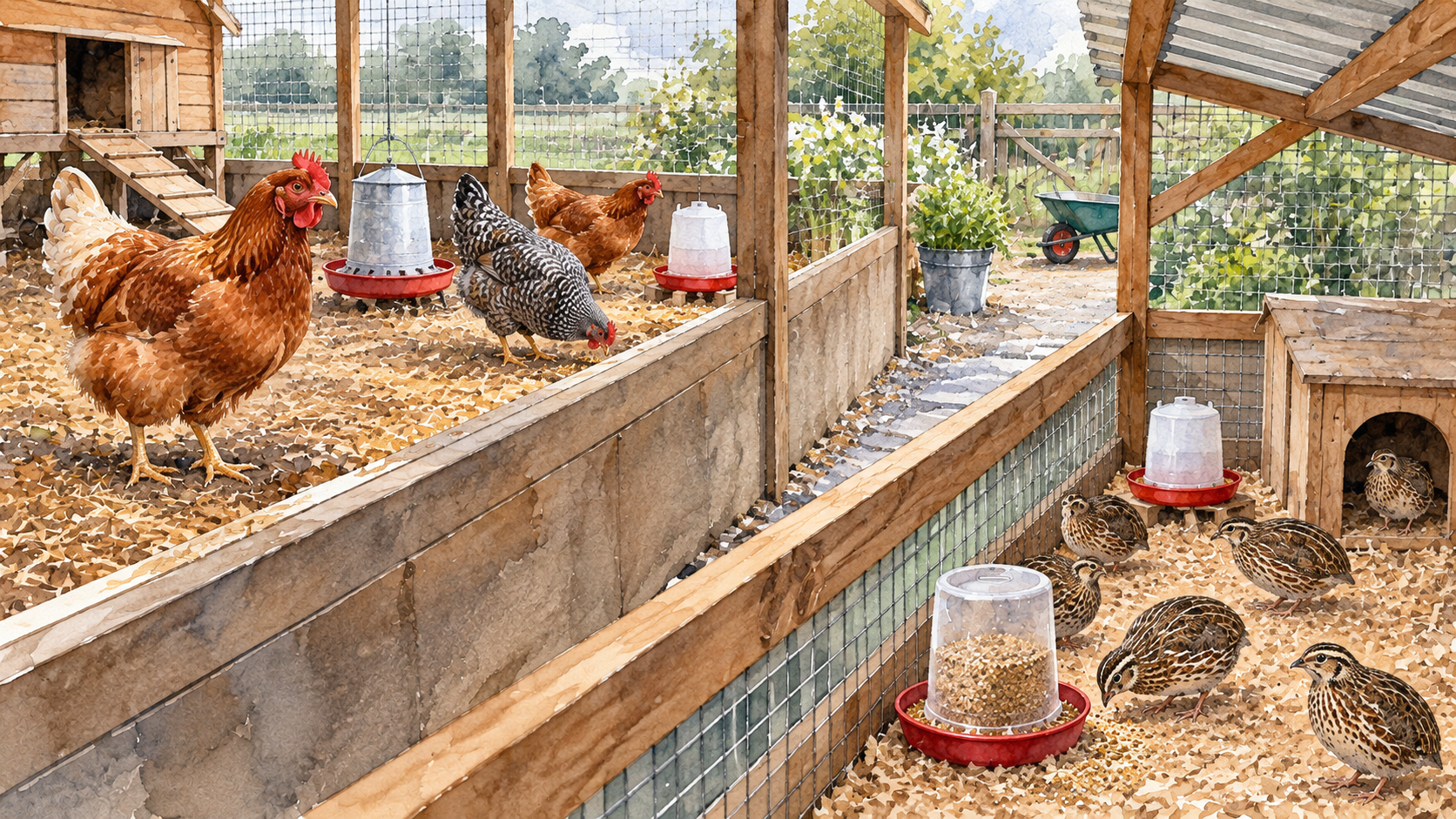
Quail and chickens can be raised on the same farm, but domestic Coturnix quail should generally not share an enclosure with chickens. Although both are poultry, their differences in body size, feeding requirements, behavior, and susceptibility to disease make unrestricted mixing unnecessarily risky.
A chicken does not need to be aggressive to injure a quail. Ordinary scratching, jostling around feeders, or an unexpected peck can harm a much smaller bird. Shared litter, water, and feeding equipment also create opportunities for infectious organisms to move between species.
The safer arrangement is to keep chickens and quail in separate, secure enclosures, each with its own food, water, and resting areas. They can occupy the same property without having direct contact.
Why Is Keeping Quail With Chickens Risky?
The greatest concern is that two species with different physical and behavioral needs must compete within the same space. Chickens are generally much larger than Coturnix and can dominate resources simply by moving through an enclosure.
Quail tend to remain close to the ground, seeking low cover when disturbed. Chickens scratch more vigorously, occupy elevated roosts, and may investigate smaller birds through pecking. An arrangement that works comfortably for the chickens may leave the quail exposed and stressed.
Health is another major consideration. Some poultry infections can affect both species, while the severity and symptoms may differ. The USDA’s recommendations for controlling disease between poultry species specifically encourage keeping different types of animals, their feed, litter, and equipment separate.
Occasional examples of mixed flocks living together without visible conflict do not eliminate these risks. A setup may appear peaceful until a bird becomes ill, food access changes, or a chicken injures a quail during an ordinary interaction.
Can Chickens Spread Diseases to Quail?
Yes. Chickens and quail can share certain infectious organisms through direct contact and contaminated surroundings. Not every chicken disease infects Coturnix, however, and some pathogens affect different poultry species in different ways.
Mixing birds creates additional opportunities for exposure through manure, drinking water, feed, respiratory secretions, and equipment. A healthy-looking bird can sometimes carry an infectious organism without displaying obvious signs.
Ulcerative Enteritis
Ulcerative enteritis, sometimes called quail disease, is caused by Clostridium colinum. It is particularly important in quail production because susceptible birds can become severely ill, sometimes with rapid losses.
The infection can also affect chickens, although disease is generally more severe in susceptible quail. The veterinary account of ulcerative enteritis identifies fecal contamination, infected carriers, and contaminated housing as important factors in its spread.
The species distinction deserves care: some of the most dramatic mortality figures come from northern bobwhite, not Japanese Coturnix. Nevertheless, disease has been documented in Coturnix, making shared contaminated litter an avoidable concern.
Infectious Coryza and Respiratory Infections
Infectious coryza mainly affects chickens but can also affect quail and pheasants. It may spread through contact between birds, respiratory exposure, and contaminated feed or water.
Birds that recover from infection can remain carriers. The poultry extension guidance on infectious coryza highlights the danger of introducing infected birds that show no obvious illness.
Other respiratory pathogens may also move within mixed poultry environments. Their exact effects vary by organism and species, so it is inaccurate to assume that every chicken respiratory infection will cause the same disease in quail.
Avian Influenza
Both chickens and quail can be susceptible to avian influenza. Exposure may occur through infected birds or contaminated material, depending on the virus and circumstances.
Separating domestic poultry species does not guarantee protection, but it reduces opportunities for direct cross-species transmission and makes disease monitoring easier. The USDA’s avian influenza prevention guidance specifically recommends separating species as part of flock biosecurity.
A sudden cluster of sick or dying birds warrants veterinary or animal-health authority involvement rather than assuming a routine illness is responsible.
Can Chickens Injure or Kill Coturnix Quail?
Yes. The size difference alone makes injury possible, even when chickens are not deliberately attacking the quail.
A chicken may step on a quail, strike it while competing for food, or peck at its head and feathers. Larger birds can also push smaller ones away from preferred resting areas. Quail may react by running into enclosure walls or launching sudden escape flights.
Chickens use pecking to investigate their surroundings and establish social relationships. However, their normal social behavior is not necessarily compatible with much smaller Coturnix.
A mixed group may initially appear calm because the birds are unfamiliar with one another or have sufficient resources. Aggression can emerge later as individuals mature, compete for access, or experience changes in their environment.
The causes of pecking and fighting among quail are already important within a single-species flock. Adding larger poultry introduces additional physical risks that Coturnix cannot reliably avoid.
Will Chickens Bully Quail Away From Food and Water?
They can. A quail may have access to a feeder in theory but struggle to use it when chickens repeatedly occupy the surrounding space.
This does not require obvious fighting. A dominant chicken may simply move toward the feeding area, causing quail to retreat before they can eat. Repeated displacement can be difficult to notice during a quick inspection.
Water access presents a similar problem. Equipment positioned for adult chickens may be too high for small Coturnix, while low containers intended for quail can become contaminated by chickens scratching nearby.
The practical placement of quail feeders and waterers therefore needs to reflect the smaller birds’ reach and behavior.
Providing multiple feeders inside a mixed enclosure may reduce crowding, but it cannot fully remove the size difference or guarantee that every quail can feed without intimidation.
Can Quail Eat Chicken Feed?
Chicken feed and quail feed are not automatically interchangeable. Domestic Coturnix have nutritional requirements that differ according to age and whether they are growing, breeding, or laying eggs.
Young quail generally require a more protein-rich starter ration than standard chick feeds designed for many backyard chicken flocks. Adult laying quail also need an appropriate balance of nutrients for their size and production stage.
The Merck Veterinary Manual’s guidance on nutrition in quail and other gallinaceous birds recognizes species-specific feeding requirements.
Shared feeding makes it difficult to control which ration each bird consumes. Chickens may eat expensive quail feed, while quail may consume a chicken diet that is unsuitable as their primary ration.
Medicated feeds create another concern. An additive authorized for one poultry species or production purpose is not automatically approved or appropriate for another, particularly where birds produce eggs or meat for people.
The nutritional needs of adult quail should determine their ration independently of the chicken flock.
Why Are Chicken Coops Not Always Suitable for Quail?
A conventional chicken coop is designed around the way chickens move, roost, nest, and access equipment. Coturnix behave differently.
Chickens commonly use elevated roosting bars and nesting compartments. Japanese quail usually remain on the ground and benefit more from sheltered floor-level resting areas. Their smaller bodies also allow them to pass through openings that might safely contain chickens.
A shared enclosure can create several practical mismatches.
| Housing feature | Chickens | Domestic Coturnix |
|---|---|---|
| Sleeping location | Commonly use elevated roosts | Generally rest on the ground |
| Nesting | Often use raised or enclosed nest boxes | Prefer accessible, concealed ground-level sites |
| Feeding equipment | Sized for larger birds | Requires lower, appropriately sized access |
| Escape response | May run, jump, or fly | Can launch rapidly upward when startled |
| Barrier openings | Designed for larger birds | Smaller gaps can permit escape or contact |
| Social interactions | Larger birds can dominate shared areas | Vulnerable to displacement and injury |
These differences do not mean every piece of chicken housing equipment is unsuitable for quail. They mean the structure should be assessed for the specific species using it.
For example, the ground-dwelling behavior of Coturnix makes high sleeping perches unnecessary, while suitable nesting areas for laying quail are generally low and sheltered.
The problem with shared housing is not merely convenience. It is that modifications benefiting one species can create hazards or inaccessible resources for the other.
Can Quail and Chickens Share an Outdoor Run?
A shared open run presents many of the same difficulties as a shared coop. Chickens can pursue, peck, or accidentally injure quail, and outdoor space does not necessarily prevent unwanted contact.
The presence of vegetation may give quail somewhere to hide, but it also makes them difficult to locate after a disturbance. If the run has fencing appropriate for chickens rather than Coturnix, the smaller birds may escape.
Unrestricted roaming adds other hazards. The risks of allowing farm quail to free-range include predation, unpredictable flight, and exposure to environmental disease sources.
A better arrangement uses separate enclosures or distinctly separated runs. Each group should have secure overhead containment and access to its own equipment.
This allows both species to benefit from outdoor activity without forcing them into direct competition or permitting uncontrolled contact.
Can You Keep Chickens and Quail in the Same Building?
Separate enclosures within one outbuilding are possible, but they do not provide the same biosecurity separation as genuinely independent facilities.
The birds may still share air, dust, manure-handling routes, and the people who care for them. Pathogens can move between pens on footwear, gloves, buckets, and other equipment.
A solid partition can prevent direct pecking, but ventilation and sanitation arrangements also matter. Placing a quail cage directly beneath chicken roosts, for example, creates an obvious risk of droppings falling onto the smaller birds.
The USDA’s guidance on controlling what enters poultry areas encourages separate equipment, litter, and feed for different species.
When both flocks must occupy the same building, minimize shared contact and cross-contamination. Separate rooms or ventilation arrangements may offer better protection than adjacent open cages, although they do not eliminate all airborne or equipment-related risks.
Is a Divided Coop Safer Than Mixing Both Species?
Yes. A properly divided coop is usually safer than allowing chickens and Coturnix to move freely among one another.
Partitions need to prevent birds from passing through, reaching one another, or sharing contaminated flooring. A simple piece of chicken wire may not prevent pecking through the barrier, especially when birds rest directly against it.
Consider whether the divider extends securely across the entire space, including overhead and lower openings. Chickens should not be able to perch above an uncovered quail section or scatter manure into its feeding area.
Each side should function independently, with suitable water, feeding points, shelter, and access for inspection.
However, a divided coop remains a shared building. The principles of poultry biosecurity still apply to equipment, footwear, ventilation, and movement between the two groups.
For a new setup, independent enclosures are generally easier to manage than trying to make one shared compartment serve both species.
Do Quail and Chickens Recognize Each Other as Flockmates?
Quail and chickens can become familiar with seeing or hearing one another, but familiarity should not be confused with compatible flock social behavior.
Domestic Coturnix have their own social relationships, dominance interactions, and avoidance behaviors. Chickens likewise establish social hierarchies within their groups.
A chicken may tolerate a quail’s presence without treating it as a member of its own flock. The quail may remain stressed by movements that a chicken considers ordinary.
This difference becomes more important in confined spaces where a smaller bird cannot retreat. Apparent peacefulness during a short observation does not demonstrate that the arrangement works comfortably around the clock.
The social needs of Coturnix quail are better met through compatible quail companions rather than expecting chickens to provide equivalent social interaction.
What About Raising Chicken Chicks and Quail Chicks Together?
Raising both species together from a young age does not solve their differences in growth, nutrition, vulnerability, or disease exposure.
Coturnix chicks are exceptionally small, particularly immediately after hatching. Chicken chicks may soon become considerably larger, creating risks of trampling or accidental injury.
Equipment is another issue. Drinking containers suitable for chicken chicks may present drowning hazards to tiny quail, while feeders must accommodate the nutritional requirements and size of each species.
As the chicks develop, their environmental and social requirements diverge further. Early familiarity does not guarantee that the birds will remain compatible after reaching maturity.
The brooder requirements of quail chicks should therefore be met separately rather than assuming a shared chick enclosure is safe simply because the birds initially appear calm.
Does Quarantining New Birds Make Mixed Housing Safe?
Quarantine helps identify some problems before new birds join an existing flock, but it cannot eliminate every infectious disease risk.
Certain pathogens can persist in recovered carrier birds, and an apparently healthy animal may still shed infectious organisms. A normal appearance at the end of quarantine is not a guarantee that mixing species will be safe.
The Merck Veterinary Manual’s description of ulcerative enteritis specifically notes the possibility of lifelong carrier birds. Other infections have different transmission patterns and incubation periods.
A proper quarantine procedure for new quail remains important when expanding a Coturnix flock, but it should not be interpreted as permission to eliminate species separation afterward.
Biosecurity is a continuous management practice rather than a single waiting period.
What if Chickens and Quail Are Already Living Together?
If the birds currently share a pen, the absence of obvious fighting does not establish that the arrangement is risk-free. Observe whether individual quail are being displaced from food, experiencing feather damage, hiding excessively, or struggling to reach water.
Separating the species into secure accommodations is the more dependable long-term choice. Prepare the new quail enclosure before moving the birds so the transfer does not introduce escape, handling, or environmental hazards.
Do not assume that a quail sitting quietly beneath a feeder is comfortable. A small bird may remain still because it is avoiding larger flockmates.
If either species develops respiratory signs, marked lethargy, reduced appetite, or unexplained deaths, contact a poultry veterinarian. Do not move apparently healthy birds between the groups in an effort to test whether an illness is contagious.
The general warning signs of disease in quail deserve prompt attention, particularly when birds have recently shared housing with another poultry species.
Common Questions About Quail and Chickens Living Together
Can Coturnix quail and chickens share a coop? They should generally be kept in separate enclosures. Shared housing creates avoidable risks involving injuries, disease, feeding competition, and incompatible equipment.
Can chickens transmit diseases to quail without appearing sick? Yes. Some poultry infections can be carried or shed by birds without obvious signs. The specific risks depend on the pathogen and the species involved.
Will chickens deliberately attack quail? Some may peck or chase quail, but deliberate aggression is not required for injury. Accidental trampling and competition around resources can also harm the smaller birds.
Can chickens and quail live next to each other? Yes. Separate, properly secured enclosures on the same property are generally more practical than mixing them. Barriers, equipment separation, and biosecurity practices still matter.