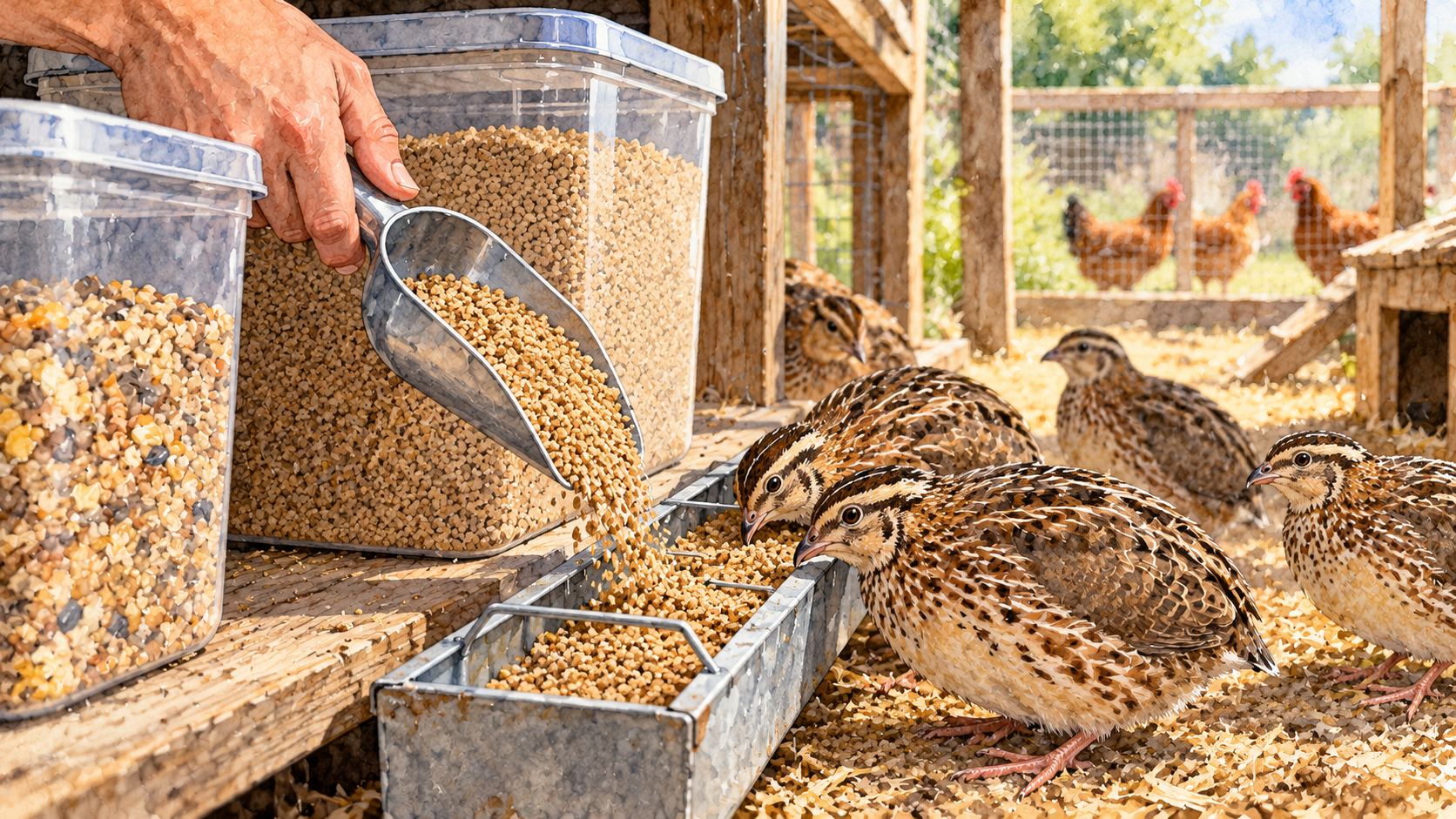
Quail can eat some types of chicken feed, but chicken feed is not automatically suitable as their regular diet. Whether it meets their needs depends on the quail species, age, growth rate, and reproductive status, as well as the feed’s protein, amino acid, energy, and mineral concentrations. Chicken starter, grower, layer, and all-flock feeds are formulated for different purposes, so they cannot be treated as interchangeable substitutes for a complete quail ration.
The main concern is nutritional compatibility rather than an ingredient that is inherently dangerous to quail. Both chickens and quail can digest many of the same grains and protein sources, but their requirements may differ enough that a chicken product becomes inadequate or inappropriate when fed continuously. Comparing the intended production stage and guaranteed analysis is more useful than deciding suitability based on the picture of a chicken on the bag.
Why Is Chicken Feed Different From Quail Feed?
Commercial feeds are formulated around the nutrient requirements and expected consumption of particular birds. A chicken ration typically reflects chicken growth rates, body weights, egg-production demands, and feed intake, whereas captive quail may need different concentrations of protein, essential amino acids, energy, and minerals. These differences are especially important during early growth and reproduction.
The gamebird feeding recommendations from Alabama Cooperative Extension provide separate dietary specifications for Japanese quail and bobwhite quail, illustrating that even two commonly raised quail species do not have identical requirements. Commercial chicken feeds are designed around another set of nutritional targets. Therefore, a ration that supports healthy chickens may not provide the same results in a quail flock.
Chicken feed is not necessarily poor-quality food. The issue is whether its complete formulation matches the intended birds. A product specifically labeled for several poultry species, including quail, may be appropriate, while a product intended only for mature laying chickens should not automatically be used for growing quail.
Does Chicken Feed Have Enough Protein for Quail?
Protein concentration is one of the most noticeable differences, particularly when comparing ordinary chicken starter with gamebird starter. Young quail often require a more concentrated protein supply than standard chicken chicks, although the exact amount differs between quail species and growth stages.
For example, published gamebird feeding specifications recommend 26–28% crude protein for young bobwhite quail and 24–26% for Japanese quail in their starter or early grower stages. Standard chicken starter products are commonly formulated at lower protein levels, often around 18–22%. That difference can be nutritionally significant when a growing quail receives chicken starter as its only feed.
Adults do not necessarily need the same high protein concentration as chicks. The appropriate level depends on maintenance, reproduction, and other production demands. Moreover, crude protein alone does not reveal whether a ration supplies enough lysine, methionine, and other essential amino acids. A high-protein chicken product can still differ from a suitable quail formulation in important ways.
Can Baby Quail Eat Chicken Starter Feed?
Ordinary chicken starter is generally not the preferred first feed for newly hatched quail. Even when the particles are small enough to swallow, its nutrient concentrations may not support the rapid development expected in certain gamebird species. The fact that chicks willingly eat the product does not prove that it is nutritionally sufficient.
The differences between bobwhite and Japanese quail starter requirements make this particularly clear. Their published protein and amino acid recommendations are designed for quail growth, not extrapolated directly from chicken feeding programs. A complete turkey or multipurpose gamebird starter may sometimes be a closer match, but the intended species and formulation still need checking.
If chicken starter is the only product immediately available, it should not be assumed suitable for long-term use without professional guidance. The specific starter feeding requirements of baby quail include particle size, nutrient density, and the timing of feed transitions, which all matter when evaluating a substitute.
Can Adult Quail Eat Chicken Grower Feed?
Some mature, non-laying quail may be able to use a suitable chicken grower or maintenance product, but its compatibility must be assessed rather than assumed. Chicken grower feeds typically contain less protein than early chick starters and are designed to support developing chickens before reproductive maturity. That purpose does not automatically match adult bobwhite, Japanese quail, or ornamental species.
Alabama’s gamebird dietary specifications list 16–18% crude protein for bobwhite finisher or holding feed and 17–19% for Japanese quail finisher feed. These figures overlap with some commercial chicken grower products, but similar protein percentages do not guarantee equivalent energy, amino acid, calcium, or phosphorus concentrations.
A chicken grower feed may therefore be nutritionally closer to the needs of certain non-laying quail than a chicken layer ration, but it should only be used regularly when its complete specifications are appropriate. Feed designed for a rapidly growing chicken should not be presumed ideal for every mature gamebird.
Is Chicken Layer Feed Suitable for Laying Quail?
Chicken layer feed may provide substantial calcium, but its overall formulation is not necessarily suitable for laying quail. A laying hen needs nutrients for egg contents, eggshell formation, and her own maintenance. Those needs depend on species, feed consumption, and the balance between protein, energy, calcium, and available phosphorus.
The published breeder-diet specifications for Japanese quail and bobwhite quail differ in protein and mineral recommendations despite both birds being raised for eggs or breeding. Consequently, a commercial chicken layer ration should not be judged suitable merely because its calcium percentage appears high enough.
An explicitly labeled multipurpose layer or breeder feed may be appropriate for quail when the manufacturer’s directions and nutritional specifications support that use. Otherwise, a quail-specific production ration is the more dependable option. The nutritional needs of actively laying quail require attention to more than eggshell calcium alone.
Can Male or Non-Laying Quail Eat Chicken Layer Feed?
Chicken layer feed is generally a poor default choice for males and non-laying quail because it is formulated to support eggshell production. Birds that are not laying do not have the same calcium demands as productive hens, making unnecessarily calcium-rich feed an avoidable nutritional mismatch.
A non-laying bird still requires sufficient calcium for normal body functions, but that is different from the concentration intended for sustained egg production. Feeding a high-calcium chicken layer product to an entire nonbreeding group simply because it is available can provide minerals in proportions that do not match their needs.
The selection of complete maintenance and breeder feeds for adult quail depends on reproductive status. When choosing any chicken-feed substitute, distinguish a non-laying group from an actively breeding flock rather than treating all mature birds as identical.
How Do Chicken and Quail Feed Differ in Energy?
Dietary energy is another important difference that may be overlooked when comparing protein percentages. Feed energy comes mainly from carbohydrates and fats, and birds generally regulate food consumption partly in response to the energy concentration of their diet. Consequently, a ration with similar protein content but substantially different energy density can change the amount of protein and minerals a bird consumes.
The Alabama gamebird feeding tables specify metabolizable energy separately for each stage of quail production. They also note that gamebirds raised for release may need different growth and body-condition management from birds raised for meat. That distinction helps explain why matching crude protein alone does not establish whether a commercial chicken feed will produce the intended results.
Energy concentrations cannot be evaluated meaningfully without considering how much feed the bird actually consumes. The variation in daily quail feed consumption means a formulation comparison should consider both nutrient concentration and intake rather than assuming identical consumption across species.
Why Do Calcium and Phosphorus Matter When Substituting Chicken Feed?
Calcium and available phosphorus are essential for skeletal health, metabolism, and reproduction, but their required amounts and proportions change with the bird’s stage of life. Chicken layer feed commonly contains considerably more calcium than starter or grower feed because laying chickens regularly produce shells. The same distinction exists within quail diets, although the recommended concentrations are not identical across all species.
For example, Alabama Cooperative Extension’s quail tables list 0.8% calcium for Japanese quail starter/grower feed and 2.5% for the breeder ration. For bobwhite quail, the listed concentrations are 0.9% for starter and 2.6% for breeders. These are examples of established feeding recommendations, not universal values for every commercial strain.
A chicken product that contains suitable protein but substantially more calcium than needed may still be a poor choice. Likewise, feed with an apparently suitable calcium concentration may provide an inappropriate amount of available phosphorus or other nutrients. Supplementing an unsuitable product with additional minerals does not necessarily correct the overall formulation.
Is All-Flock Chicken Feed Safe for Quail?
The term all-flock usually describes a feed intended for more than one class of poultry, but manufacturers do not always use it to mean exactly the same thing. Some products are marketed for chickens, ducks, turkeys, and gamebirds, while others have narrower directions. The name alone does not establish that the feed meets the needs of quail at every age and production stage.
An all-flock product may be appropriate for certain adult quail if its intended use and nutritional specifications match their needs. However, a feed suitable for mature non-laying birds may still be inadequate for rapidly growing chicks or egg-producing females.
Read the manufacturer’s label rather than relying on the product category. A useful distinction is whether quail are explicitly included among the intended birds and whether the formulation applies to the relevant growth or reproductive stage.
Does Chicken Feed Pellet Size Matter for Quail?
Yes. Even when the ingredients and nutrient concentrations are suitable, the physical size of the feed can affect how readily quail consume it. Chicken pellets may be larger than those intended for smaller gamebirds, particularly ornamental quail and newly hatched chicks. Crumbles and smaller pellets can be easier for many quail to pick up and swallow.
Particle size also influences waste. Birds may scatter large or awkward pieces while attempting to feed, leaving the hopper apparently depleted without consuming all the food. The placement and design of quail feeders can reduce losses, but equipment changes cannot compensate for a fundamentally unsuitable feed formulation.
Grinding an appropriate complete product into smaller pieces changes its physical form, not its intended nutritional composition. That can address a particle-size problem, but it cannot transform an ordinary chicken diet into a complete quail ration when essential nutrients are deficient.
What About Medicated Chicken Starter?
Medicated chicken feed requires particular care. Products may contain anticoccidial medications or other additives approved for specific poultry classes, ages, and uses. Approval for chickens does not automatically mean a product is permitted or appropriate for quail.
The concern includes species-specific safety, correct dosage through feed consumption, legal labeling, and restrictions affecting meat or eggs intended for human consumption. Never assume a medication is safe simply because it is included in a commercially sold chicken starter.
If a medicated chicken product is the only one available, obtain veterinary guidance before using it for quail. The label should identify the active ingredient, intended birds, directions, and any restrictions. Do not attempt to correct medication concerns by mixing the product with unmedicated grain, because doing so also changes nutrient and medication concentrations unpredictably.
Can You Mix Chicken Feed With Quail Feed?
Mixing two complete feeds changes the final nutrient concentrations and may undermine the formulation of both. Although a combination may appear to offer a convenient compromise, it is not necessarily balanced for any particular group of birds.
If a chicken feed has insufficient protein or an unsuitable calcium concentration, blending it with another product does not guarantee that the resulting mixture supplies the correct amino acids, energy, phosphorus, vitamins, or trace minerals. The proportions would need to be evaluated using the full nutrient specifications, not just the crude-protein percentages printed on the bags.
A qualified poultry nutrition professional can assess a deliberate feed substitution, but routine mixing should not be used as an improvised remedy for choosing the wrong product. An appropriate complete quail or gamebird feed is generally more predictable than an untested combination.
How Can You Tell Whether a Chicken Feed Is Suitable for Quail?
Start with the product’s intended species and life stage, then compare its nutritional specifications with recommendations for the quail being kept. The guaranteed analysis commonly identifies crude protein, calcium, phosphorus, and other selected nutrients, but it may not provide enough detail to evaluate amino acid balance or dietary energy. When these details are missing, the manufacturer can clarify whether the feed was formulated for quail.
The most useful questions are whether the feed is complete, whether it supports growth or reproduction as appropriate, whether the particle size is manageable, and whether any medication or ingredient restrictions apply. An apparently healthy flock is not proof of optimal nutrition, particularly when deficiencies affect growth or reproductive performance gradually.
Changes in appetite, poor growth, feather condition, or reproductive performance should prompt investigation of the entire management situation rather than an automatic conclusion that chicken feed is responsible. The general signs of illness in quail can overlap with nutrition-related problems, so persistent abnormalities deserve appropriate veterinary assessment.
Common Questions About Quail Eating Chicken Feed
Can quail survive on chicken feed? Some quail may consume chicken feed without immediate problems, but survival does not establish that the ration meets their nutritional requirements. Suitability depends on the feed formulation and the birds’ species and production stage.
Is chicken starter suitable for baby quail? Ordinary chicken starter may contain less protein and different amino acid concentrations than growing quail require. A complete quail or suitable gamebird starter is generally preferable.
Can laying quail eat chicken layer pellets? Some explicitly compatible multipurpose products may be suitable, but ordinary chicken layer feed should not automatically be assumed appropriate. Protein, calcium, phosphorus, energy, and particle size all matter.
Is chicken grower feed better for quail than chicken layer feed? For certain non-laying adults, a suitable grower or maintenance formulation may be closer to their requirements than high-calcium chicken layer feed. However, neither is automatically suitable without reviewing the complete specifications.