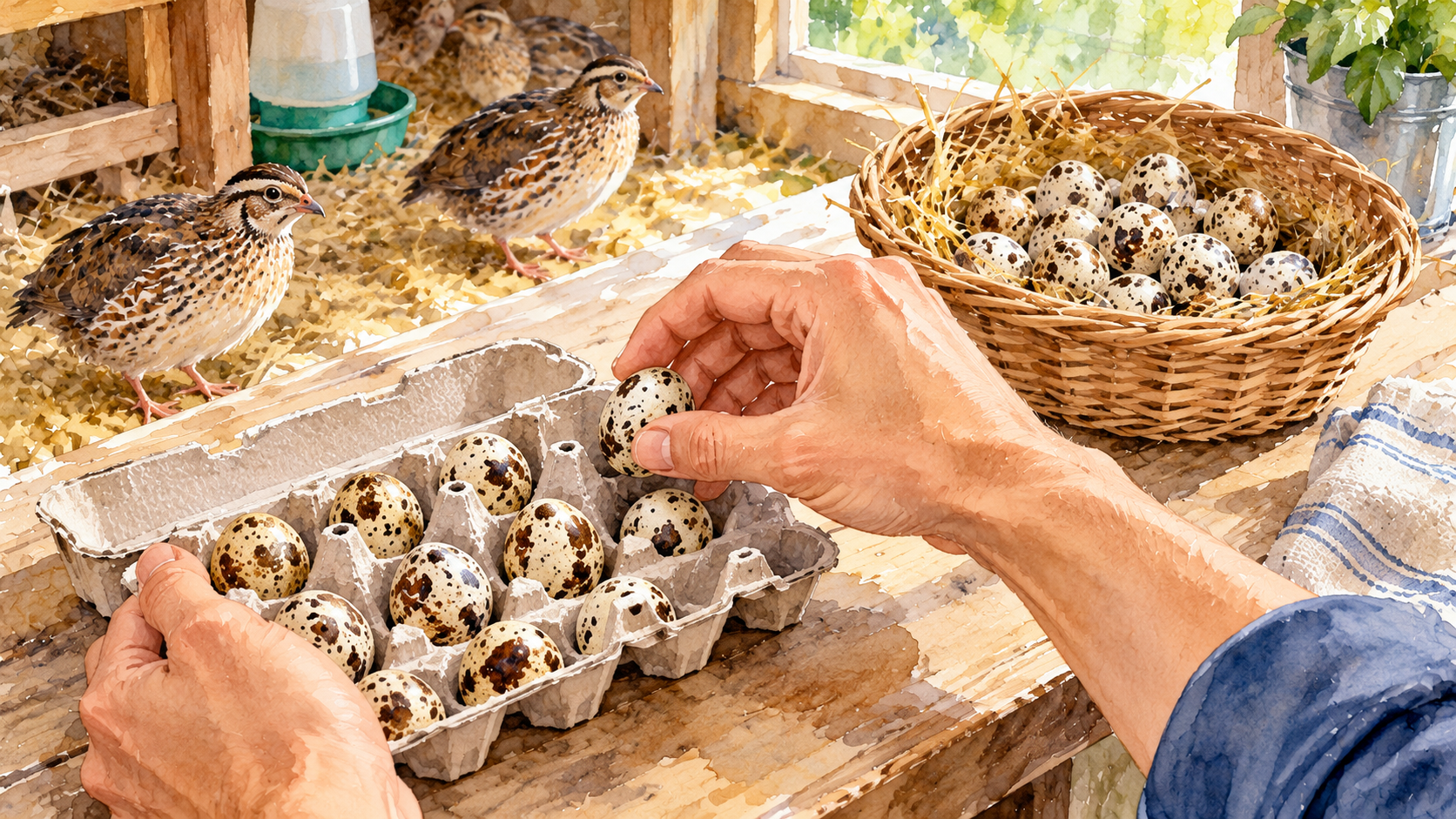
Fresh quail eggs should be collected at least once or twice daily, checked for cracks and contamination, placed in clean containers, and refrigerated promptly at 40°F (4°C) or below. During very hot or freezing weather, collecting them more frequently reduces the time they spend exposed to unsafe temperatures, moisture, droppings, and damage.
Clean, intact eggs generally require less handling than dirty ones. Washing is not always necessary, and doing it incorrectly can increase contamination risks. For Japanese (Coturnix) quail and other farmed quail kept for table eggs, a consistent collection routine is more dependable than trying to clean or rescue eggs after they have become heavily soiled.
How Often Should You Collect Quail Eggs?
Collecting quail eggs at least once in the morning and once later in the day is a sensible routine for many backyard flocks. Japanese quail often lay during the afternoon or evening portion of their light cycle, so collection times can be adjusted to when eggs actually appear.
The important consideration is how long an egg remains in the enclosure. Frequent egg collection reduces exposure to dirt, breakage, and temperature extremes. Eggs left among active birds are more likely to be stepped on, buried beneath bedding, or contaminated.
During hot weather, an additional collection may be necessary to prevent eggs from remaining in an overheated enclosure. Freezing conditions also require more frequent checks because a shell can crack when its contents freeze and expand.
There is no need to disturb birds continuously to gather each newly laid egg. Establish regular collection times that keep eggs reasonably clean while maintaining a predictable environment for the flock.
What Should You Use to Collect Fresh Quail Eggs?
A clean, shallow container with enough cushioning to prevent eggs from rolling or striking one another works well. Small cartons, washable egg trays, and dedicated collection baskets are suitable when their surfaces are clean and dry.
Quail eggs are much smaller than many commercially available poultry eggs, so oversized carton compartments may allow excessive movement. Containers designed for quail eggs can reduce rolling and accidental breakage.
Avoid using containers that have recently held feed waste, bedding, manure, or unwashed farm equipment. The outside of an egg can pick up microorganisms from contaminated surfaces even when it was clean at the moment of collection.
Clean collection equipment and hand hygiene help reduce bacterial transfer. Wash your hands after working with the birds and before handling kitchen utensils or preparing food.
How Do You Collect Quail Eggs Without Breaking Them?
Pick up each egg gently rather than gathering several loosely in one hand. Place it directly into a collection tray instead of allowing it to drop into a basket.
Where eggs are produced in cages with collection channels, examine the tray for shells caught at an angle or pressed against one another. A trapped egg can crack when additional eggs roll into it. The differences between cage and aviary housing can affect the equipment needed for collection.
In floor-housed flocks, remove accessible eggs carefully without dragging them through damp material. Keep the collection container stable and avoid stacking eggs deeply.
The usual places where captive quail lay eggs influence collection logistics, but the same principle applies to every housing system: handle eggs gently and limit contact with dirty surfaces.
What Should You Check Immediately After Collection?
A brief inspection helps separate suitable table eggs from those that should not enter household storage.
| Egg condition | Recommended action |
|---|---|
| Clean, dry, intact shell | Place in a clean container and refrigerate |
| Small amount of removable dry debris | Consider gentle dry cleaning, following applicable guidance |
| Heavily contaminated with droppings | Reject rather than attempting to salvage it for household use |
| Visible crack, leakage, or broken shell | Discard |
| Unusually thin or soft shell | Do not treat as an ordinary sound table egg |
| Egg found after an unknown period outdoors | Do not assume it is safe because it appears normal |
Shell inspection is especially important because cracks allow bacteria greater opportunity to reach the egg contents.
Keep rejected eggs out of the clean collection container. A leaking egg can contaminate other shells, the carton, and your hands.
Should You Wash Fresh Quail Eggs?
Clean quail eggs generally do not need routine washing at home. Their shells naturally possess an outer protective coating, commonly called the cuticle or bloom, which helps limit the entry of microorganisms.
Washing can disturb this protective surface, especially if eggs are soaked, scrubbed harshly, or exposed to unsuitable water temperatures. The safer approach is to prevent contamination through good husbandry and frequent collection.
For backyard flocks, public-health guidance recommends avoiding unnecessary wet washing. When eggs do require cleaning, the method matters.
Commercially graded eggs may be washed and sanitized under regulated procedures. Those controlled processes should not be confused with soaking eggs in a household sink.
How Should You Clean a Slightly Dirty Quail Egg?
A small amount of dry material may be removed gently with a clean, dedicated, soft brush. Avoid spreading contamination from one shell to another or scratching through the shell’s protective surface.
If wet washing is necessary, use clean potable running water that is warmer than the egg. Do not use cold water: cooling the contents during washing can encourage contaminated moisture to move inward through shell pores.
Safe backyard egg-washing guidance calls for warmer water, no soaking, and thorough drying. Where an approved egg-washing product is used, follow its label and the applicable local requirements.
Do not use ordinary dishwashing products, scented cleaners, or household disinfectants on eggs unless the product is specifically appropriate for egg washing. After cleaning, dry the shells promptly with clean materials and refrigerate them.
The goal is not to make a heavily contaminated egg acceptable. An egg with substantial fecal contamination is better discarded.
Why Is Water Temperature Important When Washing Eggs?
An eggshell contains microscopic pores. If an egg is immersed in water colder than its contents, the contents may contract, increasing the chance that contaminated water moves toward or through those pores.
Water warmer than the egg reduces that particular risk, although warmth alone does not make an unsafe cleaning process acceptable.
For example, Manitoba’s small-farm egg-handling guidance recommends wash water about 10°C warmer than the egg. Commercial Canadian egg-washing guidance specifies its own controlled processing requirements, which are not automatically instructions for household sinks.
Avoid soaking eggs regardless of water temperature. Clean, running water and prompt drying are preferable when wet cleaning is appropriate.
Where Should You Store Fresh Quail Eggs?
Store fresh quail eggs in the main compartment of a refrigerator, inside a clean, covered carton or egg container.
The recommended household refrigerator temperature is 40°F (4°C) or lower. Keeping eggs inside the refrigerator rather than in the door helps avoid repeated temperature changes whenever the appliance is opened.
Refrigeration slows the growth of harmful bacteria and helps preserve egg quality. It does not sterilize eggs or make heavily contaminated shells safe.
A dated carton also protects the eggs from breakage and makes it easier to use older batches first. Avoid placing them in direct contact with raw meat packages, dripping liquids, or dirty produce.
How Long Can Fresh Quail Eggs Be Kept in the Refrigerator?
For home-collected, sound quail eggs, using them within about three to four weeks of collection is a prudent planning guideline when they have been handled hygienically and continuously refrigerated.
Canadian backyard-flock guidance gives a refrigerated storage period of three to four weeks. The USDA’s general shell-egg guidance lists three to five weeks, although that broader guidance should not be interpreted as a guaranteed safe period for every ungraded farm egg.
These time frames assume appropriate collection, intact shells, and reliable refrigeration. They are not promises that an egg with an uncertain history will remain safe until the final day.
Label cartons with the collection date, especially when several batches are gathered each week. Using the oldest acceptable eggs first reduces unnecessary holding time.
Should Quail Eggs Be Stored Pointed End Down?
Placing eggs with their narrower ends facing downward is a common storage practice. It helps keep the broad end, which normally contains the air cell, uppermost.
This orientation may help maintain internal structure during storage, but it is less important for food safety than clean shells, consistent refrigeration, and an accurate collection date.
Backyard egg-handling recommendations include point-down storage, but a clean egg carton placed in a reliably cold refrigerator is preferable to a poorly refrigerated container simply because the eggs are oriented correctly.
If your tray holds quail eggs sideways, that alone does not mean the eggs are unsuitable for table use.
Can You Leave Unwashed Quail Eggs at Room Temperature?
Some keepers believe unwashed eggs can safely remain on a kitchen counter because their protective cuticle is intact. However, an intact cuticle is not a substitute for reliable temperature control.
For households following U.S. or Canadian food-safety recommendations, prompt refrigeration is the safer default for freshly collected quail eggs. This is particularly important because backyard collection conditions are not as standardized as commercial grading systems.
Health Canada advises against leaving eggs at room temperature for more than two hours. That recommendation does not mean an egg can be left for two hours every day, repeatedly warmed and cooled, without consequence.
Once eggs have been refrigerated, keep them cold until needed rather than returning them to long periods of unrefrigerated storage.
What Happens if Refrigerated Quail Eggs Warm Up?
When cold eggs are exposed to warm, humid air, moisture can condense on their shells. This is sometimes called sweating.
Condensation creates a damp surface that may help contaminants move across the shell. Repeated temperature fluctuations also work against consistent food storage conditions.
Keep refrigerated eggs in their carton until they are needed. Avoid leaving them on a counter during prolonged preparation or returning them repeatedly to the refrigerator after lengthy exposure to room temperature.
The two-hour room-temperature limit in U.S. food-safety guidance is an upper boundary for ordinary handling, not a recommended holding period.
Can You Freeze Quail Eggs for Longer Storage?
Yes, but do not freeze raw quail eggs inside their shells. The contents expand as they freeze and can crack the shell.
If freezing is necessary, break the eggs into a clean container, remove shell fragments, and freeze the edible contents in a suitable food-safe freezer container. Label the quantity and date.
The USDA advises against freezing raw eggs in their shells. Freezing is a way to manage surplus eggs, not a substitute for collecting and handling them hygienically in the first place.
Frozen egg contents may have different texture characteristics after thawing. Keep frozen portions separate from fresh eggs so that the preparation method and handling history remain clear.
Do Egg-Storage Rules Differ Between the United States and Canada?
Yes. Both countries emphasize hygienic handling and refrigeration, but the rules governing washing, grading, sale, and transport differ. Requirements can also vary between states and Canadian provinces.
| Topic | United States | Canada |
|---|---|---|
| Home-collected table eggs | Prompt refrigeration is the recommended safe practice | Prompt refrigeration is recommended |
| Refrigerator temperature | Generally 40°F (4°C) or below | Generally 4°C (40°F) or below |
| Washing | Guidance distinguishes dry cleaning, approved wet cleaning, and regulated commercial washing | Backyard guidance discourages unnecessary washing; commercial grading has controlled procedures |
| Commercial egg handling | Federal and state requirements may apply | Federal and provincial requirements may apply |
| Sale of ungraded eggs | State rules differ | Provincial rules and the type of egg or sales outlet matter |
In the United States, federal shell-egg recommendations apply alongside state-specific rules for direct farm sales. In Canada, federal food-inspection guidance sets out preventive controls for commercial egg washing.
For example, Ontario’s rules explicitly address eggs from birds other than domestic hens, requiring clean, uncracked eggs and cold holding under specified conditions when they enter regulated food premises.
Where a province permits the sale of ungraded farm eggs, additional labeling and distribution requirements may apply. A keeper selling quail eggs should verify the rules applicable to that particular product and location rather than assume that every chicken-egg exemption also covers quail eggs.
What About Collecting and Selling Quail Eggs in Manitoba?
Manitoba permits certain direct sales of ungraded eggs under its Poultry Products Regulation, subject to conditions covering egg cleanliness, packaging, identification, and refrigeration.
The current Manitoba regulation requires eligible ungraded eggs sold directly to consumers to be clean, free of visible cracks or leakage, packaged in appropriately labeled cartons, and maintained at 4°C or lower.
The provincial guidance for small egg producers also describes handling practices intended to reduce contamination.
These provisions should not be interpreted as blanket authorization for every form of quail-egg sale. The type of egg, sales channel, and any other relevant legal requirements must be checked before commercial distribution.
For eggs raised strictly for household use, clean collection and continuous refrigeration remain the priorities regardless of whether the eggs are graded.
How Can You Organize Daily Quail Egg Collection?
A simple written routine makes it easier to maintain consistent hygiene, particularly when several people collect eggs.
- Prepare a clean, dry collection container.
- Wash or sanitize hands before handling clean storage equipment.
- Collect eggs gently and separate visibly damaged or contaminated ones.
- Check the enclosure for any eggs left where they may be stepped on.
- Clean only those eggs for which an appropriate cleaning method is justified.
- Dry any properly washed eggs and refrigerate sound eggs promptly.
- Label the container with the collection date.
- Clean the collection equipment before its next use.
The general food-safety considerations for eating quail eggs begin with these collection and handling practices. Birds also benefit from the routine cleaning of quail enclosures, which reduces contact between eggs and soiled housing material.
For a flock producing eggs consistently, a dated record of each day’s collection can also help identify unusual changes in production without confusing old batches with new ones.
Common Questions About Collecting and Storing Quail Eggs
Should I refrigerate quail eggs immediately after collecting them?
Yes. Prompt refrigeration at 40°F (4°C) or lower is the safest routine for household table eggs, especially when their handling conditions are not commercially controlled.
Can I wash quail eggs with cold water?
No. Cold washing water may increase the risk of contaminated water moving through shell pores. If wet cleaning is necessary, use clean running water warmer than the egg and dry it promptly.
How long can unwashed quail eggs stay in the fridge?
For clean, intact eggs handled and refrigerated properly, a conservative household guideline is approximately three to four weeks. Label them with collection dates rather than relying on memory.
Can I save a cracked quail egg by refrigerating it?
A cracked egg found during collection should be discarded. Refrigeration does not repair the shell barrier or eliminate contamination that may have entered.
2 thoughts on “How to Collect and Store Fresh Quail Eggs”