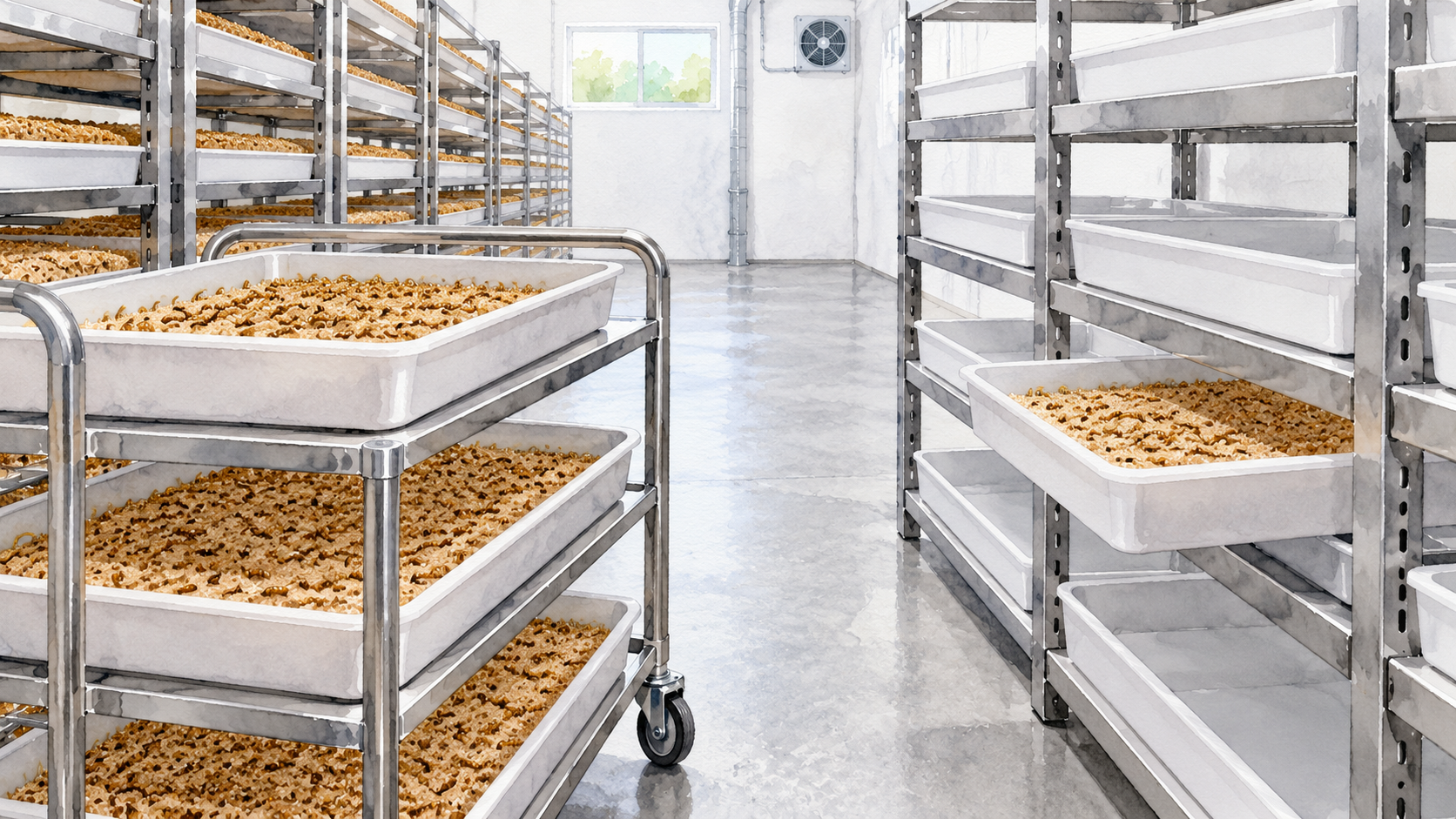
To scale up mealworm production, expand the number of managed breeding and growing batches in stages, then coordinate trays, shelf space, feed deliveries, workers, and harvest dates around that larger population. Adding more larvae without expanding the systems that support them can create overcrowding, missed transfers, and unreliable output.
An existing yellow mealworm (Tenebrio molitor) farm should first demonstrate that its normal breeding and larval-growing cycle can be repeated consistently. Expansion then becomes a question of how to run more batches at the same time, rather than simply putting more insects into each container.
Expand in Stages Rather Than All at Once
A sensible expansion begins with one additional rack, group of trays, or breeding cohort. Run the expanded arrangement through a complete cycle and confirm that feeding, transfers, handling, and harvests remain manageable before repeating the increase.
A review of commercial insect-rearing methods identifies distinct activities for egg laying, larval growth, pupal separation, and production harvest. Each becomes more demanding as the number of occupied trays rises.
For example, doubling the growing trays without increasing the supply of eggs may leave some trays unused. Doubling breeding adults without allocating nursery space can create the opposite problem. Expansion works best when the stages remain balanced.
Match Breeding Capacity to Growing Space
A larger farm needs enough adult beetles to supply incoming batches without overwhelming available larval trays. Plan breeding cohorts and their transfers before filling empty shelves.
The practical upscaling guideline for yellow mealworms separates reproductive management from the larval-growing component. This distinction is important when an operation begins supplying many trays from a smaller breeding area.
Maintain enough healthy replacement adults to prevent gaps when older breeders are retired. The established mealworm breeding process provides the underlying rotation method; expansion requires coordinating more of those rotations at once.
Create a Batch Schedule Before Adding Trays
Identify when each larval group enters the growing area, when it needs attention, and when its tray should become available again. Staggered cohorts can spread work and harvests across the calendar instead of concentrating everything into a few days.
A 2024 production scheduling study modeled batch size, launch frequency, tray occupancy, feeding needs, and harvest work together. The researchers found that some days required far more labor than others; a large sorting task had to be distributed across additional time.
A simple production board or spreadsheet should record:
- Batch identifier and egg-laying period
- Tray count and shelf location
- Current developmental stage
- Planned checks, transfers, and screening
- Expected harvest window and tray-release date
These records prevent the assumption that free shelf space today will remain available when later cohorts arrive.
Allocate Space by Life Stage
Expansion requires more than multiplying the floor area of existing containers. Adult beetles, young larvae, larger larvae, pupae, harvested insects, and empty trays each need designated space.
The review of industrial mealworm systems describes multilevel shelving as a way to increase production within a building’s footprint. However, dense shelving must still allow access for inspection, feeding, and tray removal.
Reserve accessible aisles and working space instead of filling every available corner with racks. Store clean equipment and feed separately from active colonies where practical. The capacity of individual mealworm containers remains a limit even when more shelf levels are available.
Avoid Overloading Individual Trays
Increasing production does not require packing each existing tray with as many larvae as possible. High-density rearing can compromise individual growth and feeding efficiency, and heavily occupied trays can generate substantial heat.
The commercial rearing review explains the tradeoff between output per unit of shelf area and the performance of individual larvae. Adding trays at a manageable density is often easier to control than sharply increasing density in every tray.
As occupancy rises, verify that ventilation reaches the middle and lower racks, not just the room’s open areas. Keep space available for temporarily separating batches that require attention.
Standardize Trays and Handling Equipment
A growing farm benefits from consistent tray dimensions, labels, rack spacing, and transfer tools. Standard equipment makes it easier to interchange containers and plan labor without developing a separate method for every shelf.
The SUSINCHAIN production guideline discusses production handling, separation, and facility conditions as interconnected requirements. Consistent tray systems make these repeated operations easier to organize.
Before buying additional equipment, test whether loaded trays can be lifted safely, passed through working areas, and cleaned using the available facilities. Select machinery around actual tray specifications rather than assuming any screen or feeder will fit.
Plan Feed Supply Around Future Batches
An expanded operation needs a predictable flow of dry feed and suitable fresh feeding material. Estimate demand from scheduled occupied trays and their expected stage of growth, then plan deliveries before existing supplies run low.
The production scheduling study connected its batch calendar to materials planning and considered delivery dates, storage, and staff availability. This is especially relevant when feed deliveries compete with harvesting for limited working space or labor.
Keep ingredient purchases traceable and storage suitable. The best feed for farmed mealworms concerns formulation; a scaling plan must ensure that approved ingredients are available to support every additional cohort.
Organize Labor by Repeated Tasks
As tray numbers increase, work that took only minutes can become an hours-long operation. Divide duties into feeding, inspections, adult rotations, sieving, transfers, harvesting, and equipment cleaning.
In the 2024 scheduling analysis, the predicted workload varied sharply by day, showing why the largest handling tasks cannot always be managed by one worker in a normal shift.
Assign responsibilities and create straightforward written procedures. Cross-train workers so normal production does not stop when one person is absent. Recording actual time spent per task helps identify where extra staffing or equipment is needed, without turning the article into a profitability calculation.
When Is Mechanization Worth Introducing?
Mechanization becomes relevant when repetitive handling prevents the farm from managing additional batches reliably. Candidate tasks include separating larvae from grain, sorting insects by size, moving trays, portioning feed, and tracking environmental conditions.
A research overview of scaling production equipment highlights screening and separating developmental stages as particularly labor-intensive operations. A monitoring-system study also explores automated observation of rearing conditions.
Begin with the task that creates the clearest operational bottleneck. A better sieve or semi-mechanical screening station may be more useful than a complex automated line when feeding and tray transfers are still performed on a small scale. Test equipment for insect damage, throughput, cleaning needs, and compatibility before relying on it across the farm.
Maintain Environmental Control as Rack Numbers Grow
More occupied trays change airflow, heat generation, and access within the growing area. Conditions that worked with one rack may not remain consistent when shelving fills a room.
The insect-rearing methods review warns that vertically stacked trays present challenges involving ventilation, feeding, waste removal, and density. The upscaling guideline likewise stresses ventilation and air quality as farms grow.
Monitor representative positions across racks, and plan how to inspect containers that are difficult to reach. The humidity management of mealworm colonies remains relevant, but the scaling challenge is ensuring that acceptable conditions extend throughout the larger facility.
Prevent Harvesting From Becoming the Bottleneck
A farm can raise additional larvae without having enough people or equipment to collect them when ready. Expansion plans should reserve harvesting time, clean receiving containers, and capacity to handle insects after collection.
The mealworm harvesting process requires separating insects from substrate and unwanted material. More trays mean more material to screen, inspect, and move.
Schedule harvest work before filling the next wave of growing trays. If harvests repeatedly run late, adding another rack may increase congestion rather than useful output.
Use a Small Expansion Trial to Check Readiness
Before another increase, review whether the newly added batches met their handling schedules, stayed within their allotted spaces, received feed on time, and moved through each stage without avoidable delays.
Compare the planned tray occupancy and labor requirements against what actually happened. The 2024 scheduling model demonstrates how even a spreadsheet can connect launch dates, shelf occupancy, and recurring work into one plan.
The operating expenses of raising mealworms are relevant to expansion decisions, but this operational check focuses on whether the larger workflow functions reliably. Add the next production group only when space, people, feed, and harvest handling can accommodate it.
Questions About Expanding Mealworm Production
Is adding more beetles enough to scale up production? No. Extra breeding adults also require nursery and larval-growing space, feed, workers, and eventual harvest capacity.
Should every new tray begin at the same time? Not necessarily. Staggering groups can spread feeding, sorting, and harvesting work across different dates.
Is automated equipment necessary for expansion? No. Incremental expansion can remain partly manual, but mechanization becomes useful when repetitive handling limits reliable operations.
Can vertical racks replace additional floor space? They can increase tray capacity within a building, provided airflow, access, safe handling, and working space remain adequate.
One thought on “How to Scale Up Mealworm Production”