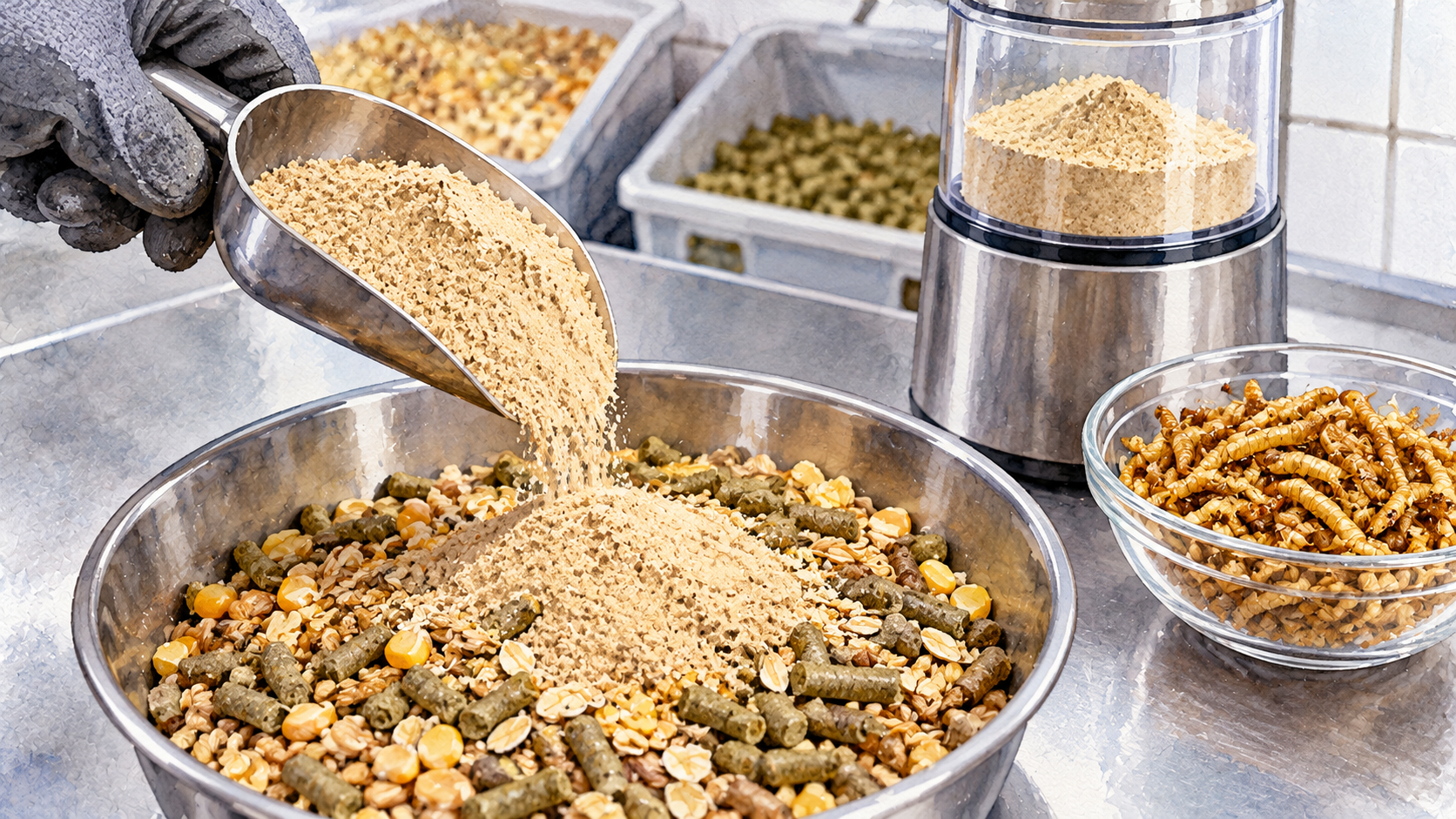
Mealworm powder is used primarily as a protein- and energy-containing ingredient in animal feed. Made from processed yellow mealworm (Tenebrio molitor) larvae, it can be incorporated into suitable manufactured rations, pellets, and other feed products. Its nutritional role depends on whether the powder retains the insects’ natural fat or has undergone additional processing to remove some of that fat.
Mealworm powder is also called mealworm meal, mealworm flour, or ground mealworms. These terms are sometimes used interchangeably, although products sold under them may differ substantially in composition. For farms, the important distinction is between nutritional potential, demonstrated uses in research, and uses actually authorized under applicable animal-feed regulations.
What Is Mealworm Powder Made From?
Mealworm powder is produced by processing yellow mealworm larvae into a dry, finely divided ingredient. Commercial production generally includes hygienic handling, an appropriate processing treatment, moisture removal, and grinding.
The resulting powder contains nutrients from the larvae, including protein, fat, minerals, and components of their external skeleton. It is not the same as the fine residue that accumulates underneath a growing colony.
A review of commercial insect-rearing methods identifies powdered mealworms among products made for food and feed applications.
The life cycle of darkling beetles includes eggs, larvae, pupae, and adults, but mealworm powder normally refers to material derived from the larval stage.
The suitability of the finished ingredient depends on the insects’ source, the production process, and the intended use.
What Is the Difference Between Mealworm Powder and Defatted Mealworm Meal?
The main distinction is how much of the larvae’s original fat remains in the finished product.
| Product | Main characteristics | Potential feed role |
|---|---|---|
| Full-fat mealworm powder | Ground larvae retaining much of their natural fat | Supplies protein and concentrated energy |
| Partially defatted mealworm meal | Some fat has been removed | Provides protein with a reduced fat contribution |
| Highly defatted or protein-enriched meal | Much of the original fat has been removed, sometimes with further processing | Provides a more concentrated protein fraction |
A review of mealworm products in animal nutrition describes full-fat, defatted, and hydrolyzed ingredients investigated in feed research.
Removing fat generally raises protein’s percentage of the remaining dry material. It does not create additional protein from the same original mass of larvae.
The amount of fat removed depends on the equipment and processing method. Two products both labeled mealworm meal may therefore have different nutritional specifications.
How Much Protein and Fat Does Mealworm Powder Contain?
Mealworm powder can contain substantial protein and fat, but there is no single composition that applies to every product.
The Feedipedia profile of yellow mealworms reports averages of approximately 50% crude protein and 36% fat on a dry-matter basis for dried mealworms. Individual products vary considerably.
For comparison, the same resource describes a study in which full-fat mealworm meal contained 57.8% crude protein and 19.1% fat, while a defatted preparation contained 64.6% crude protein and 2.8% fat.
These figures come from specific samples and processing methods, not universal product guarantees.
Crude protein is also commonly estimated from nitrogen content. Because insects contain non-protein nitrogen, the conventional calculation can overstate actual protein. A meaningful product specification should identify the analytical method, moisture basis, and preferably the amino-acid composition.
The nutritional characteristics of mealworms for farm animals provide further context for interpreting protein, fat, energy, and mineral measurements.
Why Is Mealworm Powder Used in Animal Feed?
Grinding creates a more uniform ingredient that can be weighed, mixed, and handled within a feed-manufacturing process.
Whole larvae vary in size and can separate unevenly from other ingredients. A sufficiently consistent powder can be distributed through a dry feed mixture more predictably, although the actual mixing performance depends on particle size, density, and equipment.
Mealworm meal also offers a way to incorporate insect-derived nutrients into products where whole larvae would be impractical.
An animal-feed review of yellow mealworm products describes their use in research involving poultry and pigs, including different processed forms.
Powdered mealworms remain a feed ingredient, not a complete ration. Their inclusion requires the same attention to digestible nutrients, formulation, safety, and legal status as any other nonstandard feed material.
Can Mealworm Powder Be Used in Poultry Feed?
Research has evaluated mealworm meal in formulated poultry diets, including diets for growing birds and laying poultry.
A review of insect meal in poultry feed summarizes studies reporting acceptable results with certain mealworm ingredients and inclusion levels. Results were not identical across experiments because meal composition and the rest of the diet differed.
The powder’s nutrient contribution is also affected by fat content. Full-fat products deliver more lipid-derived energy than heavily defatted preparations.
For farm birds, species-specific feeding questions remain important. The suitability of mealworms for chickens, ducks, quail, and guinea fowl cannot be reduced to one universal feed recommendation.
Research results alone also do not establish that a particular ingredient is legally authorized for every U.S. poultry-feed use.
Is Mealworm Powder Useful in Fish Feed?
Mealworm meal has been investigated as an ingredient in aquaculture feeds, where finely processed materials can be incorporated into manufactured pellets.
Studies involving fish have examined growth, nutrient digestibility, feed utilization, and product characteristics. Results depend on the fish species, whether the meal is full-fat or defatted, and the overall formulation.
The Feedipedia review of yellow mealworms documents aquaculture research alongside studies of terrestrial animals.
Mealworm powder’s physical form may make it convenient for pellet manufacturing, but its presence does not guarantee that a pellet will remain intact in water. Pellet stability also depends on binders, processing conditions, and other ingredients.
Use in aquaculture must be assessed for the particular fish species and under the applicable feed rules.
Are There Applications in Pig Feed?
Research has also examined mealworm-based ingredients in pig diets, particularly where digestible protein and amino acids are important.
A review of mealworm larvae in monogastric animal nutrition describes studies involving growing and weaned pigs, including processed insect ingredients.
Some experiments reported favorable digestibility or growth results, but the findings depended on the feed composition and processing method.
These studies indicate potential applications rather than providing a ready-made feed formula. They should not be used to justify adding an untested quantity of mealworm powder to a pig ration.
Does Grinding Mealworms Change Their Nutritional Value?
Grinding primarily changes the ingredient’s particle size and physical form. It does not automatically add protein, fat, vitamins, or minerals.
However, processing can affect how easily ingredients mix, how nutrients interact with other feed components, and how readily fats are exposed to oxygen.
A review of mealworm processing characteristics notes that heat treatment, fat removal, and protein processing can influence the properties of mealworm-derived ingredients.
Finer powder also produces more airborne particles during handling. Suitable dust controls, clean equipment, and measures against cross-contamination are therefore important.
The preceding drying of mealworms for animal feed determines much of the material’s initial moisture and microbiological condition. Grinding does not correct inadequate processing.
What Limits the Use of Mealworm Powder?
Several characteristics restrict how much mealworm powder can contribute to a feed product.
First, its calcium content is generally low compared with phosphorus. A high-protein ingredient does not necessarily provide the mineral balance required by the receiving animal.
Second, the amino-acid profile may not perfectly match the species’ requirements. Crude protein alone cannot determine nutritional suitability.
Third, mealworm larvae contain chitin, a structural substance that can influence analytical protein values and digestibility.
Finally, the lipid content of full-fat powder can affect shelf stability. Mealworm fats are susceptible to oxidation, especially when exposed to unsuitable storage conditions.
A review of efforts to improve mealworm feed value emphasizes the effects of rearing substrates, processing, and variation between batches.
These limitations reinforce the need for a tested product specification rather than treating all mealworm powders as interchangeable.
Can Farm-Raised Mealworms Be Processed Into Powder?
Farm-raised larvae can be the raw material for mealworm powder, but a safe feed ingredient requires more than grinding insects into small particles.
The starting larvae must be suitable, and the processing operation must control microbial hazards, moisture, foreign material, and contamination between batches.
The safe storage of dried mealworms illustrates why moisture and lipid stability remain important after processing. Powdered products can be particularly vulnerable to dust exposure and repeated handling.
For a farm considering regular feed manufacture, the questions include whether its equipment can produce consistent material, whether the powder has been analyzed, and whether the intended animal-feed use is legally permitted.
Without suitable testing and processing controls, a homemade powder should not be assumed equivalent to a professionally manufactured feed ingredient.
What Should a Mealworm Powder Specification Include?
A meaningful specification should identify the insect species, form of the product, processing history, and principal nutritional characteristics.
Useful measurements include moisture, crude protein, fat, ash, relevant amino acids, calcium, phosphorus, and, when appropriate, microbial and contaminant results.
The research on mealworm nutritional variation demonstrates why one batch’s composition should not be assumed for every producer.
A supplier’s label should also make clear whether the product is full-fat, partially defatted, or highly defatted. Those forms have materially different energy and protein characteristics.
For a formulated ration, the ingredient’s digestible nutrient content is more informative than a general marketing claim that mealworm powder is high in protein.
Are Mealworm Powders Authorized for Farm-Animal Feed in the United States?
Authorization depends on the ingredient, intended species, processing, and specific use. A powder that has been studied successfully in poultry or fish does not automatically qualify for all commercial feeds.
The FDA’s animal-food ingredient guidance explains the legal requirements governing substances used in animal food. The agency also recognizes that animal-feed ingredients must be evaluated for their particular intended uses.
Farmers should verify the current federal and state requirements before manufacturing, distributing, or using a mealworm-based product commercially, especially where animals produce meat, milk, or eggs for human consumption.
A product described as pet food, reptile food, or a general insect protein supplement should not automatically be assumed suitable or authorized for livestock feed.
Questions About Mealworm Powder on Farms
Is mealworm powder the same as mealworm meal?
Often, yes. Both terms can describe ground processed mealworms, but the actual ingredients may differ in fat content, processing, and nutritional composition.
Does defatted mealworm powder contain more protein?
It generally has a higher protein percentage because some fat has been removed. That does not mean the processing creates additional protein.
Can mealworm powder be added to animal-feed pellets?
It has been investigated as an ingredient in manufactured feeds and pellets. Suitability depends on the formulation, processing equipment, intended animal, and applicable regulations.
Is mealworm powder a complete animal feed?
No. It is a potential ingredient supplying protein, energy, and other nutrients, but it does not provide a balanced complete diet by itself.
One thought on “What Is Mealworm Powder Used for on a Farm?”