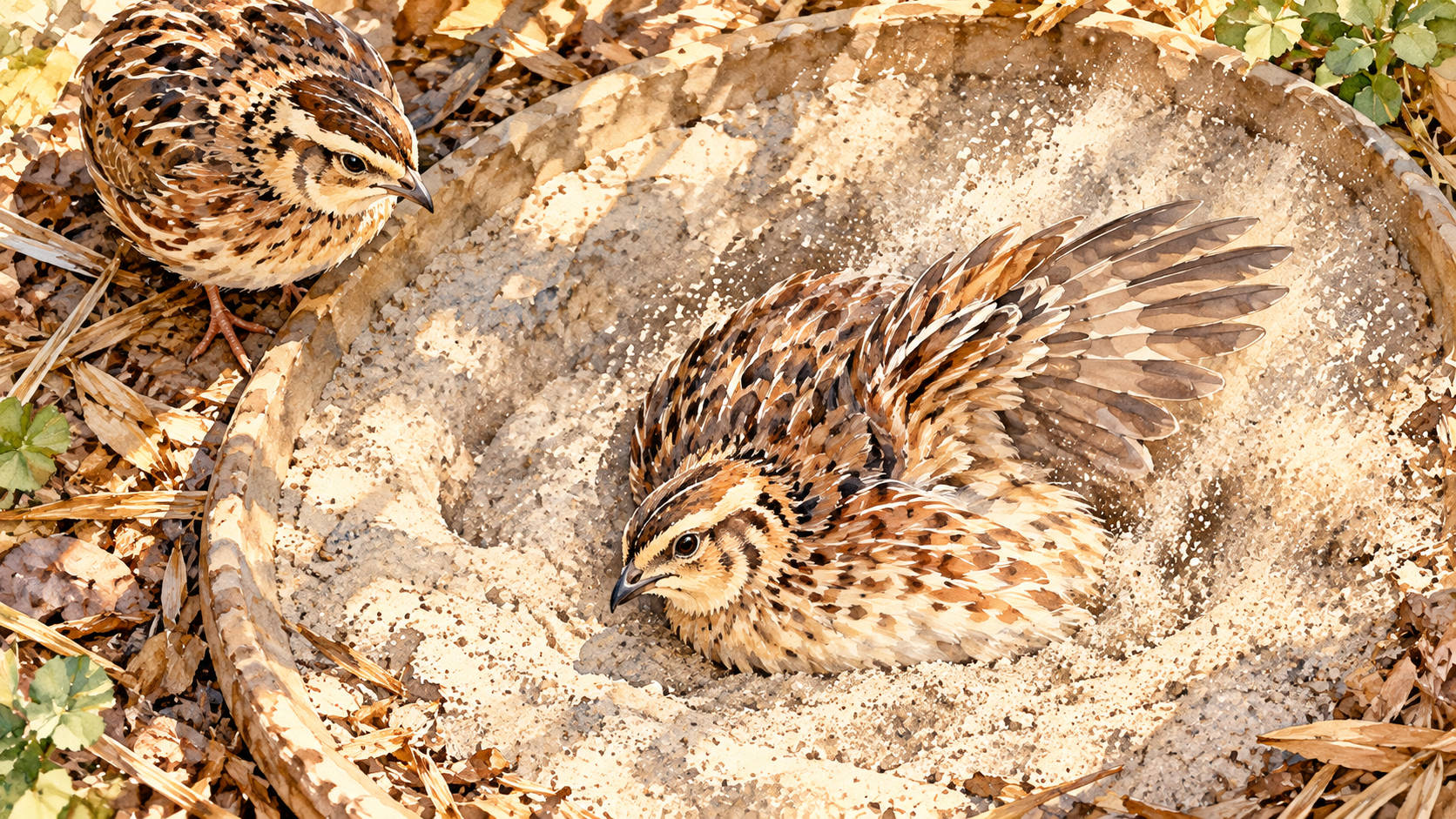
Quail need access to suitable dust-bathing material to perform an important natural behaviour. They roll, wriggle, flutter their wings, and work fine particles through their feathers. Dust bathing helps maintain plumage and allows quail to carry out normal grooming and comfort activities that contribute to their welfare.
The best dust bath is a shallow, accessible area filled with clean, dry, loose material such as suitable sand or uncontaminated fine soil. It should provide enough room for the birds to turn and flutter without becoming trapped or competing for space. Although Japanese quail are particularly well studied, dust bathing is also a familiar behaviour in other quail species, including bobwhites and California quail.
Why Do Quail Take Dust Baths?
Dust bathing helps quail maintain their feathers and skin while performing a strongly motivated natural behaviour. During a typical session, a bird crouches in loose material, scratches and shifts its body, shakes its feathers, and flicks particles over its back and wings. Afterwards, it may shake vigorously and preen to remove excess material.
The behaviour is more than casual play. Quail deprived of suitable material show increased motivation to dust-bathe when access is restored. Birds without loose substrate may even perform some of the movements on an unsuitable surface, a behaviour sometimes called sham dust bathing. These movements do not provide the same opportunity to work particles through the feathers.
Dust bathing may also help manage feather oils and loose debris. However, providing a dust bath should not be considered a substitute for veterinary care when a quail develops skin or feather problems.
Do All Quail Species Dust-Bathe?
Dust bathing is characteristic of many quail species, although individual preferences, frequency, and preferred locations vary. Japanese quail commonly perform the behaviour when given fine, loose material. Northern bobwhites, California quail, and other ground-dwelling quail also use exposed soil or dusty areas for grooming.
Much of the detailed captive-welfare evidence concerns Japanese quail. Observations of Japanese quail in aviaries found that the birds preferentially dust-bathed in natural soil, rather than a nearby wood-chip mixture. This supports offering loose, fine material while recognizing that the ideal choice for every quail species has not been established through equally extensive research.
The differences among quail species and varieties matter when selecting the dimensions of a bathing area. A small king quail does not need the same physical space for an individual bathing movement as a substantially larger bird, but both must be able to move comfortably.
What Is the Best Material for a Quail Dust Bath?
Clean, dry, fine-grained sand or loose, uncontaminated soil is generally a suitable starting point. The material should move easily through feathers without forming hard clumps, containing sharp fragments, or producing excessive airborne dust.
Fine, friable material is preferred for dust bathing in Japanese quail. This does not mean that the finest possible powder is best. Extremely dusty materials can irritate respiratory passages and make the enclosure unpleasant for both birds and keepers.
| Material | Suitability |
|---|---|
| Clean, dry natural soil | Good when free from chemical contamination and harmful debris |
| Washed, fine-grained sand | Suitable when not excessively dusty or sharp |
| Clean sandy soil mixture | Practical when it remains loose and dry |
| Coarse gravel | Poor choice because particles do not move readily through plumage |
| Powdered wood ash | Not recommended as a routine additive because of irritation and contamination concerns |
| Diatomaceous earth | Avoid as a routine dust-bath additive because airborne particles can be inhaled |
The ideal texture is loose enough for the bird to work through its feathers without creating dense clouds of airborne powder. If a material produces substantial dust during ordinary handling, select a less dusty alternative.
Can You Use Garden Soil for a Quail Dust Bath?
Garden soil can work if it is dry, friable, and free from pesticides, fertilizers, treated wood residues, and other contaminants. Soil collected from an area where chemicals have been applied should not automatically be considered safe simply because it looks clean.
Avoid soil containing sharp stones, broken glass, animal feces, mold, or obvious contamination. Material taken from places used by wild birds or other animals may introduce additional biological hazards. Keeping poultry environments clean and reducing contact with potentially contaminated material are important aspects of flock biosecurity.
Soil also behaves differently depending on its composition. Heavy clay may become compacted, while very dry, finely powdered earth can produce excessive airborne dust. A naturally sandy mixture that remains loose is often easier to maintain.
Should You Add Diatomaceous Earth or Wood Ash?
Adding diatomaceous earth or wood ash is unnecessary for routine dust bathing. Although both are sometimes recommended in backyard poultry discussions, neither is required for quail to perform normal grooming behaviour.
Diatomaceous earth can generate respirable particles during handling and vigorous bathing. Food-grade labeling does not mean a powder is harmless when inhaled, and its use as a routine dust-bath additive has not been established as necessary for quail welfare.
Wood ash can be irritating, particularly when very fine or alkaline, and ash from painted, treated, or contaminated fuel may contain undesirable residues. Even clean wood ash offers no demonstrated requirement that would justify adding it to every quail bath.
A straightforward mixture of suitable sand or clean soil avoids introducing unnecessary materials. Suspected parasite problems should be assessed separately rather than treated by repeatedly adding powders to the bathing area.
How Big Should a Quail Dust Bath Be?
A dust bath should allow a bird to lower its body, spread and flutter its wings, turn, and shake without constantly striking the sides. The area must also accommodate the number of birds likely to use it, particularly where more dominant individuals occupy preferred bathing spots.
Quantitative welfare guidance for Japanese quail identifies a minimum functional bathing area of approximately 1,155 square centimetres for small groups, with additional space calculated according to flock size. That baseline is roughly equivalent to a square 34 centimetres (13.4 inches) across. It is a research-derived minimum for the specified housing model, not a universal container size or an ideal target for every species.
A larger area may be appropriate where several quail try to bathe simultaneously or one bird prevents others from entering. Observe actual movement rather than assuming a container is adequate simply because a bird can fit inside it while standing.
What Kind of Container Works for a Quail Dust Bath?
A shallow, stable tray with sufficiently low sides can make a practical dust bath. Its edges should allow the birds to enter and exit easily, while retaining enough material for them to roll and scratch. A container that tips when birds climb into it can cause injury or spill material throughout the enclosure.
Smooth, easy-to-clean surfaces are preferable to cracked or splintered materials. The tray should not have narrow gaps where toes can catch or steep sides that make leaving difficult. Small ornamental quail may require a lower entry point than larger gamebird species.
A designated container is not always necessary when a suitably maintained enclosure already has an ample area of clean, loose soil. In both arrangements, the important feature is access to a safe material that supports full dust-bathing movements.
Where Should You Put a Quail Dust Bath?
Place the dust bath on a stable, accessible surface where birds can use it without being repeatedly disturbed. A sheltered location can help keep the contents dry and reduce contamination from surrounding activity. The bathing area should not obstruct movement or become a bottleneck between important parts of the enclosure.
Avoid locations directly beneath surfaces where droppings accumulate or where moisture regularly reaches the substrate. Positioning the bath near an exposed entrance may leave nervous birds reluctant to use it, particularly if people or other animals frequently pass nearby.
Cover and opportunities for normal exploratory behaviour contribute to better quail welfare, although the ideal dust-bath location will depend on the actual enclosure. A protected but accessible position is generally preferable to a completely exposed corner that birds avoid.
How Often Do Quail Need Access to a Dust Bath?
Quail should ideally have regular, readily available access to suitable bathing material. Their motivation is not necessarily constant throughout the day, but they benefit from being able to perform the behaviour when inclined.
Controlled observations of Japanese quail identified daily patterns in dust-bathing activity, with substantial activity occurring at particular times after the light period began. These findings do not support restricting all quail to a fixed number of bathing minutes.
It is better to make a suitable area consistently accessible than to assume that a brief, occasional session will satisfy every bird. When a bath must be removed for cleaning, return fresh material once the container is ready.
Why Are My Quail Rolling and Flapping in the Dust?
Rolling, crouching, kicking material upward, and fluttering the wings are normal parts of dust bathing. A bird may lie partly on one side, spread its feathers, and perform vigorous movements that appear unusual to an inexperienced keeper.
Normal dust bathing includes coordinated movements that distribute particles through the plumage. The bird may remain in the substrate for a while before standing, shaking off excess material, and resuming other activities.
Such behaviour is usually consistent with comfortable grooming when the bird appears alert and moves normally afterwards. Persistent collapse, inability to stand, loss of balance, or abnormal movements outside the bathing context should not be dismissed as dust bathing. The signs that a quail may be ill require attention when behaviour appears physically abnormal.
Why Won’t My Quail Use Their Dust Bath?
A quail may ignore a newly provided bath because the material is unfamiliar, the container is difficult to enter, or the location feels exposed. Some birds also have different daily activity patterns, so failing to observe dust bathing during one inspection does not mean it never occurs.
Check that the substrate is loose and dry and that the container allows natural movement. Observe whether one dominant bird is monopolizing access or whether others avoid the location because of social tension. Competition for bathing space has been observed in captive Japanese quail, making access an important consideration in group housing.
Avoid forcing a bird into the container or covering it with dust. Allow voluntary investigation, and assess whether the setup itself discourages use before assuming the quail lacks interest.
How Do You Keep a Quail Dust Bath Clean?
Dust-bathing material must remain reasonably clean because birds repeatedly work it through their feathers and may peck at the particles. Droppings, spilled food, feathers, damp clumps, and other debris accumulate over time, particularly in small containers.
Remove visible contamination during routine enclosure checks and replace the substrate when it becomes dirty, damp, compacted, or difficult to clean. Empty and wash reusable containers when necessary, then allow them to dry thoroughly before refilling. There is no single replacement interval suitable for every flock; usage, group size, humidity, and contamination determine how quickly a bath needs attention.
Dry, friable material free from physical, chemical, and biological hazards is the appropriate standard. The routine cleaning of quail housing should account for dust-bathing areas because a dirty substrate is not an acceptable alternative to providing enrichment.
Can a Quail Dust Bath Become Too Dusty?
Yes. Dust bathing naturally sends some particles into the air, but excessive airborne dust is undesirable for birds and people working in an enclosure. The problem becomes more significant in enclosed buildings with poor ventilation or when very fine powdered materials are used.
Research on cage-free quail housing identifies increased airborne dust as a potential management disadvantage. The appropriate response is to select a less dusty substrate, maintain ventilation, and remove heavily contaminated material—not to eliminate the birds’ opportunity to dust-bathe.
Avoid placing the bath directly in front of equipment that blows particles into the birds’ faces or distributes fine debris throughout the enclosure. A suitable dust bath should support comfortable feather maintenance without creating persistent clouds of dust.
Do Dust Baths Prevent Mites and Lice in Quail?
Dust bathing contributes to normal feather and skin care, but it should not be treated as a guaranteed prevention or cure for mites, lice, or other parasites. A quail can dust-bathe regularly and still develop an infestation. The welfare value of access to suitable dust-bathing material is established independently of parasite treatment. Adding insecticidal powders or other chemicals without an appropriate diagnosis can create additional exposure risks.
If birds develop unusual scratching, feather damage, visible parasites, or skin irritation, evaluate those signs as a separate health issue. Routine dust bathing remains appropriate, but it does not replace veterinary examination or species-appropriate treatment.
Common Questions About Quail Dust Baths
Can quail dust-bathe in ordinary sand?
Yes, provided the sand is clean, dry, appropriately fine-grained, and not excessively dusty or sharp. Avoid contaminated construction materials and heavily powdered products.
Do quail need a dust bath every day?
Regular access is recommended. Quail may choose to bathe at different times, so making suitable material consistently available is preferable to a rigid schedule.
Can you use soil instead of sand for a quail dust bath?
Yes. Clean, dry, loose soil can be suitable if it is free from pesticides, fertilizers, harmful debris, and obvious biological contamination.
What happens if quail have no dust bath?
They lose an opportunity to perform normal grooming and comfort behaviour. Quail deprived of suitable material may attempt dust-bathing movements on unsuitable surfaces, which does not adequately replace access to a proper substrate.
One thought on “Do Quail Need Dust Baths?”