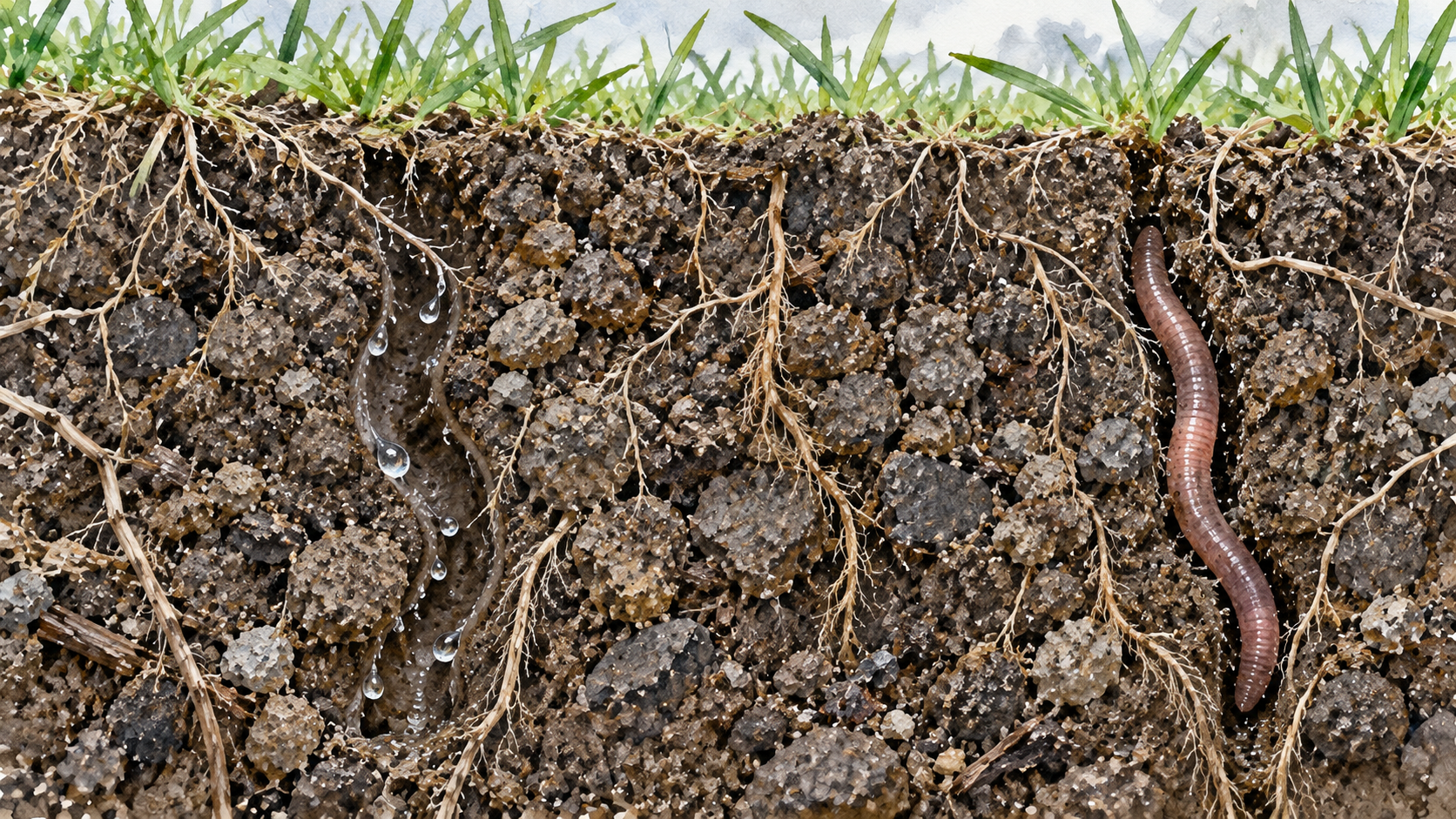
Earthworms improve soil aeration and drainage mainly by creating connected pores and tunnels through which air and water can move. They also influence how soil particles hold together, helping maintain spaces between them. A well-connected burrow may give rainwater a route below the surface while allowing oxygen to reach deeper soil layers.
Not all worm species build the same tunnels, and not every soil can take advantage of them. A deep, open burrow in a well-structured field behaves differently from a shallow tunnel in waterlogged clay. Understanding that difference makes the explanation more useful than the common claim that earthworms simply “loosen” soil.
What Is Actually Changing in the Soil?
Soil contains pores of many sizes. Very small pores retain water strongly; larger pores, often called macropores, allow water to enter and move more rapidly when they are connected. Air occupies some pores when soil is not saturated. Roots and soil organisms depend on this balance between water and oxygen.
An earthworm tunnel is a biological macropore. It may connect the surface to lower soil layers or link smaller spaces within the profile. Earthworm casts and soil mixing also help create aggregates, the small clusters of soil particles that leave pores between them. Soil-health guidance on macropores and aggregation explains how these structural features support infiltration, drainage, gas exchange, and root growth.
A large visible hole is therefore only part of the story. The tunnel’s continuity, whether its entrance stays open, and the condition of the surrounding soil determine whether it still functions as a pathway. A sealed surface or collapsed opening can sharply reduce the benefit even when worms were active there earlier.
Deep Vertical Burrows Can Speed Up Rainwater Infiltration
When rain reaches bare or crusted soil faster than it can enter, water may pond or run off. Open vertical worm burrows can intercept part of that water and conduct it into the soil instead of requiring every drop to move slowly through the surrounding fine pores. This is particularly relevant in established pasture, perennial beds, and reduced-tillage fields where the burrows are less frequently destroyed.
Deep-burrowing earthworms, including some nightcrawlers, are notable because their tunnels can connect the soil surface with deeper layers. In technical guidance on earthworm water infiltration, vertical burrows are described as important entry points for water, especially under no-till management. Crop roots may later occupy old passages and extend into lower horizons with less resistance.
Infiltration and drainage are related but not identical. Infiltration is water entering at the surface; drainage is excess water moving away through or out of the soil. A burrow may help water get below a crust while the field still drains poorly because of an underlying restrictive layer, a high water table, or an inadequate outlet. Faster entry alone does not guarantee a dry root zone.
Worm Tunnels Also Support the Exchange of Oxygen and Carbon Dioxide
Living plant roots consume oxygen and release carbon dioxide. Soil microbes do the same as they respire. Gases move through interconnected air-filled pores, but diffusion becomes much slower when those spaces fill with water. Earthworms help aeration by contributing tunnels and aggregate-related pore space, not by actively pumping oxygen around the root system.
The earthworm soil-structure explanation describes how both deep and shallow burrowing groups affect pore formation and the exchange of gases with the atmosphere. If some of the connected pore network remains air-filled, roots have greater access to oxygen and carbon dioxide can escape more readily.
It is possible to have many worm tunnels and still experience oxygen-starved conditions. Prolonged saturation can occupy even large pores with water; a small patch of soil with poor drainage may remain poorly aerated until the excess water has somewhere to go. Earthworms therefore improve the potential for aeration under suitable conditions, rather than making wet soil permanently oxygen-rich.
Different Earthworms Create Different Kinds of Pore Networks
The word earthworm covers animals that use soil in notably different ways. Deep-burrowing, or anecic, worms often maintain relatively large, vertical passages. Topsoil-dwelling, or endogeic, worms form more branching networks through mineral soil. Surface-litter specialists, or epigeic, worms spend much of their time within decomposing material and typically influence deep mineral-soil drainage much less directly.
A research review of earthworm activity and soil-water movement distinguishes these groups and describes their contrasting burrow orientations and effects on macroporosity. That distinction matters if you see red composting worms in a mulch pile and assume they will produce the same deep drainage passages as nightcrawlers.
| Worm activity | Usual pore effect | Most relevant limitation |
|---|---|---|
| Deep vertical burrowing | Can connect the surface to deeper soil for rapid infiltration | The passage must remain open and have somewhere to conduct water |
| Branching tunnels within topsoil | Can increase connectivity among pores across the cultivated layer | Effects depend on soil structure, moisture, and disturbance |
| Surface-litter dwelling | Mainly modifies the organic layer rather than creating deep mineral-soil channels | Less direct influence on subsurface drainage |
These are ecological patterns, not a guarantee about every individual species. The physical process of how worms excavate tunnels is a separate question from the function those tunnels have after they form.
Clay, Sandy Soil, and Compacted Ground Respond Differently
Fine-textured clay soils tend to have many small pores that hold water tightly. Where a connected large pore can remain open, it may provide an especially noticeable alternative path for water. However, some clay soils swell when wet and shrink when dry, and burrow walls or openings can change with those cycles. Soil structure, rather than texture alone, helps determine whether worms improve infiltration.
Sandy soils usually allow water to enter relatively quickly through spaces between grains. An added worm tunnel may matter less for initial infiltration there, while low organic matter and rapid drying may limit worm activity. For clay-dominated beds, the more specific relationship between earthworms and clay soil deserves attention rather than assuming a universal benefit.
Compaction introduces a different constraint. Heavy machinery or livestock traffic, especially when soil is wet, can squeeze pores and make roots and worms less able to move. An earthworm may exploit an existing crack or less resistant zone, but severe compaction may restrict its activity in the first place. The soil-management discussion of earthworm limitations emphasizes both reducing compaction and protecting existing habitat. Earthworms are useful biological contributors, not substitutes for preventing repeated physical damage.
Can Earthworm Burrows Ever Move Water Too Quickly?
Rapid water movement through connected macropores is usually welcomed when the concern is ponding or surface runoff. Yet the same preferential pathways can sometimes carry dissolved nutrients or agricultural chemicals downward with less contact with the surrounding soil than slower matrix flow would allow. The environmental significance depends on rainfall, timing of applications, soil properties, and the location of drains or groundwater.
This is a recognized hydraulic tradeoff, not a reason to eliminate earthworms. Research on earthworm burrowing and soil hydraulic properties discusses how macropores can promote deeper water movement and reduce surface runoff, while their effects vary with burrow orientation and moisture. A separate field study of infiltration found that worm effects differed with soil texture and plant composition, reinforcing why a single impressive infiltration rate should not be treated as universal.
Responsible nutrient application, soil cover, and drainage management remain important regardless of worm activity. A field with rapid infiltration might still need attention to leaching risk, while a waterlogged field might need an engineered drainage solution that biology alone cannot deliver.
Why Tillage, Drying, and Heavy Traffic Can Erase the Benefit
Burrow networks need time to develop and remain useful. Regular inversion tillage can cut through established channels and expose earthworms to unfavorable conditions. Repeated surface compaction can seal burrow entrances, while very dry soil reduces activity and may cause some worms to retreat or become inactive. In extreme wetness, reduced oxygen can also limit earthworm survival and performance.
Research into the long-term functioning of earthworm burrow systems found that burrows affect soil hydraulic conductivity, but their persistence depends on processes such as trampling and changes in soil structure. This helps explain why creating a favorable habitat is a continuing management task, not an instant repair.
In a managed plot, protecting surface cover, avoiding unnecessary cultivation, and keeping heavy equipment off saturated ground help preserve existing pore networks. The effects of tillage on earthworms and the effects of drying soil on worm activity are each worth considering when a previously active site shows fewer burrow openings.
How to Interpret Standing Water When Earthworms Are Present
If puddles remain after rain despite visible worms, look for signs of the constraint rather than assuming the worms have failed. Water held above a dense subsurface layer, saturation from a high water table, and ponding in a low spot can each prevent the soil profile from draining even where surface channels are present.
A useful distinction is whether water struggles to enter the soil or enters but cannot leave it. Surface sealing and crusting point toward an entry problem; persistent water below the surface suggests restricted drainage, saturation, or an outlet problem. Both can occur together. The presence of worm casts or openings alone cannot establish the diagnosis, and significant drainage alterations may require site-specific agricultural or engineering assessment.
For ordinary gardening, work on suitable soil cover and avoid damaging wet soil with repeated traffic. For a field with chronic ponding, do not rely on adding worms as a drainage plan. The broader question of whether earthworms indicate healthy soil is relevant, but a direct look at soil structure and where water is going remains essential.
Questions About Earthworm Tunnels
Do earthworm tunnels always make soil drain faster?
No. They can improve infiltration and water movement when they stay connected, but an underlying restrictive layer or saturated water table can still leave a field poorly drained.
Can earthworms aerate soil that stays flooded?
Their burrows can increase potential air exchange once pores are air-filled. Persistent flooding can fill those same pores with water and restrict oxygen exchange.
Are compost worms as effective as nightcrawlers for drainage?
Not typically for deep mineral-soil drainage. Compost-associated surface dwellers generally do not maintain the extensive vertical soil burrows associated with some nightcrawler species.