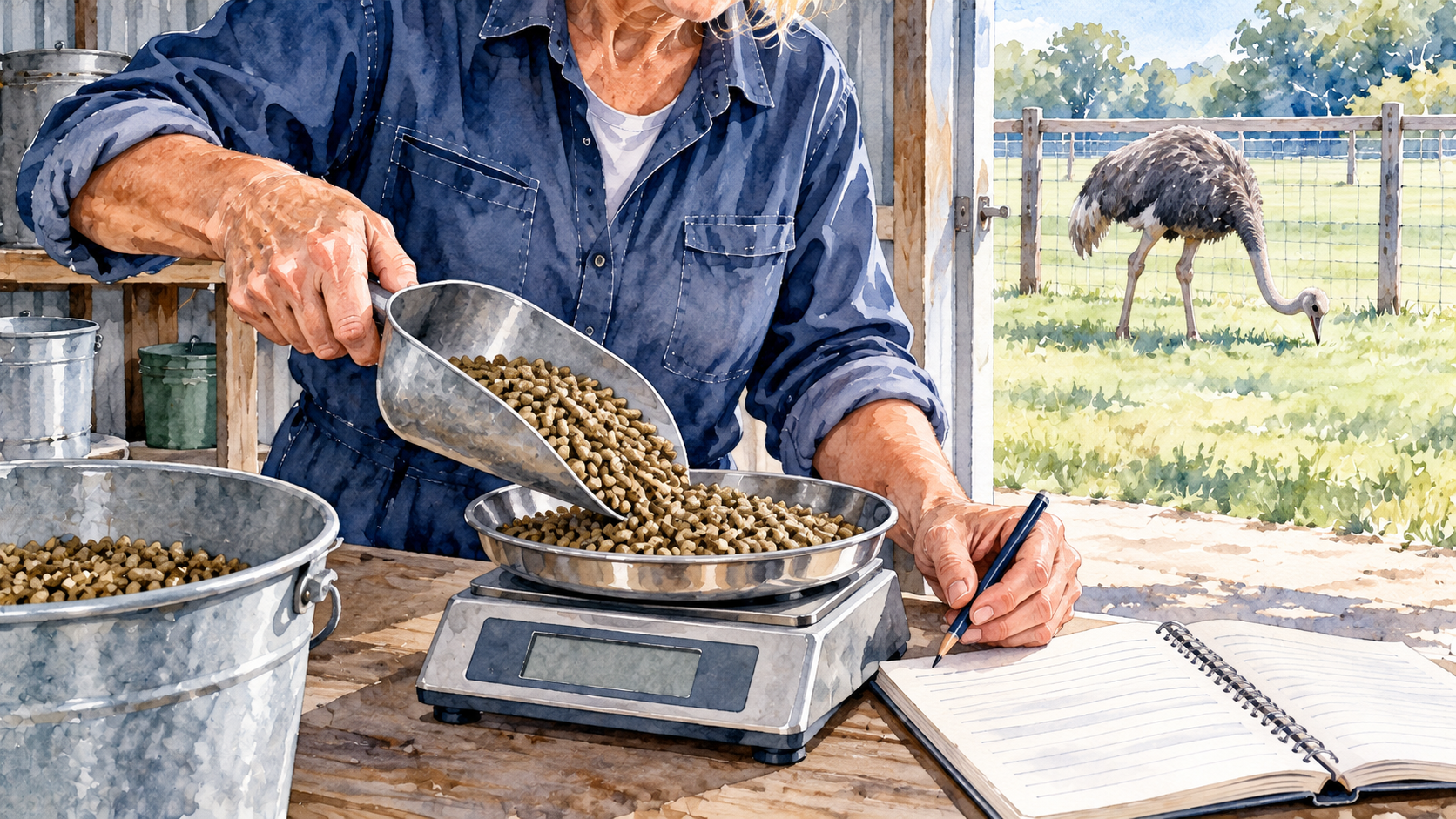
An adult ostrich commonly consumes approximately 4–6 pounds of feed dry matter per day in published maintenance and breeding examples, while growing birds may eat much less when young and progressively more as they gain size. These figures are planning references, not fixed allowances for every ostrich. The amount of pellets or other feed placed in a trough may differ from the total amount eaten, especially when the birds graze pasture or waste part of their ration.
For a U.S. farm, the most useful approach is to estimate consumption by age group, distinguish the weight of fresh forage from its dry matter, and check what actually disappears from feeders without confusing spillage with eating. A growing bird’s needs change rapidly; a mature maintenance bird and an actively breeding bird may also consume different quantities. Keep clean drinking water available at all times.
Daily Ostrich Feed Intake by Age: A Practical Reference Table
Ostrich feeding studies and production models do not agree on a single amount for each age, in part because their feed types, environmental conditions, and measurement methods differ. The following figures are from a South African government-supported ostrich production manual. Its Table 3.5b reports modeled average feed intake for intensively managed growing birds; the pounds are conversions from kilograms and are rounded for readability.
| Growth stage in the published model | Age range | Average daily feed in model | Approximate pounds per bird daily |
|---|---|---|---|
| Pre-starter | 0–2.8 months | 0.73 kg | 1.6 lb |
| Starter | 2.8–5.5 months | 1.12 kg | 2.5 lb |
| Grower | 5.5–8.1 months | 1.72 kg | 3.8 lb |
| Finisher | 8.1–11.5 months | 2.23 kg | 4.9 lb |
These are averages for whole stages, not what a newly hatched chick eats on its first day. A stage average combines younger and older birds with changing appetites. It should not be interpreted as a recommendation to put 1.6 pounds in front of a day-old chick or to force a bird to consume a model quantity. The early-life feeding and management details involved in feeding baby ostriches need age-appropriate professional oversight.
A second table in the same manual uses a different practical production model and reports lower intake for the earliest pre-starter period and higher intake at later stages. This is an important reason not to present the first table as a biological law. Farm planning should start with a defensible reference and then improve the estimate using observed intake, body condition, and growth.
How Much Does an Adult Ostrich Eat Each Day?
A mature ostrich may consume around 2.0–2.5 kilograms (4.4–5.5 pounds) of dietary dry matter or a broadly similar weight of suitable formulated ration in some production systems. However, an adult’s total food intake cannot be expressed reliably as one pound figure without stating whether the number refers to dry matter, pellets as sold, fresh forage, or all feed combined.
A historical New Zealand grassland conference analysis of ostrich farming cites average daily intake on all-mash rations of approximately 2.3 kilograms of dry matter for adult maintenance and 2.5 kilograms for breeding-season birds. These correspond to about 5.1 and 5.5 pounds of dry matter. The underlying figures came from older production references and should be treated as examples, not modern universal minimums.
For breeders, a 2023 South African ostrich feeding discussion describes approximately 2.5 kilograms (5.5 pounds) of breeder ration per bird daily in its production approach. This is another system-specific reference, and it is not a reason to feed all mature birds as though they are laying eggs.
Sex, reproductive activity, body condition, weather, and exercise can change actual consumption. The nutritional needs behind keeping ostriches for breeding stock are different from merely maintaining a mature bird between production seasons. Use the feeding program recommended for the actual life stage, then monitor whether the individual is eating and maintaining appropriate condition.
How Does Daily Feed Consumption Change as Ostriches Grow?
Rapidly growing birds typically increase their absolute daily feed intake as their bodies become larger. That does not mean they eat a constant percentage of their body weight or that every stage should be fed according to the same multiplier. Differences in diet energy, forage intake, and growth rate all change the relationship between body size and consumed weight.
The early weeks are especially different from later juvenile development. A bird that weighs only a few pounds cannot reasonably be managed as though it consumes the same daily amount as a large grower. As it develops, total intake rises, and a finishing bird may consume several pounds of feed per day under intensive conditions.
Another historical production table in the ostrich manual illustrates how feed use can vary across months: it reports approximately 1.1 kilograms daily at 6–7 months, 2.2 kilograms at 8–9 months, and 2.9 kilograms at 9–14 months under the study assumptions. Those figures differ from the stage averages above because the underlying calculations and production conditions are different. Both show the broad rise in intake with growth, but neither should be imposed on every animal.
Track intake against the changing size and development of the flock. Ostrich growth stages help explain why an estimate made for birds at three months may become inaccurate only a few weeks later. Abrupt or sustained reductions in feeding, particularly when accompanied by lethargy, weakness, or mobility changes, warrant prompt veterinary assessment rather than automatic increases in the feed offered.
Fresh Feed Weight Is Not the Same as Dry Matter
One of the most important distinctions in ostrich intake calculations is as-fed weight versus dry-matter weight. The as-fed figure includes moisture. Dry matter is what remains after water is excluded, making it more useful when comparing wet pasture, hay, and pellets on a consistent basis.
A pound of fresh, moisture-rich green forage supplies much less dry matter than a pound of dry pellets or hay. Consequently, a bird grazing several pounds of fresh vegetation does not necessarily receive the same amount of food dry matter as one eating several pounds of bagged feed. The difference matters when a farm tries to reconcile published intake figures with what is present in a paddock.
Consider a purely illustrative comparison: 10 pounds of grass at 20% dry matter provides 2 pounds of dry matter, while 2.25 pounds of a pellet at 90% dry matter provides roughly 2 pounds. Actual dry-matter percentages differ by vegetation, harvest conditions, and feed product. The example explains the measurement method, not what any ostrich should be given.
This is also why the different foods ostriches consume should not be added by fresh weight without adjustment. A bucket of leafy greens, a scoop of pellet, and a pile of hay do not represent equivalent nutritional quantities merely because their scales show the same number.
Does Pasture Reduce How Much Feed an Ostrich Eats From a Trough?
Suitable pasture can contribute to an ostrich’s total food consumption, so birds obtaining meaningful forage may eat less purchased feed than birds relying primarily on a managed pellet ration. However, the reduction is not automatically pound-for-pound. Pasture quality, plant maturity, weather, availability, and the birds’ actual grazing behavior determine what they obtain.
In a 2025 review of ostrich nutrition and feeding management, researchers describe the effects of age, dietary energy, feeding arrangements, and production stage on intake. This evidence supports treating feed consumption as a response to the whole feeding environment, rather than prescribing the same amount of concentrate regardless of forage access.
Green pasture can make an apparent feeding decline look more dramatic than it really is. If the feeder contains more leftover pellets after a bird has spent longer grazing, it might have obtained more forage. Equally, reduced trough intake could reflect spoiled feed, competition, illness, or unsuitable conditions. Do not automatically attribute every decline to successful grazing.
The practical considerations behind ostrich pasture access include safe plants, secure fencing, and observing what birds actually eat. In dry seasons, forage intake may drop even if animals continue to walk through the same field. Review the feeding plan with a qualified adviser rather than guessing how much purchased feed can be removed.
How Much Feed Should You Allow for Spillage and Waste?
The feed a farm provides is not necessarily the feed its ostriches consume. Pellets scattered onto soil, wet or spoiled material, contaminated trough leftovers, and feed lost during storage may all show up as purchases without entering a bird’s diet. A reliable daily estimate should distinguish these categories.
For example, if a group consumes 40 pounds of feed per day and 10% of what is purchased is lost, the farm must supply approximately 44.4 pounds to deliver 40 pounds of consumption. This is a hypothetical waste assumption for illustrating arithmetic, not a measured ostrich-industry waste rate. Simply adding 10% to 40 pounds gives 44 pounds and slightly understates purchases when the loss is defined as a percentage of purchases.
Measure losses where possible by recording how much is delivered, how much remains in usable condition, and how much must be discarded. Spilled feed that is contaminated should not be swept back into a feeder to make the figures look better. Equipment design and pen conditions affect how easily birds can access feed without scattering it.
When feed quantities appear to climb unexpectedly, inspect storage, trough placement, water damage, and access by pests or wild birds. Keep the daily feed record separate from the monetary accounting used in estimating ostrich feed expenditure: this article is concerned with pounds consumed and pounds purchased, not prices.
How to Calculate Daily Feed Needs for an Ostrich Flock
A mixed flock should be budgeted by age or management group, not by multiplying the intake of a large adult across every chick and juvenile. Use a published reference as a starting point, adjust it with consistent farm observations, and estimate the amount of purchased feed separately from forage consumption.
For a simple planning example, imagine a flock of four finishing juveniles expected to consume 4.9 pounds each per day and two adult maintenance birds estimated at 5.1 pounds of dietary dry matter each. Those groups sum to 29.8 pounds of dietary dry matter per day, assuming the juvenile reference is brought onto the same dry-matter basis. This assumption is necessary: mixing as-fed juvenile numbers with adult dry-matter figures without conversion would give a misleading total.
For a cleaner calculation when all birds eat one measured prepared feed, suppose six growers each consume 4 pounds as-fed daily. Their total consumption is 24 pounds daily. If 5% of purchased feed is lost, expected purchases are 24 ÷ 0.95 = about 25.3 pounds per day. Over seven days, that is about 177 pounds, before any change in growth, forage access, or weather. This is an arithmetic illustration, not a suggested six-bird feeding allowance.
| Planning step | What to calculate or observe | Common mistake to avoid |
|---|---|---|
| Sort birds into groups | Bird count, approximate age, size, purpose | Applying one adult figure to every age |
| Select an intake reference | Published daily intake with units and study conditions | Treating a historical average as a fixed prescription |
| Match measurement basis | As-fed pounds or dry-matter pounds, consistently | Adding wet forage and pellet weights as equivalents |
| Measure actual consumption | Feed offered minus usable leftovers and identified losses | Counting spilled feed as eaten |
| Allow for losses | Consumption ÷ (1 − expected waste fraction) | Confusing loss percentage with added feed percentage |
| Review regularly | Growth, condition, appetite, season, forage availability | Keeping the same estimate as juveniles mature |
Keep a small buffer of properly stored feed to cover delayed deliveries, but avoid purchasing more than the farm can protect from moisture, pests, and deterioration. Review delivery quantities against bird records and remaining inventory. For a large production group, meat-grower management benefits from consistent group-level feed records, especially as finishing birds become larger.
Why Might an Ostrich Eat Less Than Expected?
Changes in daily appetite can arise from normal variation in weather, activity, reproductive status, and available forage. Feeding behavior may also shift after a move, regrouping, or change in feed. These are possible explanations, not diagnoses. If a bird stops feeding, becomes weak, has abnormal droppings, shows gait problems, or appears distressed, obtain prompt veterinary assessment.
Feeder competition can produce unequal intake even when the group total looks adequate. Smaller or subordinate birds may receive less while dominant birds consume more. Observe actual access to the feeding points rather than assuming that the amount delivered is evenly shared.
The frequency and routine of ostrich feeding also influence when troughs empty and how much remains at any one check. This is distinct from the total daily pounds the birds consume. A midday feeder that appears empty does not, by itself, establish the entire day’s intake.
Fresh water is essential, particularly during heat. Hot weather, stress, inadequate drinking access, or feed deterioration can complicate appetite and welfare. Do not respond to unexplained low intake by forcing feed, restricting water, or changing the ration abruptly without appropriate professional advice.
Common Questions About Daily Ostrich Food Intake
Does a full-grown ostrich eat 10 pounds of pellets every day?
Ten pounds of pellets is not a universal adult allowance. Published maintenance and breeder examples are often closer to about 4–6 pounds of dietary dry matter daily, although systems differ. Fresh forage adds weight without providing the same dry matter, and individual consumption must be evaluated in context.
How much does a baby ostrich eat in its first week?
Published averages spanning the first several months cannot accurately describe daily intake in the first week. Hatchlings start much smaller, and feeding practices are specialized. Use an appropriate chick-management program and monitor the individual rather than applying a multi-month stage average to a newborn.
Can I calculate intake as a fixed percentage of body weight?
A percentage-of-body-weight estimate may be useful as a rough screening method in a defined feeding system, but no single percentage reliably describes hatchlings, growers, maintenance adults, and breeders. Published age-specific intake figures and measured farm consumption provide a better planning basis.
Should I measure ostrich feed before or after feeding?
Record both the amount supplied and the amount remaining, and account separately for spillages and contaminated feed. Where pasture contributes to the diet, trough measurements describe only the prepared feed portion, not the bird’s total consumption.
One thought on “How Much Food Does an Ostrich Eat per Day?”