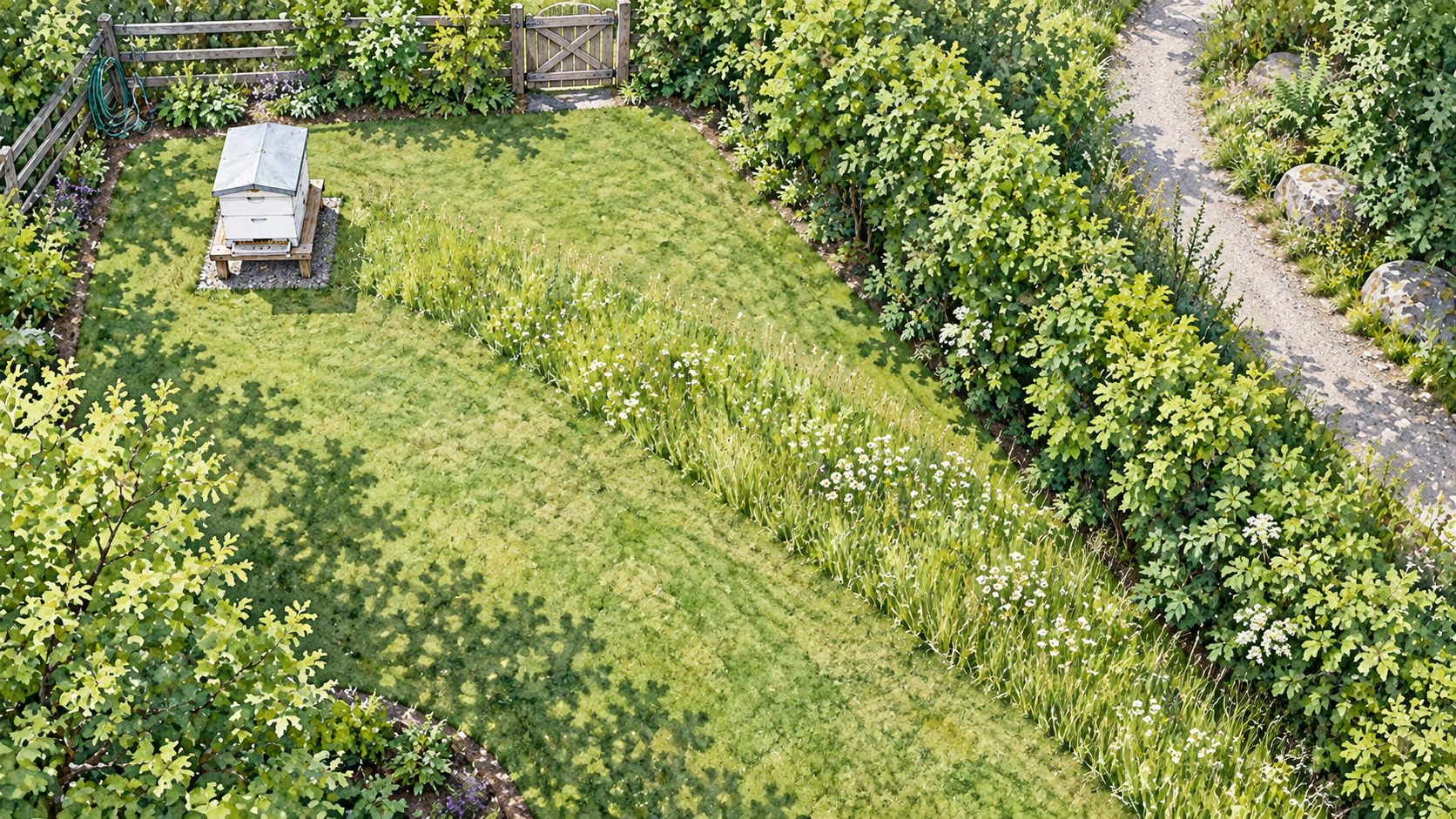
A single honey bee hive occupies only a few square feet, but a safe place to keep it takes considerably more room. For a small U.S. farm or backyard, plan for working space behind and beside the hive, an unobstructed or safely redirected flight path in front, and any setbacks required where you live. There is no universal U.S. minimum lot size that makes a property suitable for beekeeping.
A useful starting point for a conventional Langstroth hive is roughly 3 feet of working clearance at the rear and sides, plus a 10–15-foot low-traffic approach in front of the entrance. These are practical planning guidelines drawn from beekeeping advice, not mandatory nationwide dimensions. A flyway barrier may redirect departing bees, but the location still needs safe access and separation from daily activity.
The Hive Takes Little Ground Space, but That Is Not the Space Requirement
A standard ten-frame Langstroth box is approximately 20 inches long by 16 inches wide, depending on its components and manufacturer. That gives the box itself a footprint of roughly 2.2 square feet. The assembled hive also includes a bottom board, lid and stand, so its actual ground arrangement can extend beyond the box. A vertical hive can grow taller as more boxes are added, but a taller stack does not solve a cramped working area.
The distinction matters because bees use the area around the hive differently from the beekeeper. People need room to remove covers, inspect frames and safely carry heavy boxes. Returning foragers concentrate around the entrance, while people and animals passing across that route can repeatedly encounter bees. A location can physically accommodate a hive and still be unsuitable for managing one.
The backyard placement guidance distinguishes a compact hive from the area required to operate it without creating conflicts.
For example, a side yard that doubles as the only garage access may be unusable, while a sheltered garden corner with its own gate may offer sufficient working room. Neither acreage nor box footprint captures this difference.
Leave Enough Room to Work Behind and Beside Each Hive
Beehive inspections generally require access from the side and rear rather than standing directly in the entrance flight path. About 3 feet of clearance around the working sides is a sensible initial allowance for a small hive, supported by beginner site-planning guidance. It is not a legal standard or a promise that every body type, tool or accessibility need will fit inside that allowance. More room is useful when equipment is large or heavy.
Think about the movement required during an actual inspection. The beekeeper must be able to turn while wearing protective clothing, lift a box without twisting into a fence, and set removed components on a clean stand or stable surface. There should be no exposed wire, unstable stones, thorny growth or tripping hazards where the person will step backward. A second person assisting should not have to stand in the entrance stream.
If you use a cart, wagon or mobility aid, measure its turning and passing room rather than assuming a 3-foot passage is sufficient. Plan for the heaviest ordinary job: a honey-filled box may be substantially harder to move than an empty one. The residential beekeeping guidance advises spacing colonies so a beekeeper can work beside one without disturbing another and maintaining a safe route for moving equipment. If clearance would block a required passage or leave no safe working side, choose another spot. The procedures performed in that space are covered in how to inspect a beehive.
Give Departing and Returning Bees a Safer Flight Path
The airspace immediately outside a hive entrance is the most important part of the layout that is easy to overlook. Bees commonly travel in and out along a concentrated approach before dispersing or gaining height. As a practical screening rule, allow 10–15 feet of open, low-traffic space ahead of the entrance, then assess where that route continues. The hive-placement instructions recommend this range, while residential guidelines emphasize separating bee flight from public activity.
Open space is not the same as empty property. An unused strip of lawn may be fine; a walkway, play area, deck, dog run or gate used dozens of times a day is not. Pay attention to a neighbor’s window, patio or doorway beyond your fence. Pointing an entrance away from those activities is useful, but it does not mean bees will stay entirely on your land. They can forage far beyond the hive and approach from different directions.
Stand at the proposed entrance and sight along its likely approach. Check both typical activity and what changes when a gate opens, a delivery arrives or livestock move through the area.
Do not intentionally place an entrance directly toward a public sidewalk or a neighbor’s frequently used area and assume careful beekeeping alone will prevent contact. If the available approach crosses a high-traffic route, investigate a different position or a suitable flyway barrier. If people or animals must regularly cross the active entrance area and the traffic cannot be safely separated, do not install a hive there. A large enough footprint does not override that limitation.
Property-Line Setbacks May Determine Whether the Space Is Usable
A setback is the minimum distance a rule requires between a hive and a property boundary or another protected feature. It is different from the recommended distance that keeps bees out of pedestrian traffic. No single setback distance applies throughout the United States. State requirements, municipal ordinances, lot classifications and private property restrictions can differ. Verify the controlling rules before buying bees or treating any example dimension as permission to proceed.
For a concrete example, the City of Madison, Wisconsin, lists specific beekeeping restrictions: hives must be at least 3 feet from a property line, 10 feet from a public sidewalk and 25 feet from a principal building on an adjoining lot. Its published rules also require a 6-foot flyway barrier along certain nearby property boundaries and place limits on hive numbers. These numbers describe Madison’s rules at the time reviewed, not general U.S. standards. A yard that comfortably passes a beekeeper’s working-space test might fail one of those separate measurements.
Start with a property sketch showing boundaries, adjacent homes, sidewalks, paths and structures. Mark any legal exclusion areas before deciding where an individual hive could stand. A fence does not automatically waive a setback; its effect depends on the wording of the local rule. Do not assume agricultural zoning or ownership of several acres makes every position permissible, particularly near occupied buildings or public access. For registration and local-rule research, read our whether you need a permit to keep honey bees post. Do not count a position as usable until you have confirmed that it meets applicable requirements.
A Flyway Barrier Can Help, but It Is Not a Shortcut Around Every Constraint
A solid fence, dense hedge or similar obstruction in front of a hive can encourage departing bees to rise before crossing nearby ground-level activity. This can make some otherwise awkward sites more workable. Guidance on good-neighbor hive management describes 6-foot-high barriers extending beyond the hive group, while residential bee guidance also recognizes barriers as a way to redirect flight paths.
The details matter. A low, sparse hedge does not function like a continuous high barrier. Gaps, open gates, changes in ground elevation and entrances placed past the end of a fence can leave a direct path into walking space. Because regulations may specify a barrier’s height, location and length, a visually substantial fence is not necessarily a legally sufficient one. If you are using a barrier to meet a rule, check that rule’s exact language.
A barrier also does not prevent every encounter with bees. Bees may collect water elsewhere, approach on different headings, gather outside a hive during hot weather or become defensive around an opened colony. The beekeeper still requires separate working access and must keep children, pets and unprotected visitors away from active inspections. Do not place a solid wall so close that it blocks your work area, creates a hazardous bottleneck or makes the entrance difficult to observe.
Sun exposure, drainage and prevailing winds are separate location decisions addressed in where to place a beehive on a farm.
How Much More Space Do Two or Three Beehives Need?
Multiple hives can share an access route and some work space, provided each hive can be opened and serviced without disturbing its neighbor. Plan entrance directions and handling clearance before adding boxes.
For a small group of hives, a few feet between neighboring boxes is a reasonable place to begin planning, then adjust for the working side, stands and individual management style. The apiary-location advice suggests leaving a few feet between hives in rows and considering different entrance directions to reduce drifting. Drifting occurs when bees return to the wrong colony; spacing, distinctive visual cues and irregular layouts may help reduce it. Very close placement can be managed by experienced operators, but an efficient commercial pallet layout is not automatically a good beginner arrangement.
A practical two-hive arrangement may have one shared aisle between the boxes, provided that aisle stays clear and wide enough to work both colonies safely. Avoid putting the hives face-to-face across a narrow walkway. Staggering the entrances or using recognizable visual landmarks may help bees distinguish neighboring colonies, although none of these measures eliminates drifting entirely.
A site that fits three hives is not a reason to begin with three; how many beehives a beginner should start with covers management capacity.
A Worked Space Estimate for One Hive and Two Hives
This illustrative calculation is not a legal minimum or proof that a site is safe. Replace the assumptions with measurements from your own property.
Assume each conventional hive occupies a ground rectangle about 1.5 feet wide by 1.7 feet deep, rounded upward from common Langstroth box dimensions. Set aside 3 feet of service space at the rear and on each outer side and choose 12 feet of low-traffic approach in front, within the 10–15-foot practical range. For a two-hive example, assume the boxes sit side by side with one shared 3-foot working aisle between them.
| Layout component | One hive | Two adjacent hives |
|---|---|---|
| Hive box widths | 1.5 ft | 3 ft total |
| Side working clearance | 6 ft total | 6 ft at outer sides |
| Shared aisle | Not applicable | 3 ft between hives |
| Approximate width needed | 7.5 ft, round to 8 ft | 12 ft |
| Rear clearance + hive depth + forward approach | 3 + 1.7 + 12 = 16.7 ft | Same 16.7 ft |
| Rounded planning rectangle | 8 × 17 ft = 136 sq ft | 12 × 17 ft = 204 sq ft |
The forward zone is a low-traffic corridor, not a boundary that contains flying bees. The estimate excludes legally required setbacks, storage, water stations, predator fences and vehicle access; mobility or lifting needs may enlarge the work area.
Draw the rectangles on a scaled property sketch, then mark buildings, traffic routes and setbacks. A geometric fit does not override a legal restriction or unsafe flight path.
What These Space Requirements Mean for Backyards and Small Farms
The same basic measurements can yield different decisions depending on how the land is used. Consider these common site types:
Small fenced backyard: A corner not used for recreation may work if the working sides remain accessible, bee traffic can be directed away from doors and neighboring activities, and local rules permit the location. A small lot is not automatically disqualified, but claims that every 200-square-foot yard will accommodate one or two hives ignore how that space is shaped and used. A narrow, irregular yard can have less usable space than a smaller but carefully separated rectangular one.
Narrow side passage: It may appear convenient because it is out of sight, yet this is often the only route for bins, tools, deliveries or emergency access. If a beekeeper cannot pass or work without blocking that route, or the entrance directs bees into a gate, look elsewhere. Never place hives in a required emergency-access passage; residential management recommendations explicitly caution against blocking such routes.
Small farm or homestead: Select a portion away from ordinary stock movement and frequent people traffic. Hives near pasture entrances, water troughs, feed storage or equipment staging areas may expose animals and handlers to avoidable contact. The wider farm may offer other choices, but they still need maintainable access throughout the season. Before putting hives beside a boundary, also consider what happens on the adjoining property, not just your own side of the fence.
For issues beyond the available ground space, read can you keep honey bees in your backyard?.
Keep People, Pets and Livestock Out of Routine Bee Traffic
For livestock, the challenge is not only routine flight traffic. Horses, cattle and other confined animals may be unable to retreat if bees become defensive, especially near gates, feed stations or water troughs. The apiary siting guidance flags this risk for grazing animals.
Consider what happens when a colony needs attention. A beekeeper in protective clothing can choose where to stand; a visitor approaching from behind a hedge may not know a hive is open. Equipment needs a route into and out of the area that does not bring unprotected people directly through the work zone. In shared spaces, physical access controls and clear communication matter more than signs alone.
A secure, suitable boundary can reduce casual access, but do not assume a lightweight rope or an ordinary yard gate will keep curious animals away. Choose barriers appropriate to the animals and local conditions; where bears or other predators are a concern, account for a separate perimeter and safe maintenance access rather than crowding protective structures immediately against hive boxes. The related guidance on protecting beehives from predators covers protective systems in detail.
People with known severe sting allergies require particular consideration when evaluating shared household or work areas. Occupational sting-safety guidance recognizes potentially life-threatening allergic reactions that require emergency care. No hive spacing guarantees zero sting exposure. When the site would force a vulnerable person into routine bee traffic, an off-site apiary or a different activity may be safer. Sting prevention during active beekeeping is addressed separately in how to avoid honey bee stings while beekeeping.
Leave a Reliable Route for Equipment, Water and Emergency Access
A location can pass the flight-path test but fail as soon as you try to carry a full box of honey over uneven ground. Walk the intended access route holding an empty box or a similar bulky object to check for pinch points, slippery slopes, branches, low openings, unstable steps and gates that cannot be operated easily while carrying equipment. This is a practical pre-installation test, not a claim that a particular route is safe for everyone.
Access must work during normal seasonal conditions, not only on a dry summer afternoon. Mud, deep snow, vegetation growth or pooled water may make a remote corner difficult to reach. A wheelbarrow or garden cart needs a firm route and turning area; a rooftop or elevated location requires additional structural and safe-lifting assessment rather than an assumption that unused roof square footage is available. If structural capacity or fall protection is uncertain, obtain an appropriately qualified assessment before installing hives there.
Reserve somewhere suitable for a reliable bee water supply, but do not interpret that as requiring a large pond or an additional acre. Water provision should avoid drawing bees to livestock drinking areas, children’s play zones or neighboring pools. The guidance on keeping bees away from nuisance water sources explains why water planning matters; how to provide water for honey bees deals with the actual water station.
Keep all required public, service and emergency routes clear. For stand placement and complete bee-yard organization, use how to set up a beekeeping apiary.
Test the Available Space Before Buying Bees
A short site assessment is more dependable than choosing a hive count from acreage alone. Use the following sequence with a scaled sketch or measuring tape. Its steps combine the flight-path, working-clearance, neighbor-safety and legal checks supported by the sources above; the pass/fail sequence is an editorial synthesis, not a government approval procedure.
- Remove legally unavailable ground. Check the current state and local rules for your exact property and identify any setbacks, prohibited positions or required barriers. If a requirement is unclear, seek confirmation before proceeding.
- Mark unavoidable people and animal routes. Include your household, neighboring activity visible from the boundary, farm gates, play spaces, sidewalks and required emergency access. A route that cannot be redirected is a fixed constraint.
- Draw the low-traffic flight approach. Begin with a 10–15-foot forward zone, then judge where bees will fly beyond it. If a proper barrier is proposed, assess its real height, continuity and legal adequacy.
- Reserve the beekeeper’s working area. Begin with around 3 feet beside and behind each hive, then enlarge it for equipment movement, a helper or accessibility needs. Make sure the entrance zone is not the only place someone can work.
- Check the practical access route. Can you move a hive box, feeder, cart and other equipment without blocking a gate or putting an unprotected person in the bee area? Is the route usable in wet or cold weather?
- Allow for future activity, not just today’s empty space. A vegetable bed may become a play area, a pasture gate may be moved and a second hive may be added. If an ordinary change would force the hive into an unsafe position, identify another viable location before starting.
Reject sites that fail a legal or nonnegotiable safety check. Compare convenience and future expansion only among the remaining options.
Questions About Very Small Beekeeping Spaces
Can you keep a beehive on a patio or rooftop? Sometimes, where permitted and where the structure and access arrangements are suitable. The question is not just load-bearing area: people need safe access, bees need a flight path separated from occupied doors and terraces, and any elevated site needs appropriate fall and structural precautions. Do not assume a roof is suitable without a qualified assessment when structural capacity or access safety is uncertain.
Can a shared driveway count as the space in front of a hive? Only if bee traffic can be separated from everyone who regularly uses it, including delivery drivers and visitors. A driveway that must remain open or carries frequent pedestrians is usually a poor choice for the entrance approach. Measure its traffic pattern rather than counting its square footage as automatically usable.
Does having several acres mean you can keep any number of hives? No. Acreage may give you more location choices, but safe management still depends on access, people and livestock movement, regulations, and the beekeeper’s capacity. The amount of food available to colonies is a separate question from the physical yard space occupied by hives. For flowering resources around the farm, how to plant a honey bee-friendly garden addresses habitat improvement without suggesting that one acre has a guaranteed hive-carrying capacity.
One thought on “How Much Space Do You Need for Beekeeping?”