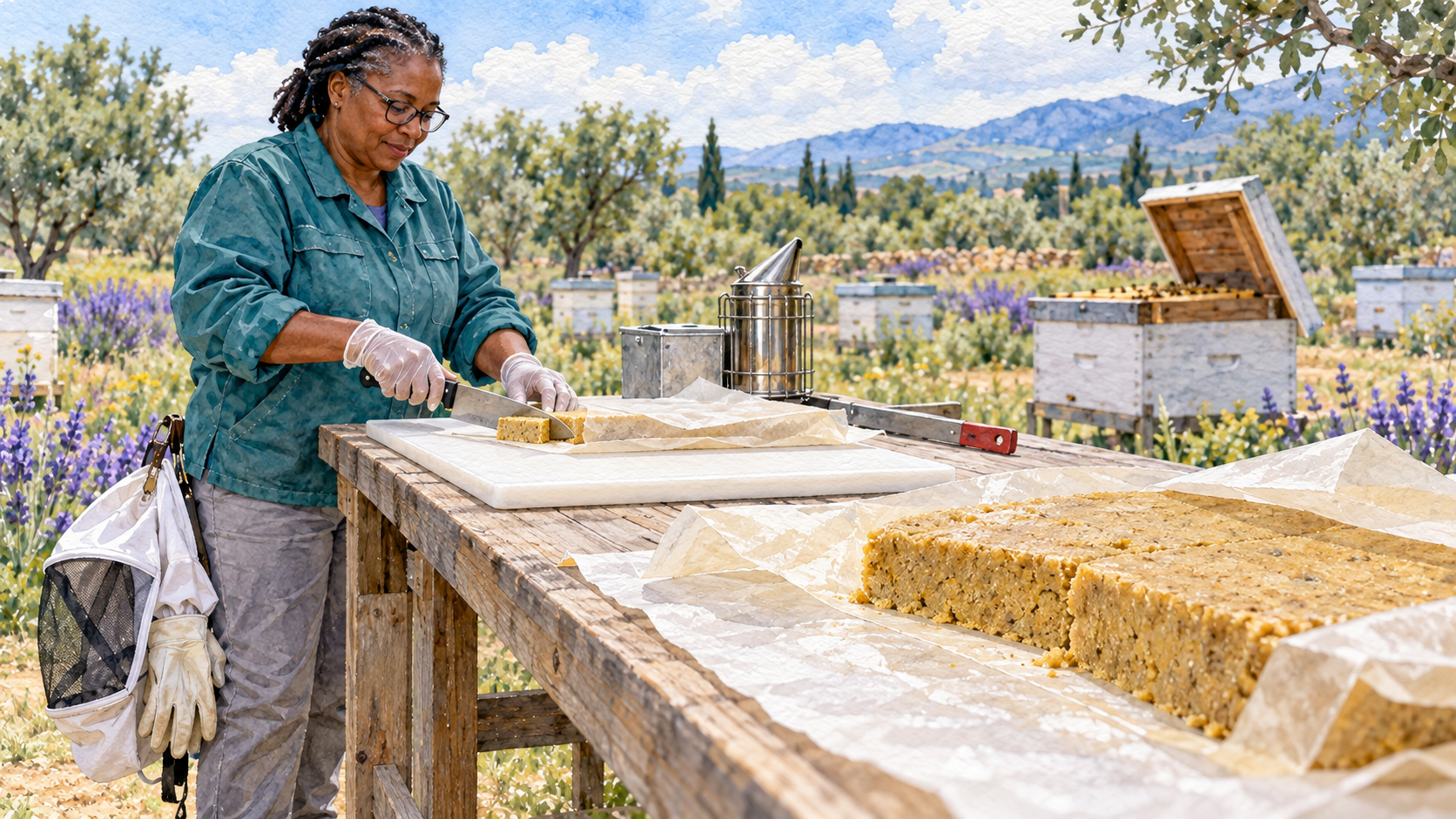
Honey bees can benefit from pollen substitutes when a colony is raising brood but cannot obtain enough natural pollen. The safest approach is to confirm the shortage, choose a product formulated for honey bees, place a modest portion of protein patty directly above the brood nest, and check whether the bees consume it before offering more. Protein feeding is not a routine requirement for every hive, and it cannot correct queen failure, disease, or a shortage of carbohydrate stores.
For most small US apiaries, a prepared pollen-substitute patty is easier to manage than loose powder or a home-mixed formula. The details that matter most are when the colony needs protein, whether it can support additional brood, and how quickly uneaten feed can spoil. Those questions determine whether supplementation helps or simply adds work and risk.
What Pollen Substitutes Do for a Honey Bee Colony
Natural pollen supplies amino acids, fats, vitamins, minerals, and other compounds used by honey bees, especially nurse bees caring for developing brood. During a pollen shortage, supplemental protein can help maintain brood-rearing activity and support the adult population that follows. It does not replace the energy bees obtain from nectar, honey, or suitable carbohydrate feed. Those energy sources and the broader natural diet are covered in what honey bees eat.
The terminology on feed packaging matters. A pollen substitute contains formulated protein ingredients without natural pollen. A pollen supplement contains some natural pollen along with other ingredients. Both are commonly sold as soft patties, and many sellers use “pollen patty” for either type. The name alone does not establish what the product contains. Check the actual ingredients and manufacturer’s directions.
Protein is only part of the nutritional picture. A useful diet must also offer an appropriate balance of essential amino acids and other nutrients. The Honey Bee Nutrition supplemental-feeding guide explains why a high crude-protein number, by itself, cannot prove that one substitute is better than another. Products may differ in digestibility, fats, micronutrients, acceptance, and consistency between batches.
There is also a biological limit to the term substitute. In a study tracking the fate of commercial pollen patties, some adult workers ate the feed, but researchers did not find that it was directly fed to larvae or stored as bee bread in the same way as natural pollen. Patties are therefore a short-term management aid, not a permanent replacement for diverse flowering plants. Natural pollen gathering belongs to the separate guide on how honey bees collect pollen.
Check Whether the Colony Actually Needs Protein
A pollen shortage is more persuasive when several observations agree. During a suitable inspection, examine the brood area for stored pollen or bee bread, usually visible as colored material packed into cells around the brood nest. Look for eggs and larvae, judge the number of adult bees able to care for them, and compare those conditions with what foragers are bringing home on days when flight is possible.
An absence of pollen loads at the entrance during rain or cold weather is not enough to establish a shortage. Likewise, seeing pollen-laden bees does not prove that their collection rate will sustain a rapidly expanding brood nest. The decision should reflect both the reserve inside the hive and the reliability of forage outside it.
Use this field assessment before opening a package of substitute:
| Colony and forage observations | Feeding decision | What to check next |
|---|---|---|
| Brood is expanding, bee bread is scarce, and natural pollen is limited by weather or flowering | A modest patty is reasonable if adequate energy stores are available | Consumption, brood development, and new pollen arriving |
| Brood is expanding and several frames have accessible bee bread while foragers bring in pollen consistently | Usually hold off | Whether reserves remain adequate at the next normal inspection |
| Colony is queenless or has little brood for an unexplained reason | Investigate colony condition before trying protein feed | Queen status, pests, disease signs, and sufficient adult bees |
| Colony has little honey or other usable carbohydrate food as well as little pollen | Treat energy shortage as an immediate priority | Food stores and colony strength, not just patty uptake |
| Unconsumed patties already show mold or beetle activity | Remove affected feed; do not add more | Colony ability to protect the hive and the extent of the pest problem |
This is an editorial decision framework synthesized from the 2024 feeding guidance and field research on supplemental protein, not a validated diagnostic test. An unusually spotty brood pattern, abnormal larvae, heavy mite pressure, or a weak adult population calls for a more complete colony assessment rather than assuming feed is the answer. The general inspection process is covered in how to inspect a beehive.
Choose the Right Season Instead of Feeding by Calendar Date
Early spring: This is a common time for carefully targeted protein feeding. A queenright colony may begin raising more brood before the surrounding plants supply pollen consistently. In that situation, a patty close to the brood can support continued feeding during interruptions in foraging. Spring arrives at very different times across the United States, so a fixed February or March start date does not fit every location. Do not force open a tightly clustered hive during dangerously cold conditions just to place a patty.
Summer pollen gaps: Drought, prolonged rain, loss of flowering habitat, or a particular crop-pollination schedule may interrupt pollen availability while bees are still raising brood. Protein feed may be useful when inspections confirm a genuine shortage. If flowers are abundant and bee bread is available, supplementation is less likely to be necessary. Warm weather also makes the spoilage and small hive beetle problem more immediate.
Late summer and fall: Supplemental protein may be considered when colonies need to raise the workers that will survive into winter and local pollen is insufficient. However, stimulating additional brood also increases the colony’s demand for food and can complicate seasonal mite management. The choice depends on climate, brood pattern, natural forage, and whether there is enough time and food to sustain the resulting bees. A late-fall patty is not automatically beneficial, particularly where colonies are entering a brood break.
Winter: Routine high-protein patties are generally inappropriate for colonies that are tightly clustered and not actively expanding brood. Winter emergency carbohydrate feeding is a different task and is covered in how to feed honey bees in winter. A 2026 discussion of pollen supplementation also describes why opinions differ on fall feeding; the evidence does not justify one schedule for every region.
Choose Between Prepared Patties, Dry Powder, and Pollen-Containing Feed
For a small apiary, a ready-to-feed patty sold specifically for Apis mellifera is usually the most manageable starting point. Patties can be placed close to brood, measured in portions, and removed if they go uneaten. Buy only what you can store as directed, check the expiry or lot information if available, and avoid products with unexplained ingredients or promises of guaranteed disease prevention.
A powder may be intended either for mixing into patties or for presentation in a separate dry feeder. These are not interchangeable methods: follow the product’s intended preparation. Mixing an unfamiliar amount of syrup into a powder can make it runny, alter how much of the diet is eaten, or lead to premature fermentation. The ratio for one product is not a reliable recipe for another.
A pollen-containing supplement may be readily consumed, but it also introduces a sourcing question. Pollen collected from unknown hives can carry pathogens or pesticide residues. If you choose a product containing actual pollen, investigate its source and any documented risk-reduction treatment; do not assume that “natural” means disease-free. The bee-farm biosecurity guidance on supplemental protein explains the rationale for preferring pollen-free substitutes or appropriately treated pollen.
Be skeptical of a product presented as superior solely because its label shows a larger crude-protein percentage. In a three-year field comparison of spring protein diets, feed consumption and brood production varied with the treatment, the year, and the forage context; increased intake did not consistently produce more brood. Matching an appropriately formulated diet to a real shortage matters more than selecting the largest advertised number.
How to Place a Pollen-Substitute Patty in a Hive
Have the prepared feed, hive tool, protective clothing, and an appropriately fitting hive cover or feeding rim ready before opening the colony. Choose a time when the hive can be opened safely under local weather conditions. Bees already short of food, disturbed by robbing, or unusually defensive should not be subjected to prolonged unnecessary handling.
- Confirm the reason for feeding. Review the colony’s bee bread, brood, adult population, and energy stores. If you cannot determine why the colony is struggling, do not rely on protein feed alone.
- Read the product label. Check whether the feed is ready to use, how the manufacturer recommends opening the wrapper, where it should be placed, and how it must be stored. Do not add unlisted essential oils, medications, or improvised “boosters.”
- Start with a manageable portion. Give no more than the colony is likely to consume promptly. In an area with active small hive beetles, use smaller portions and plan to check them sooner. There is no universally correct pound-per-hive dose.
- Place it over the active brood area. In a standard framed hive, lay the patty on the top bars immediately above the brood nest where nurse bees can reach it without crossing empty equipment. Follow packaging instructions so bees can access the exposed feed. Never block frame movement or compress bees and brood to make it fit.
- Restore the hive’s normal closure. If the patty is too thick for the cover, use appropriate compatible feeding space rather than leaving a gap that allows robbing, weather entry, or pests. Keep entrances and ventilation suitable for the colony.
- Record the placement. Note the date, hive, product or batch, approximate portion, brood condition, visible pollen, and any beetle activity. This makes the next inspection more informative.
- Check the feed and the colony. At the next safe opportunity, inspect how much remains, remove spoiled material, and decide whether to replenish, reduce, or stop feeding. In beetle-prone conditions, a quick follow-up within a couple of days may be warranted rather than waiting through a long inspection interval.
The position directly over brood is supported by the supplemental-feeding guide’s equipment recommendations. Keep the opening brief, avoid crushing the queen or workers, and do not feed an amount that the colony cannot defend from pests. Beekeepers unfamiliar with handling frames safely should first learn appropriate protective clothing and inspection practices.
How Much Protein Feed Should You Give, and When Should You Refill It?
The appropriate amount depends on colony strength, natural pollen availability, product composition, how quickly bees consume it, and regional pest pressure. A growing, well-populated colony during a persistent pollen shortage can use a different quantity than a small nucleus colony. Neither should be given an oversized patty just because it fits inside the box.
Begin with the manufacturer’s feeding instructions as an upper-level reference, then adapt the initial portion to what the bees can consume before it spoils. In warm areas with small hive beetle pressure, the small hive beetle prevention guidance recommends giving only enough pollen supplement for roughly two days of consumption. That is a pest-management precaution, not a universal feeding interval across all climates and colony strengths.
A practical way to evaluate the next portion is to note the approximate fraction of the first patty left after a known number of days. If most remains and begins drying or deteriorating, reduce future portions and reassess whether pollen is truly scarce. If it is being eaten rapidly while the brood nest remains strong, bee bread is minimal, and pollen collection is poor, another portion may be appropriate. The next inspection also needs to confirm that honey or other usable energy food is sufficient for the growing brood population. Where stores are chronically low, the more immediate management question is preventing honey bee colonies from starving, not increasing protein intake.
Do not mistake an empty wrapper for proof of improved bee health. Workers may consume a formulation without turning it into more viable brood, and variations in product composition make direct comparisons uncertain. An effective feeding program is judged by the colony’s condition over time, not by how many pounds of patties disappear.
Should You Use an Outdoor Dry-Protein Feeder?
Dry protein feed can be offered outside the hive in a purpose-designed feeder when natural pollen is scarce. Workers may collect it similarly to powdery pollen, and this can be practical for some larger managed apiaries. The feeding guide describes that approach, including its dependence on dry conditions and the willingness of bees to use a substitute when flowers are not supplying pollen.
An open feeder has disadvantages that a beekeeper should evaluate rather than treating it as an easier version of a patty. It is harder to know which hive consumed the powder, and bees from other colonies can gather at a shared food source. Moisture can spoil the product, wind can waste it, and communal use complicates biosecurity. Shared feeders are therefore a poor first choice when the goal is to supplement one weak colony without drawing workers from elsewhere.
For most backyard hives, contained in-hive patties give better control over which colony receives the feed and what remains at the next inspection. If a beekeeper chooses an external dry-feeding system, it should be protected from rain, maintained hygienically, and managed with awareness of neighboring apiaries and possible bee-to-bee contact. Never use loose feed from a container contaminated by rodents, water, dead bees, or pesticides.
Prevent Mold, Small Hive Beetles, and Robbing Around Feed
Protein-rich patties are attractive not only to honey bees. An uneaten portion left in a warm hive can become a food source for small hive beetles (Aethina tumida). Beetles may lay eggs in or around the patty, and developing larvae can damage the feed and hive environment. The risk is especially relevant in areas where small hive beetles are established and temperatures favor their reproduction.
Use portions bees can consume quickly, place them where a strong population can patrol them, and remove feed that becomes moldy, fermented, slimy, or contaminated by insects. Do not scrape the affected layer off and return the remainder to the hive. Also check underneath the wrapper, where beetles may hide. An infested patty is a warning to evaluate the colony’s strength and pest pressure rather than keep offering fresh material. Keep protein feed out of honey supers intended for harvest, and follow any product-specific restrictions on use when collecting honey; supplementation does not excuse careless handling of food-producing equipment. The beetle-management recommendations describe why excessive supplement feed increases this hazard.
Robbing is primarily associated with accessible carbohydrate food, but careless handling of any feed can leave sweet residues that attract outside bees. Do not leave opened patties, syrup-soaked wrappers, or mixing containers exposed beside hives. Clean up spills, keep the hive closed securely, and avoid shared, contaminated feeding arrangements. More complete prevention and response steps belong to how to stop honey bee robbing.
Storage is part of feeding hygiene. Keep unopened patties and powders in clean, pest-resistant conditions that match the label. Refrigerate or freeze a product only when its manufacturer recommends it, observe shelf-life guidance, and do not place a frozen patty directly onto brood. Discard feed with off-odors, obvious mold, or evidence of pest activity, even if the best-before date has not passed.
Avoid Disease Risks From Collected Pollen and Home-Mixed Recipes
Collected bee pollen is not automatically safe to move between hives. It may contain disease organisms or residues from foraging areas, and its history may be unknown. Avoid store-bought pollen sold for human consumption, pollen of uncertain origin, and material removed from sick or dead colonies as a shortcut to feeding bees. If a pollen-containing feed is necessary, choose a traceable source with appropriate safeguards rather than trusting appearance or smell.
Homemade pollen substitutes pose a different problem: their nutritional balance can be difficult to assess. Soy flour, brewer’s yeast, or another high-protein ingredient alone does not make a complete bee diet. Inadequate amino acid balance, unsuitable ingredients, poor mixing, or rapid spoilage may limit usefulness. Recipes sometimes add essential oils or other substances marketed for bee health, but that does not establish a validated benefit or legal approval for disease treatment.
If using a published formulation, follow its complete ingredient and handling instructions instead of improvising substitutes. For a beginner keeping only a few colonies, a correctly labeled commercial product is a more controllable option. The research review of pollen substitutes documents variation in diets and outcomes, and the biosecurity recommendations for honey bee inputs explain why pollen origin matters. Feeding is husbandry, not a treatment for American foulbrood, Nosema infections, or another suspected disease.
Monitor Brood Growth, Stores, and Mites After Feeding
The first follow-up question is whether the feed is still safe and being eaten. The second is whether the colony’s condition supports continued feeding. Look at brood development over successive normal inspections, available nurse bees, stored pollen, the return of natural pollen foraging, and the supply of carbohydrate food. Do not make repeated deep inspections solely to count cells if weather or colony temperament makes that unsafe.
A well-timed supplement may help a colony rear more bees during a forage shortage. A three-year study of commercial protein feeds found improved brood and adult populations in a pollen-limited apiary compared with unsupplemented colonies, but it also recorded variable consumption and feed efficiency. In contrast, a field trial involving 75 colonies found no statistically detectable difference in colony strength between the tested feeding treatments and the unfed control. The studies involved different conditions, so neither result proves that protein feeding always works or never works. It is most defensible when an identifiable shortage is limiting brood rearing.
Additional brood can also increase the colony’s resource demands. Keep enough energy stores for nursing and heating developing bees, watch available brood-chamber space, and maintain a proper Varroa monitoring and control program. Protein feed does not kill mites. For a broader health assessment, refer to common honey bee diseases and health problems and the separate Varroa management guide.
Stop feeding when natural pollen is reliably available and the colony has adequate accessible bee bread, or when the feed is repeatedly ignored, becoming contaminated, or no longer matches the seasonal management goal. If brood remains poor despite suitable nutrition, seek an experienced beekeeper, apiary inspector, or bee-health specialist to investigate rather than feeding more by default.
Three Colony Situations That Call for Different Choices
A strong colony in a cold, unsettled spring. The queen is laying, young brood is present, and pollen stores are low. Some flowers have opened, but a run of cold, wet days has interrupted foraging. A modest in-hive patty may bridge the gap, provided there is enough stored honey or suitable carbohydrate feed. Check consumption once the weather allows and reassess when pollen returns.
A small nuc with few adult bees and plenty of unused patty. The nuc has little stored pollen, but its small population cannot consume a large portion or defend it well against pests. Adding more protein may worsen the situation. Reduce or remove the remaining feed, verify queen and brood status, inspect energy stores, and correct the actual limiting condition. The specifics of establishing new colonies are covered in how to care for a new beehive during its first month.
A well-populated hive during summer bloom. Pollen baskets are visible on returning workers, bee bread surrounds the brood, and the colony is growing normally. Even if the keeper has protein patties left over, there is no clear reason to put one on. Store the product correctly and continue ordinary monitoring. Feeding only because a package is available adds expense, handling, and spoilage risk without a demonstrated need.
These examples are decision illustrations, not reports of tested colonies. Their shared lesson is that the quantity of feed should follow a verified nutritional need and a viable colony, rather than determine the management plan by itself.
Common Questions About Pollen-Substitute Feeding
Can you give pollen substitute to newly installed package bees?
Possibly, but first determine whether the package has adequate energy food, usable comb, and an established queen and brood-rearing pattern. A nutrition guide recommends prioritizing carbohydrate support for a package without drawn foundation. Providing a protein patty before there are enough nurse bees and suitable brood conditions may accomplish little. Installation and first-month care require their own assessment.
Will feeding pollen patties make a queen lay more eggs?
Protein availability can support brood rearing when pollen is the limiting resource, but an increased laying rate is not guaranteed. Colony population, queen condition, season, food stores, temperature, and mite pressure still matter. Feeding should not be used to conceal queen or brood problems.
How do you know when to remove an uneaten pollen patty?
Remove it promptly if it is moldy, wet, fermented, infested, or otherwise deteriorating. If it remains largely untouched while natural pollen is available, remove it and reassess the reason for feeding. A clean, partly used patty can be evaluated at the next safe inspection according to the product instructions and local beetle pressure.
Can pollen substitute replace flowering plants near an apiary?
No. Commercial feed does not reproduce all the nutritional and behavioral functions of diverse natural pollen. Reliable forage remains the better long-term foundation; supplements fill carefully identified gaps rather than eliminate the need for suitable flowering habitat.
4 thoughts on “How to Feed Honey Bees Pollen Substitutes”