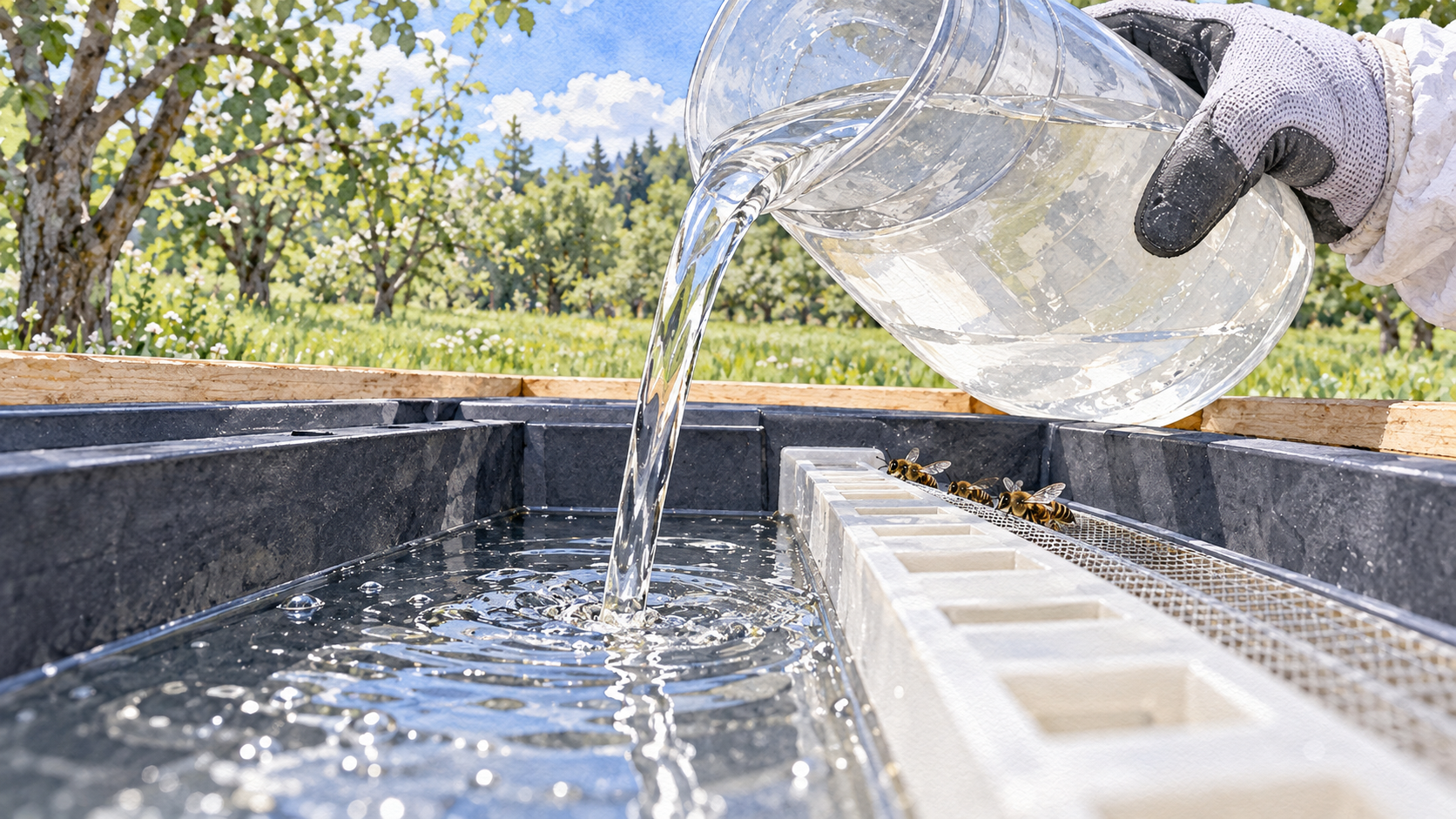
Feed honey bees sugar syrup when an inspection shows they need extra carbohydrate, such as a newly installed colony with little drawn comb, a hive running short of stores before reliable nectar is available, or a colony that needs to replenish stores before winter. Use plain refined white sugar and clean water, offer the syrup in a covered feeder that the resident bees can reach, and stop when the colony no longer needs it. Do not feed syrup while honey supers intended for human harvest are in place.
Sugar syrup is a temporary management feed, not a replacement for good forage, pollen, or a sound queenright colony. The aim is to close a specific food gap without creating new problems: robbing, drowned bees, spoiled feed, a brood nest packed with syrup, or honey contaminated with fed sugar. The supplemental feeding guidance for managed colonies emphasizes judging each colony’s requirements rather than feeding routinely just because a season has arrived.
Decide Whether the Colony Actually Needs Syrup
A light-feeling hive or poor flying weather can prompt a closer look, but neither alone tells you how much feed a colony requires. Inspect on a suitable day, assess the food already in its combs, and compare that with the colony’s size, brood demand, season, and likely forage over the following weeks. A thriving established colony during a dependable nectar flow may need nothing from a feeder even if a small package installed nearby still needs support.
New packages are a common reason to feed. Thousands of bees placed on bare foundation must construct comb before they can store much incoming food or raise a substantial brood nest. The package-feeding guidance recommends supplying feed on installation unless the bees already have sufficient drawn comb and stores. Feeding is also worth evaluating after creating a split, during a prolonged nectar shortage, and after weather interrupts foraging while brood-rearing demand remains high. The separate guides to installing package bees and splitting a beehive explain the broader colony setup involved.
Before putting syrup on a hive, look for these conditions together:
- Food reserves: Are there accessible arcs or frames of honey and nectar, or has the colony become noticeably light with little stored food?
- Colony population and brood: Does the colony have enough adult bees to warm brood, guard the entrance, and use the feeder? Is the queen’s laying area already crowded with stores?
- Forage and weather: Are workers actually bringing in fresh nectar, or are flowers scarce, dry, or inaccessible during a stretch of rain?
- Intended honey harvest: Are there supers on the hive that will be extracted for people? If so, routine syrup feeding is the wrong step.
- Colony health: Is feed shortage the main problem, or is a failing queen, unusual brood, heavy mite pressure, or another issue restricting growth?
A useful way to avoid automatic feeding is to compare the colony’s condition with the purpose of the syrup. These examples are hypothetical decisions, not reports of hives personally inspected:
| Colony situation | Feed decision | Reason |
|---|---|---|
| New package on mostly undrawn foundation; little food stored; nectar intermittent | Usually offer 1:1 syrup in an enclosed feeder | Bees need accessible carbohydrate while establishing comb and stores; reassess as forage improves |
| Strong established hive; substantial capped stores; fresh nectar entering daily | Usually leave the feeder off | Additional sugar offers little benefit and may take laying or storage space |
| Small split during a dry nectar gap; stores falling; no harvest supers present | Consider modest enclosed feedings and recheck soon | A short-term deficit can become serious before the next nectar flow; guard against robbing |
| Colony with harvest supers on and a discovered food emergency | Protect the bees first, but keep supplemental syrup away from harvest honey | Do not present syrup-fed comb as pure honey; revise the harvest plan if necessary |
The general hive-inspection procedure covers how to examine brood and stores without prolonged disturbance. If the colony is near starvation, deal with its food shortage promptly, but do not assume syrup alone will correct unrelated health problems. The dedicated guide to preventing colony starvation addresses longer-term assessment of reserves.
Choose 1:1 or 2:1 Sugar Syrup for the Job
Sugar-syrup ratios refer to the weight of sugar compared with the weight of water, not the volume of dry sugar scooped into a jug. Measuring by weight prevents confusion because a cup of granulated sugar does not weigh the same as a cup of water. These two mixtures are common beekeeping starting points rather than rigid rules that every colony must follow.
| Feeding purpose | Sugar-to-water ratio by weight | Small illustrative batch | Why this mixture is commonly used |
|---|---|---|---|
| Support a new colony, light spring stores, or comb building | 1:1 | 1 lb refined white sugar + 1 lb water | A lighter syrup suited to readily available carbohydrate during colony growth |
| Replenish stores in late summer or autumn while bees can process liquid feed | 2:1 | 2 lb refined white sugar + 1 lb water | More concentrated feed, requiring less water removal before storage |
These are ingredient weights, not finished-syrup weights or guaranteed feeding amounts. The seasonal syrup guidance distinguishes spring or summer shortages from fall storage needs. A heavier syrup does not necessarily mean faster brood development; what is useful depends on the intended outcome.
For a larger 1:1 batch, 5 lb sugar with 5 lb water keeps the same ratio. For 2:1, 6 lb sugar with 3 lb water does likewise. One U.S. pint of water weighs approximately 1 lb, so 2 U.S. cups of water are approximately 1 lb. Weighing both ingredients is still the clearest method. Never turn a recipe intended for pounds into the same number of cups of dry sugar without checking the actual mass.
Use ordinary refined white granulated cane or beet sugar. Brown sugar, molasses, raw or unrefined sugar, and powdered confectioners’ sugar are not substitutes; their accompanying minerals, molasses, or added starch make them unsuitable as routine bee feed. Do not experiment with artificial sweeteners or add essential oils, medicines, acids, or flavorings to a basic syrup recipe. If any medication is prescribed or a registered bee product requires feeding as part of its labeled use, follow the current product label and qualified direction rather than altering this recipe.
Prepare Fresh Syrup Without Burning or Contaminating It
You need a food-grade mixing container, a scale, potable water, refined white sugar, a clean stirring utensil, and a bee feeder that fits your hive. Set out the feeder before mixing so syrup is not left sitting in an uncovered bucket while you search for equipment. Wash and rinse the container and utensil thoroughly, and use supplies reserved for food or bee feed rather than equipment previously used for pesticides or unknown chemicals.
- Measure by weight. Decide whether the colony needs 1:1 or 2:1 syrup and weigh the water and sugar separately. Make only the volume you can place promptly in a clean feeder.
- Warm the water if necessary. Warm water helps dissolve the crystals, especially for 2:1 syrup. Remove the water from the heat source before adding sugar.
- Stir in the sugar gradually. Continue until it has dissolved. Do not boil the sugar-water mixture, let it scorch on a hot pot, or deliberately caramelize it.
- Cool the mixture. Allow the dissolved syrup to reach ambient temperature before filling the feeder. Hot syrup can damage equipment and harm bees.
- Fill a clean, leak-free feeder. Keep the lid, seals, screen, and access points correctly fitted. Wipe away exterior drips before carrying it to the hive.
Avoid adding vinegar, lemon juice, or other acids merely to make an improvised “invert syrup.” Heating and storing some sugar mixtures can increase levels of compounds such as hydroxymethylfurfural (HMF); the scientific risk assessment of HMF in honey bee feed explains why temperature, sugar composition, and storage conditions matter. A fresh, simple sucrose solution avoids unnecessary complication.
Fresh syrup is preferable to a large batch held for weeks. Store any short-term remainder in a clean, sealed, clearly labeled food-safe container somewhere cool and inaccessible to insects and children. Discard it if it develops a sour or fermented smell, bubbles unrelated to mixing, visible mold, or discoloration. Never try to make spoiled feed acceptable by reheating it, diluting it, or mixing it into fresh syrup.
Choose a Feeder That Protects Bees and Limits Robbing
The feeder should make the syrup available to the resident colony while preventing outside bees and wasps from reaching it. It also needs to be safe for the bees inside: an open pool without a reliable ladder, float, or screened feeding channel can drown workers. Feeders differ in their refill convenience, capacity, and likelihood of spills, so select one for the particular colony rather than buying the largest one available.
| Feeder type | Useful circumstances | Important drawback or safety check |
|---|---|---|
| Hive-top feeder | Replenishing larger amounts of stores; convenient refills without removing brood frames | Check screened access, lid fit, leaks, and whether bees can reach the feed without drowning |
| Inverted jar or pail enclosed above the inner cover | Small to moderate feedings where an extra hive box can enclose the container | Confirm the lid seals and does not drip continuously; keep the container inaccessible to robber bees |
| Division-board or frame feeder | A smaller colony that benefits from feed near its brood nest | Takes the space of a frame; inspect ladders or floats and avoid crushing bees when refilling |
| Entrance or Boardman feeder | Sometimes used for short spring feedings in low-risk conditions | More exposed to robbing, sun, pests, and temperature changes; not the preferred general choice |
| Communal open feeder | No recommended routine role for a small farm apiary | Attracts other colonies, encourages robbing, makes intake impossible to attribute, and can spread pathogens |
The practical comparison of feeder designs describes the trade-off between hive-top access and frame-feeder proximity. A separate residential beekeeping safety guide discourages exposed communal feeding and warns about entrance feeders when robbing begins.
For a small nuc, a modest enclosed jar or properly fitted small feeder may be more appropriate than a large reservoir of syrup it cannot consume. For a strong colony needing substantial autumn reserves, a clean hive-top feeder can reduce repeated opening of the brood nest. Whatever the design, ensure the cover closes securely, rainwater cannot run into the reservoir, and no syrup is dripping down the hive’s outside walls. If the unit cannot be made escape-resistant and drowning-resistant, replace it rather than improvising with an open bucket.
How to Put Sugar Syrup on a Hive Safely
Plan to feed when you can work without rushing or leaving hive parts exposed. Wear appropriate beekeeping protection and have your smoker and hive tool ready if opening the colony is necessary. If nectar is scarce, a brief visit late in the day reduces the hours that exposed feed odors can attract other foragers, although it does not eliminate robbing risk. The exact placement depends on the feeder’s design, so follow its instructions instead of treating every lid, jar, and frame feeder as interchangeable.
- Finish your food-store assessment first. Confirm why you are feeding, check for harvest supers, and choose a reasonable starting quantity instead of automatically filling a large reservoir.
- Prepare the feeding space. For a top or inverted feeder, arrange the inner cover, feeder rim or enclosing box so bees have the intended internal access route and outsiders have none. For a frame feeder, select the appropriate position without unnecessarily breaking up the brood nest.
- Place the feeder firmly and level. Avoid rocking a syrup-filled tray over open brood. Fit ladders, floats, and protective screens before the bees reach the liquid.
- Add the cool syrup with controlled handling. Refill through the designated opening where possible. Do not splash syrup over frames, entrance boards, the hive stand, or the ground.
- Close the hive fully. Refit covers, secure gaps that could admit robbers, check that ventilation is not accidentally obstructed, and clean any drips immediately.
- Record what you did. Note the date, syrup ratio, amount offered, feeder type, current stores, nectar conditions, and planned recheck.
A jar feeder set over an inner-cover opening should be surrounded by a properly fitting empty box and covered with the hive roof, not left exposed as a sugary beacon. The package-feeding instructions describe this enclosed arrangement. Frame feeders must fit the hive correctly and allow bees to exit the feeding chamber; a smooth-sided improvised container without a ladder is unsafe.
After installation, watch briefly from a safe distance for obvious leakage or a sudden crowd of bees probing the sides of the hive. Normal workers entering their own entrance are not automatically robbers, but fighting, bees forcing entry at seams, and frantic searching for exposed syrup warrant immediate attention. Take care not to mistake a wasp visit for ordinary honey bee traffic.
Prevent Robbing, Drowning, and Disease Exposure
Sugar syrup can attract bees from surrounding managed or unmanaged colonies, particularly when flowers are scarce. Robbing can escalate from a few intruders to intense fighting and can increase movement of pests and pathogens between colonies. The research-based guidance on robbing identifies exposed syrup, loose hive joints, prolonged inspections, and weak colonies as common vulnerabilities.
Keep the syrup inside a sealed hive feeding arrangement rather than in a shared open dish. Check that entrance openings are appropriate for the colony’s strength, especially during a dearth. A small colony may need an entrance reducer to help guards protect it, but the entrance still must permit safe bee traffic and ventilation. Clean spilled syrup promptly and remove empty jars, sticky containers, and exposed comb from the bee yard. For signs of active attacks, the detailed guide to stopping honey bee robbing covers the wider response.
Drowning prevention deserves a separate physical inspection. With a frame feeder, see that its ladder reaches the intended feeding surface, has usable grip, and is not displaced during filling. With a tray feeder, examine the screen for holes and ensure the internal bee passage cannot turn into an unprotected open pool. A rigid float or manufacturer-designed climbing surface is preferable to loose material that may shift, rot, or become submerged. If you find numerous drowned bees, empty and correct the feeder before using it again.
Use separate clean equipment when colonies have suspected disease, and do not move feed or sticky parts from a questionable hive into a healthy one. The same caution applies to saved comb and honey of uncertain origin; the distinct article on feeding honey back to bees discusses why source matters. A feeder is part of the colony’s biosecurity system, not just a container for sugar water.
Adjust Feeding for Spring, Summer, and Autumn
Spring: A newly installed package on foundation may need regular access to 1:1 syrup while it builds enough comb and natural nectar remains unreliable. An established colony emerging from winter might need syrup only if stores are deficient and bees are active enough to use liquid feed. Feeding simply because trees have not yet flowered can be unnecessary if the hive has sufficient stored honey. Keep an eye on the queen’s usable laying space; overfeeding can fill cells needed for eggs.
Summer: A nectar dearth is not automatically a feeding emergency. Some strong colonies carry enough stores to bridge a brief gap, while a small split or recently installed colony may have little reserve. Inspect the food situation rather than using the presence or absence of visible flowers alone. Prolonged drought or heavy rainfall can reduce nectar collection even when plants are blooming. The decision also depends on whether the colony is producing a surplus honey crop, in which case syrup must be kept away from harvest supers.
Autumn: After human-harvest supers have been removed, a colony short of winter stores may benefit from 2:1 syrup while temperatures are still suitable for bees to collect, reduce, and store it. Heavy syrup contains less water than 1:1, but the bees still need time and appropriate conditions to process it. Do not use the same last-feeding date for a Gulf Coast apiary and an upper Midwest apiary. Seasonal colony-management guidance explains the role of stored food in entering winter; actual targets and timing require regional judgment.
If bees are clustered in persistently cold weather, a liquid feeder outside their reach may sit untouched or leak. Assess the colony promptly if starvation is possible, but use the season-appropriate methods in feeding honey bees during winter rather than trying to force routine liquid feeding in freezing conditions. At any season, carbohydrate feeding cannot correct a protein shortage: pollen-substitute feeding is a separate nutritional decision.
Decide How Much to Offer and When to Refill
There is no safe, useful fixed syrup volume for every colony. A newly installed nuc, a strong double-deep hive, and an established colony in a long dearth differ in how much feed they can collect and what they should be allowed to store. A feeder’s maximum capacity is a hardware specification, not a recommendation to supply that much every time. Start with the colony’s assessed shortage and use a container suited to the anticipated intake.
After an initial feeding, check the amount remaining and the condition of the syrup soon enough to catch leaks or spoilage. In warm weather, small batches and more frequent checks are preferable to leaving a large reservoir unattended. The feeding recommendations suggest reassessing a feeder after about a week; if syrup remains unused, evaluate natural nectar availability and whether the bees can access the feeder. Do not assume a nearly empty feeder always means a shortage has been corrected. Workers can store syrup even while their brood chamber becomes crowded.
During a follow-up hive assessment, compare the amount of stored food with the remaining empty drawn comb and brood area. If bees are packing fresh syrup into cells that the queen needs for laying, reduce or stop feeding and address the colony’s available hive space separately. If stores remain very low despite suitable feeder access, check for leaks, robbing, loss of foragers, poor colony strength, and other conditions before simply increasing the quantity.
A useful feeding record takes one line per visit: date, colony, ratio, amount supplied, amount remaining, food-store observation, incoming nectar evidence, and next decision. That makes it easier to distinguish a colony that truly needed continued support from one that continued taking syrup because it was readily available.
Know When to Stop Feeding and Protect the Honey Crop
Stop or scale back syrup feeding when the food shortage has passed, natural nectar is coming in reliably, or continued feeding is filling the brood nest instead of serving the original purpose. Colonies may choose a natural nectar flow over syrup, so leaving a stale feeder on the hive is not useful insurance. If bees repeatedly ignore clean, accessible feed while bringing in nectar, remove the feeder and reassess when conditions change.
Never continue ordinary sugar-syrup feeding while honey supers intended for people are on the colony. Bees can store fed syrup in comb, and that store is not floral-source honey. The response to a beekeeper asking about year-round 1:1 feeding specifically advises stopping syrup feeding when harvest supers are used. The guidance on accurate labeling of honey and honey products reinforces the importance of representing honey accurately; do not use its labeling discussion to imply a universal state-specific sales rule.
Plan the changeover rather than abruptly putting harvest boxes on a colony that still needs feed. If a new colony lacks adequate reserves, prioritize its welfare and reconsider expectations for a honey harvest. If a colony has stored syrup in particular combs, track those frames and do not extract or market the contents as pure honey. Removing the feeder does not instantaneously convert stored syrup into floral honey. The dedicated guide to adding honey supers explains the separate storage-space decision.
At the end of a feeding period, remove the equipment, wash away sugar residue, inspect screens and floats for damage, dry the parts, and store them sealed against insects and rodents. Record why feeding ended so a later inspection can test whether the decision remains appropriate.
Troubleshoot Syrup That Is Ignored, Spoiled, or Causing Problems
The fastest response is usually to check the feeder and the colony’s actual circumstances before changing syrup ratios. Several different problems can look alike from outside a closed hive, and adding more sugar often makes at least one of them worse.
| What you observe | What to check first | Reasonable next step |
|---|---|---|
| Bees ignore the syrup | Natural nectar flow, cold weather, blocked feeder access, strong stores | Confirm access and stores; remove unused feed if it is not needed; use a suitable cold-weather option if shortage is urgent |
| Syrup leaks down the hive | Cracked reservoir, displaced gasket, incorrectly sealed inverted feeder, uneven stand | Remove the problem feeder, clean all spills, and repair or replace it before refilling |
| Workers drown in the feeder | Absent ladder or float, damaged screen, excessively deep uncovered pool | Empty the feeder, install proper safe access, and do not reuse it until corrected |
| Feed smells sour or grows mold | Time in feeder, high heat, dirty reservoir, oversized batch | Discard feed; thoroughly clean and dry the feeder; prepare a smaller fresh batch |
| Fighting or bees probing hive seams | Exposed feed, weak colony defense, entrance size, open joints | Stop spills, close exposed equipment, reduce defensible access where appropriate, and respond promptly to robbing |
| Brood chamber fills with syrup | Excess feeding, incoming natural nectar, limited drawn comb | Stop or reduce feed; reassess queen laying space and colony expansion needs |
| Stores stay low despite feeding | Feeder access, colony strength, robbing, ongoing dearth, possible health issue | Reassess the colony, not just its sugar supply; seek experienced local or diagnostic help for suspicious health findings |
The feeder and robbing precautions for small apiaries are especially useful when a problem starts outside the hive. Keep equipment closed while investigating, and avoid taking frames from a potentially diseased colony to solve an apparent feed shortage elsewhere. Unusual brood, high mortality, or severe weakness requires an appropriately qualified assessment; feeding is supportive husbandry, not a diagnosis or treatment.
Practical Questions About Sugar-Syrup Feeding
Can honey bees drink sugar syrup straight from a shallow bowl?
They can reach exposed syrup, but an open bowl is poor hive management. It can drown bees, attract other colonies and wasps, and encourage robbing. A properly designed enclosed feeder is safer and lets you know which colony is receiving the feed.
Should the syrup be warm when I put it in the hive?
No. Warm water is useful for dissolving sugar during preparation, but allow the finished syrup to cool to ambient temperature before filling or installing a feeder. Never offer scorched or caramelized syrup.
Can I keep feeding as long as the bees empty the feeder?
No. Bees consuming or storing an available sugar source is not proof they need more. Recheck natural nectar, food stores, queen laying room, and whether harvest supers will be used. If those checks no longer justify supplementation, stop feeding.
Will sugar syrup supply everything a colony needs to raise brood?
No. Syrup supplies carbohydrate energy. Brood development also depends on adequate pollen-derived nutrients, a functioning queen, adult worker care, suitable hive conditions, and overall colony health. A colony short of protein will not become nutritionally complete simply because its feeder is full.
8 thoughts on “How to Feed Honey Bees Sugar Syrup”