An established colony of red wiggler composting worms may process roughly 25–50% of its live worm weight in food scraps per day under suitable conditions. For one pound of worms, that is about ¼–½ pound of scraps daily, or approximately 1¾–3½ pounds over a week. These are published planning estimates, not a guaranteed ration for every bin. New colonies often need substantially less food, and a struggling colony may process far below the estimated rate.
The most useful number for a home vermicomposting bin is not the fastest figure advertised for worms. It is the amount the whole bin can accept without undecomposed scraps accumulating, oxygen declining, or the bedding becoming excessively wet. This guide explains the published rates, shows the arithmetic, and offers a way to estimate the capacity of an established colony without assuming every vanished ounce passed through a worm.
Daily intake estimates should be distinguished from food suitability, the starter colony size, and a bin that is processing waste unusually slowly.
Where the quarter-pound and half-pound estimates come from
The familiar feeding ratios come from extension guides, but those guides describe different circumstances. NC State Extension’s household guidance uses approximately 25% of live worm weight per day as a theoretical consumption rate for Eisenia fetida. Alabama Cooperative Extension gives a broader 25–50% range and cautions readers against overfeeding. Iowa State’s vermicomposting guide describes up to half the worms’ weight per day.
| Published guidance | What it means for 1 lb of worms | How to interpret it |
|---|---|---|
| NC State: about 25% of body weight per day | About ¼ lb of scraps per day | An approximate theoretical daily rate |
| Alabama Extension: 25–50% per day | About ¼–½ lb per day | A broad expectation under suitable conditions |
| University of Georgia: about 3 times body weight weekly | About 3 lb per week, averaging 0.43 lb/day | A weekly feeding guideline, not a daily requirement |
| Oregon State: begin with ¼–½ lb of scraps per lb of worms per week | About 0.04–0.07 lb/day if averaged over seven days | A cautious introduction rate for a new bin, not the mature colony’s maximum |
The University of Georgia’s September 2026 guide also directs keepers to adjust feed according to whether worms are processing previous additions. The Oregon State guide explicitly says to start gradually as worms adjust and multiply. Its weekly starting rate is several times smaller than the daily figures commonly repeated online, but the two recommendations address different stages of management.
Some references say worms can consume up to their own weight in organic matter each day. That is better read as an idealized upper possibility, not a promise that one pound of newly purchased worms will clear a pound of fresh kitchen scraps every 24 hours. Bedding and already-decaying organic matter also contribute to what worms ingest. None of these figures should be treated as a precisely measured universal biological constant.
Calculate a daily estimate from worm biomass
A practical calculation uses the mass of living worms, not the full bin weight or the weight of worms plus moist bedding:
Estimated daily food scraps (lb) = live worm mass (lb) × 0.25 to 0.50.
The following scenarios illustrate the arithmetic for established, active red-wiggler colonies only. They are not instructions to add that much food immediately.
| Estimated live worm biomass | 25% estimate per day | 50% estimate per day | Equivalent range over 7 days |
|---|---|---|---|
| ½ lb | 2 oz (⅛ lb) | 4 oz (¼ lb) | ⅞–1¾ lb |
| 1 lb | 4 oz (¼ lb) | 8 oz (½ lb) | 1¾–3½ lb |
| 2 lb | 8 oz (½ lb) | 16 oz (1 lb) | 3½–7 lb |
These are input-mass illustrations based on the 25–50% range published by Alabama Extension. They are not tested yields or forecasts of finished worm castings. The upper figure is not a safety threshold. It is only plausible when temperature, food condition, oxygen, moisture, and accessible working area are favorable. The bin itself may become overloaded well before a calculated upper estimate is reached.
If you purchased one pound of worms several months ago, do not automatically assume you still have exactly one pound of biomass. Worms grow, reproduce, and sometimes die. A few large adults and many juveniles can also weigh differently from another population with the same head count. NC State notes that the number of worms per pound varies greatly with their maturity. Repeatedly digging out every worm to weigh it is unnecessary for managing an otherwise healthy bin; use a cautious estimate and then let observed processing guide your loading.
New worm bins need a different starting calculation
Freshly established bins deserve particular care because both the worms and the microbial community are adjusting to unfamiliar bedding and scraps. Oregon State recommends introducing approximately ¼–½ pound of scraps per pound of worms per week at first, then increasing only as the system establishes itself.
For example, if a new bin contains a pound of worms, ¼–½ pound of scraps spread across the first week is a cautious published starting point. It is not the same as the ¼–½ pound per day often quoted for active established colonies. Use a quarter- or half-pound figure per day instead of per week, and that same number becomes seven times as much food across a week. This mistake can overload a new colony even though the arithmetic seems straightforward.
This gap is one reason to avoid choosing a feeding amount simply by multiplying the number of worms advertised on a shipping carton. Work with the current condition of the bedding, not the supplier’s theoretical processing claim. The decision of how many worms to buy belongs to the separate starter-population guide; here the question is how much material a colony is handling now.
Temperature changes the actual processing rate
Red wigglers are not equally active at all temperatures. NC State’s household guidance identifies around 70°F as favorable and states that feeding and breeding decline as conditions move outside its recommended range. Oregon State describes a favorable bin range of 55–77°F.
A bin kept in the cooler part of a garage may process scraps much more slowly than an equivalent colony in stable, moderate temperatures. Severe heat is different from normal seasonal variation: microbial activity in concentrated, fresh organic matter can warm a feeding pocket, while wet or compacted material can restrict oxygen. Neither situation should be answered by adding more food to reach a target weight.
Measure the temperature in the bedding near active feeding zones when processing slows or conditions change. Treat published consumption ratios as conditional on a suitable habitat; they are not a reason to force worms to perform at the same rate during a cold spell or heat stress. Full temperature monitoring and seasonal protection procedures are covered separately.
The type and condition of scraps affect how quickly they disappear
One pound of chopped, already-soft vegetable trimmings does not behave like one pound of fibrous stalks or dry peels. The latter may remain recognizable much longer even if the worms are active. UC Santa Barbara’s vermicomposting program explains that microorganisms colonize and break down food, and smaller pieces provide greater surface area for microbial activity. The EPA’s indoor-bin guidance likewise warns that dry, woody material can take longer to process.
That means the apparent daily rate depends on more than worm appetite. Food texture, water content, how long the material has been decomposing, the amount of loose bedding, and the size and shape of each feeding pocket all influence what you see. For a meaningful comparison, weigh scraps with similar preparation and measure them as added, rather than alternating between wet melon and dry leaves and calling the change a shift in worm health.
There is also a measurement trap. Fresh scraps contain water. A piece of fruit may lose water through drainage or evaporation while microorganisms use part of its organic matter, even before worms ingest much of what remains. Worms contribute directly to processing, but they work alongside microorganisms rather than independently converting every gram. The University of Georgia’s explanation of vermicomposting explicitly describes this combined biological process.
A simple way to measure what your bin can handle
You cannot calculate the exact mass each worm swallowed by weighing the container before and after feeding. What you can estimate is the sustainable input rate of the whole bin, which is what matters for deciding whether additional scraps will overload it.
- Start under the published estimate. If the bin is new, follow a conservative starting allowance instead of the mature-colony range. If it is established, choose a cautious amount below the upper 50% estimate.
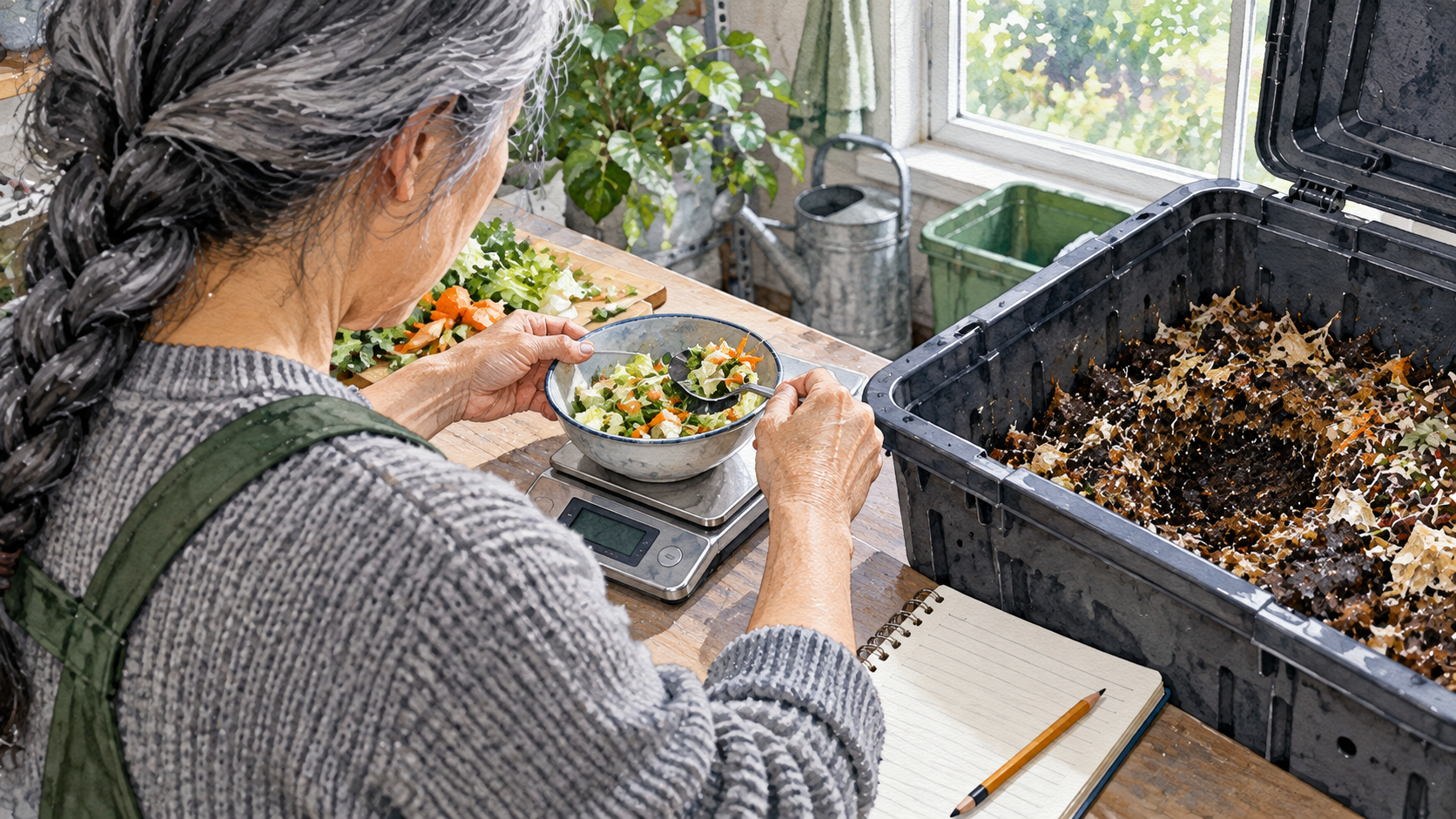
- Weigh each addition as it goes in. Record the actual weight of the food scraps, excluding the storage bowl and any new cardboard you put on top. A basic kitchen scale is adequate.
- Inspect the prior feeding area. Look for recognizable scraps, saturated patches, strong sour or rotten odors, and worms avoiding the material. Small remnants of skins or stems are not by themselves evidence of trouble.
- Do not stack fresh waste on a failing pocket. If a feeding remains wet, hot, foul-smelling, or largely unprocessed, hold additional scraps and correct the underlying condition. NC State Extension’s guidance specifically cautions against adding more until the earlier food is consumed.
- Calculate the average accepted input. Add the weights introduced over a representative observation period and divide by the number of days. Use that as a provisional loading estimate only when the bin stayed aerated and no backlog developed.
Worked example, for illustration only: An established household bin receives 0.4 pound of suitable scraps, then another 0.4 pound, then 0.6 pound during a seven-day observation. The total is 1.4 pounds. Dividing 1.4 by 7 gives an average input of 0.20 pound per day, or 3.2 ounces daily. If the material was processed without accumulating or causing distress, this is evidence the bin handled that observed load during that particular week. It does not establish that individual worms ate exactly 3.2 ounces each day or that the same loading will remain safe in different temperatures or with different scraps.
Repeat the observation as conditions change, and keep the dates, rough bedding temperature, type of scraps, and any leftovers with your weights. This modest record is more useful than a one-off maximum feeding test.
Why more worms do not always mean proportionally more food
Doubling a worm-population estimate does not automatically double the amount of waste a container can safely process. Worms need access to aerated bedding and suitable decomposing material. If a small bin is already compacted, saturated, or filled with mature castings, adding more worms or scraps can aggravate the physical limitation without creating more working space.
Reproduction also changes the population gradually rather than on a predictable calendar that guarantees more daily consumption. Mature worms, juveniles, and newly hatched young are not interchangeable in weight. For an established colony, its usable bedding surface and room to process material matter along with biomass. The separate bin-capacity guide addresses how many worms a container can sustain; this article uses worm mass only as one input to a feeding estimate.
The safest conclusion when food accumulates is often to reduce the input load, address bedding or temperature problems, or divert surplus scraps to another appropriate composting system. Do not release unwanted composting worms or their bedding into natural environments, where nonnative earthworms may cause ecological harm.
What overfeeding looks like before it becomes an emergency
A bin that receives more biodegradable material than it can process may develop a wet, compacted, oxygen-poor feeding zone. UC Santa Barbara warns that surplus rotting food can lower oxygen enough to kill worms. The EPA recommends checking what remains and withholding additional food until earlier scraps have been processed.
If fresh food is piling up, strong odors appear, or worms are persistently escaping or avoiding the feeding zone, stop adding scraps. Remove clearly spoiled excess material if it can be done without injuring worms, restore loose, absorbent bedding where conditions are soggy, and check drainage, ventilation, and bedding temperature. Do not use a chemical deodorizer or flood the bin to make food disappear faster. Persistent mass escape, widespread inactivity, or dying worms requires immediate attention to the bin environment; do not keep feeding while those signs continue.
An earthy smell and worms moving within damp, loose bedding are encouraging signs, but they do not prove that a particular daily rate has been reached. Once conditions stabilize, rebuild an actual input record rather than instantly returning to the previous maximum.
Questions that change the calculation
Does a worm really eat its own weight every day? Some guides describe that as a possible upper limit when including organic matter beyond fresh scraps, but it should not be used as a routine promise for a home bin. For food-scrap planning, the published 25–50% daily range is more cautious, and new colonies may need far less.
Should damp cardboard count in the daily food weight? Keep bedding additions separate from the mass of kitchen scraps in your records. Worms may eventually consume the cardboard and its microbial growth, but combining an entire bedding refill with scraps makes daily feeding comparisons difficult to interpret.
Can I use the amount of scraps added to predict how much finished vermicompost I’ll get? No. Moisture is lost, organic carbon is transformed, and some material remains in different stages of decomposition. Input weight is not finished-product weight. Estimating vermicompost yield requires different measurements.
3 thoughts on “How Much Food Do Composting Worms Eat Per Day?”