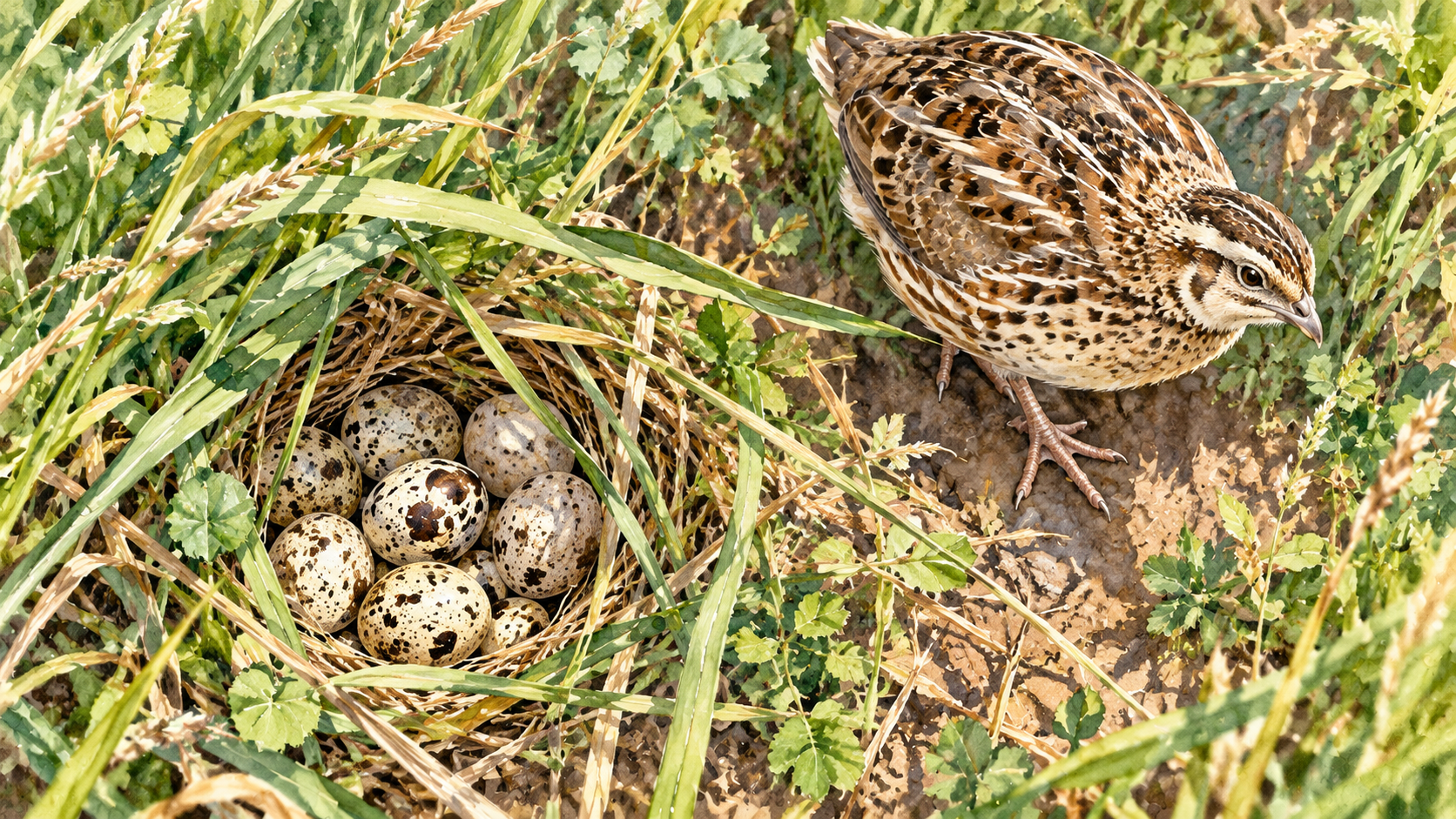
Quail usually lay their eggs on or near the ground, but the exact location depends on their housing and the nesting areas available. Domestic Japanese (Coturnix) quail may lay directly on cage floors, among bedding in floor pens, or inside sheltered nesting areas. When suitable cover is available, many hens prefer laying in a protected location rather than an exposed part of the enclosure.
This means quail eggs do not always appear in one predictable place. A hen may select a quiet corner, the edge of a pen, or a sheltered area beneath vegetation or furnishings. Understanding these preferences helps keepers find eggs promptly, reduce breakage, and provide surroundings that support normal laying behaviour.
Where Do Coturnix Quail Usually Lay Their Eggs?
Domestic Japanese quail commonly deposit eggs at ground level. In a relatively bare enclosure, they may lay wherever they happen to settle before an egg is released. In a more varied environment, they often choose locations offering some concealment.
Japanese quail show a preference for laying in covered areas, and many use designated nesting areas when those areas are appropriately positioned and designed. However, domestication and selection for egg production have not made every hen equally consistent about choosing one location.
A Coturnix hen may also change her preferred laying place. Familiarity, disturbance, social competition, and modifications to the enclosure can influence where eggs appear. A predictable nest site is helpful, but it should not be assumed that every egg will always be deposited there.
Where Do Quail Lay Eggs in Cages?
In conventional wire-floor cages, Japanese quail may lay directly onto the floor beneath their bodies. Some cage designs use a sloped floor so an egg can move away from the birds into an external collection area. In these arrangements, eggs may no longer be visible at the exact point where the hen laid them.
A cage without a sheltered laying area gives hens fewer opportunities to select a preferred nesting location. Restricted nesting opportunities can be associated with restless pre-laying behaviour, even though a hen may still produce eggs normally.
Cages containing accessible sheltered areas can produce different results. Some hens choose the sheltered location, while others continue laying on exposed floor surfaces. The important distinction is between where an egg is laid and where the housing system eventually carries or collects it.
Where Do Quail Lay Eggs in Floor Pens and Aviaries?
Floor-housed quail have more opportunities to choose among different ground-level locations. They may lay along walls, in corners, beneath low cover, or within dedicated nesting areas.
A hen often selects a place that feels relatively protected from surrounding activity. Concealed sites can attract substantially more egg laying than exposed floor space, even when the nesting areas occupy only a small proportion of the enclosure.
However, the presence of shelter does not guarantee that every bird will use it. Some hens may deposit eggs in loose bedding elsewhere, particularly when their preferred location is occupied or difficult to access.
| Housing situation | Where eggs commonly appear | Collection implication |
|---|---|---|
| Wire-floor cage | On the cage floor or in a connected collection channel | Check the collection area and any eggs left behind |
| Solid-floor cage | On the floor, especially near sheltered edges | Inspect corners and areas beneath furnishings |
| Floor pen with bedding | In loose material, corners, or covered areas | Eggs may be partly hidden |
| Aviary with nesting areas | Often within sheltered ground-level sites | Check preferred nesting sites and the surrounding floor |
The differences between cages and aviaries for quail affect both the birds’ opportunities to choose laying sites and the work involved in finding eggs.
Do Quail Prefer Dark or Sheltered Places to Lay?
Many Japanese quail prefer locations where their bodies are partly concealed. This can mean a covered corner, a sheltered opening, or a protected area beside a wall.
In controlled comparisons, quail favored nesting locations with overhead cover and relatively enclosed entrances. Some experiments also found that corners and wall-adjacent sites were more attractive than centrally positioned nests.
This does not mean an enclosure should be kept entirely dark. A hen’s choice depends on the contrast between available locations, the amount of cover, and whether she can enter and leave comfortably. Sheltered placement is generally more relevant than trying to make the entire housing area dim.
Do Quail Return to the Same Place to Lay?
Some do, but Japanese quail are not universally faithful to one nesting site. A hen may repeatedly use a preferred corner or covered area when it remains available and undisturbed, while another may distribute eggs across several locations.
Nesting-site use also differs among genetic lines and housing systems. Reported acceptance of provided nesting areas varies with strain and management, making it difficult to predict one hen’s behaviour solely from the species name.
Repeatedly finding eggs in the same corner suggests that the location is attractive, but it does not establish that one particular hen laid all of them. Several females can use the same place at different times.
Can Quail Lay Eggs Without Building a Nest?
Yes. Domestic Japanese quail may lay normally without constructing an organized nest from surrounding material.
Although hens show preferences for suitable laying locations, many domestic strains do not perform the elaborate nest-building behaviour associated with some other birds. Egg laying can occur on ordinary enclosure surfaces even when no constructed nest is present.
That ability should not be confused with having no preference for shelter. A bird may deposit an egg on the floor because it lacks an attractive alternative, while still being motivated to seek cover before laying.
The nesting behaviour of quail therefore involves both the opportunity to choose a site and the physical act of laying an egg.
Why Do Quail Lay Eggs in Corners?
Corners provide enclosure boundaries on two sides, reducing exposure compared with the middle of an open pen. They can also offer a relatively quiet location away from frequent movement.
Japanese quail have shown preferences for nesting areas positioned near walls and corners. This helps explain why eggs may repeatedly accumulate in particular parts of a floor pen.
However, corners are not always suitable collection sites. A damp corner, an area beneath accumulated droppings, or a narrow gap where eggs become trapped can create practical problems. The keeper should distinguish the hen’s preferred location from whether that location remains clean and accessible.
Why Are Quail Eggs Hidden Under Bedding or Cover?
Some eggs become partly concealed because hens settle into loose floor material before laying. Others may be covered accidentally as birds scratch, walk through bedding, or move nearby material.
A sheltered area can encourage laying while also making eggs harder to spot. Quail eggs are small, and their mottled shells can blend into bedding and other ground surfaces.
Quail often use ground-level shelter for ordinary behaviour, so a keeper should expect some eggs to appear in places that are less visible from the enclosure entrance.
When searching, move loose material gently and inspect behind accessible cover. Avoid overturning the enclosure or repeatedly disturbing resting birds simply to locate eggs.
Will Several Female Quail Lay Eggs in One Spot?
Yes. Multiple hens may choose the same attractive location, particularly when it provides better concealment than the surrounding floor.
Finding three or four eggs together does not prove that one hen produced them. The eggs may have accumulated through separate laying events involving different females.
Competition can also affect site selection. A hen unable to access a preferred location may lay elsewhere, and dominant birds may interfere with others approaching a sheltered area.
The social behaviour of adult quail matters when several birds share limited protected space. Persistent chasing or exclusion should be addressed as a welfare concern rather than accepted as an unavoidable part of egg production.
Do Quail Lay Eggs in Dust Baths?
Sometimes. A quail may deposit an egg in a dust-bathing area if it offers loose, comfortable material or a sense of shelter.
In one comparison of enriched cages, egg laying occurred in some enrichment areas, including a sand-bathing box. This does not mean that a dust bath is inherently the best laying location.
Eggs deposited in bathing material can become covered, stepped on, or contaminated as birds continue using the area. Separating the main bathing space from attractive sheltered laying locations may help make collection more predictable.
The purpose and maintenance of quail dust baths are different from the function of a preferred laying area, even when a hen occasionally uses both for the same purpose.
Can Lighting and Disturbance Change Where Quail Lay?
Yes. Nest-site preference is influenced by the available environment, including cover, lighting, and human or flock activity.
Some comparisons have found differences in the proportion of floor-laid eggs under different lighting conditions. These results do not justify making the entire enclosure dark; they show that site selection depends on the relationship between exposed and sheltered areas.
Frequent disturbance around a preferred laying site can also make a bird reluctant to settle there. Moving furnishings, blocking an entrance, or allowing dominant birds to occupy the area may cause eggs to appear elsewhere.
A stable, accessible site is more useful than continually rearranging the enclosure to encourage hens to choose a particular corner.
How Does Nest Location Affect Egg Collection?
When hens consistently use sheltered locations that can be reached easily, egg collection becomes more predictable. Eggs are less likely to be overlooked across the enclosure floor, and keepers can check preferred areas without repeatedly disturbing the entire flock.
Under favorable experimental conditions, up to 90% of Japanese quail eggs were deposited in provided nesting areas. That result demonstrates the influence of site preference, not a guarantee that every flock can reach the same percentage.
Collection efficiency also depends on whether eggs are visible, whether birds trample them, and whether the laying surface stays clean. A poorly positioned sheltered spot can attract hens while creating difficult access for the keeper.
The routine cleaning of quail housing should account for corners and laying sites where eggs and debris may accumulate.
How Can You Find Eggs That Seem to Be Missing?
First, examine the enclosure methodically rather than assuming that hens have stopped laying. Check along walls, beneath low shelters, behind furnishings, and within loose material where eggs may blend into the surroundings.
In cages with sloped collection floors, inspect both the collection channel and areas where an egg might become caught. In floor pens, look carefully in the locations hens occupy before laying.
Monitoring the birds at different times can also reveal preferred sites. Domestic Japanese quail frequently lay during the latter part of their light period, so an afternoon inspection may uncover eggs that were not present earlier.
The daily laying rhythm of Japanese quail can help explain why an enclosure appears empty during one inspection but contains several eggs later.
Do All Quail Species Choose the Same Laying Places?
No. Captive quail species share a general tendency toward ground-level laying, but their precise preferences and reproductive behaviour differ.
Most of the controlled research on cage and floor-pen egg placement concerns Japanese quail. It would be inaccurate to assume that identical nest acceptance rates apply to bobwhites, king quail, California quail, or Gambel’s quail.
Species with more strongly expressed nesting and incubation behaviour may maintain an association with one site during a reproductive clutch. Domestic Japanese quail, particularly commercial laying strains, may continue producing eggs without consistently using one nest.
The differences among quail species should therefore inform expectations about how predictable egg locations will be in a managed flock.
Common Questions About Where Quail Lay Eggs
Do Coturnix quail lay eggs directly on the floor?
Yes. Domestic Japanese quail often lay on cage or pen floors, particularly when they lack a preferred sheltered area.
Why do my quail keep laying eggs in the same corner?
That corner may offer greater concealment or less disturbance than the surrounding enclosure. Several hens may use the same location.
Can quail eggs roll away from where they were laid?
Yes. In cages with sloped floors, eggs may roll toward a collection channel, so their final position may differ from the original laying location.
Why can’t I find all my quail eggs?
Some eggs may be hidden beneath loose material or cover, deposited in corners, or caught along cage flooring. Checking the enclosure systematically can help distinguish concealed eggs from a genuine reduction in laying.
4 thoughts on “Where Do Quail Lay Their Eggs?”