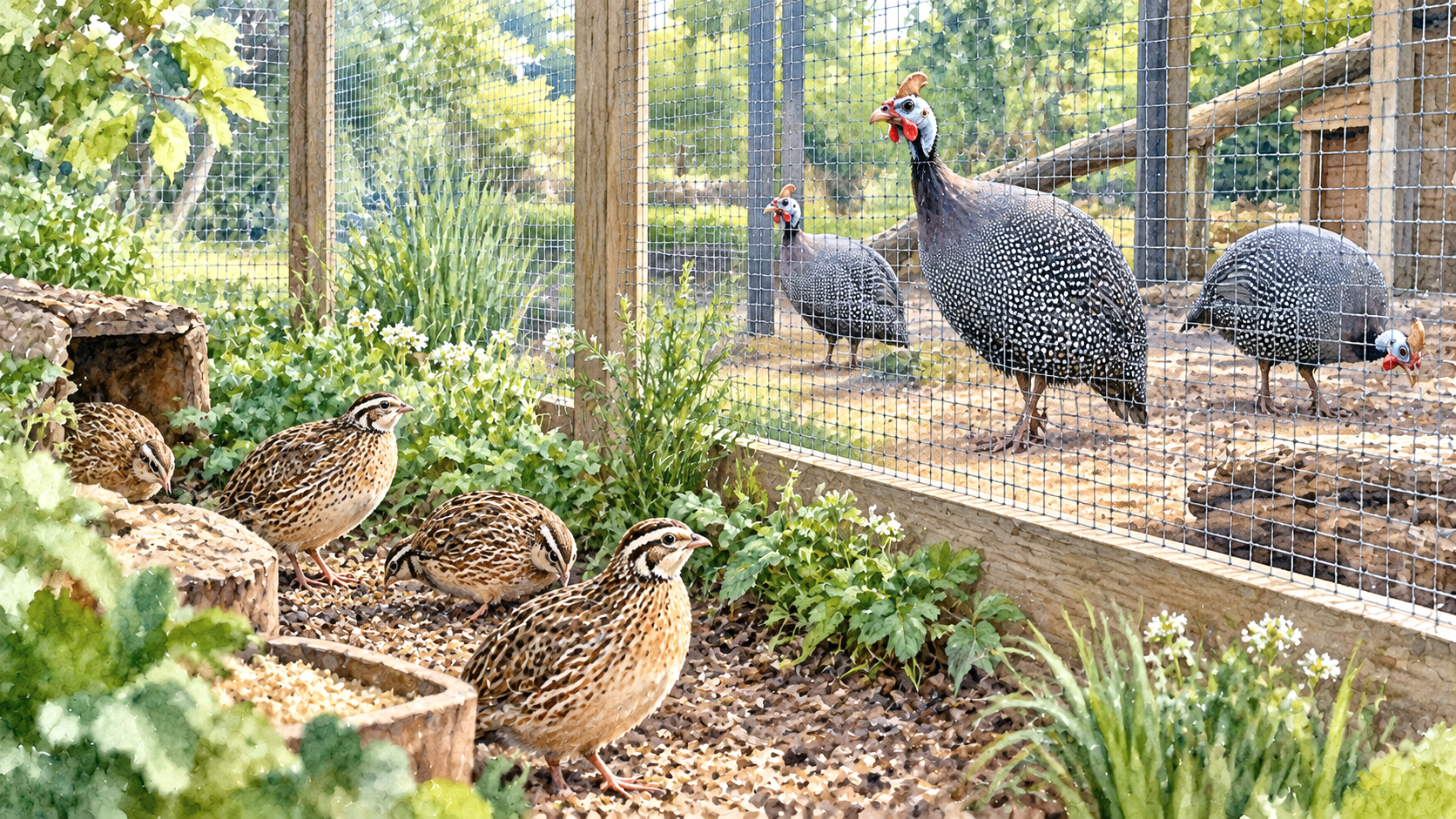
A guinea fowl investigating a feed tray might barely notice the quail standing beside it. If the larger bird suddenly turns, lunges or begins chasing another guinea, however, the smaller bird may have nowhere to escape. An enclosure that seems spacious enough for several quail can become dangerous when a much larger and more active species shares it.
Guinea fowl and quail should generally not live together in the same enclosure. Although individual birds might tolerate one another, their substantial size difference, incompatible housing habits and the risk of injury make direct cohabitation difficult to justify. Keeping them in separate, secure enclosures on the same property is a considerably safer arrangement.
The Size Difference Creates an Unequal Risk
Adult domestic helmeted guinea fowl commonly weigh several pounds, whereas the Japanese or Coturnix quail frequently raised on small farms are much smaller. Even larger domestic quail varieties remain substantially lighter than mature guinea fowl. These differences affect what happens during ordinary flock movement, not just deliberate aggression.
A guinea fowl can injure a quail by stepping on it, rushing through a crowded opening or striking it during a dispute over food. The larger bird does not need to perceive the quail as an enemy. A brief encounter involving the same force used during normal guinea fowl movement could cause serious harm to a smaller bird.
Size also affects escape opportunities. Quail may be unable to pass safely beneath an excited group of guinea fowl, and a sheltered corner can become a trap if the larger birds occupy its entrance. Adult guinea fowl are active, strong-running birds, so physical barriers and usable space must be evaluated from the smaller species’ perspective rather than assuming both groups can move around one another safely.
The normal size of adult guinea fowl makes this pairing fundamentally different from housing birds of similar body mass. Even when no aggression has occurred, the consequences of an accidental collision remain disproportionate.
Quail Need Ground Cover While Guinea Fowl Seek Elevated Roosts
Most commonly kept Coturnix quail spend their time on or close to the ground. They benefit from suitable substrate for foraging and dust bathing, as well as vegetation, shelters or other visual barriers that allow them to withdraw when disturbed.
Guinea fowl use space differently. They actively investigate open ground and often seek elevated positions when resting at night. Their sudden movements and use of higher perches can disrupt a quail enclosure designed around ground-level activity.
Suitable quail housing includes shelter, enrichment and opportunities to retreat. Those features must remain accessible without larger birds blocking entrances or occupying the surrounding space. A hiding box is of little practical value if a quail must repeatedly pass an aggressive guinea fowl to reach it.
An enclosure designed around guinea fowl roosting behavior may also place smaller birds beneath elevated perches, exposing them to falling droppings or sudden landings. Providing additional floor space does not remove these differences in how the two species use the enclosure.
Separate accommodation allows each species to occupy surroundings suited to its natural behavior without compromising the other’s safety.
Startled Quail Can Injure Themselves While Escaping
Quail respond rapidly to perceived danger. A bird that feels trapped may launch vertically, striking an overhead surface before it has time to change direction. Such movements can cause head, neck or wing injuries, particularly in poorly designed enclosures.
The risk of head injuries from abrupt escape responses is recognized in quail husbandry guidance, which recommends pliant overhead materials where appropriate, adequate cover and calm handling. These precautions address a species-specific vulnerability rather than ordinary discomfort around unfamiliar birds.
Guinea fowl can contribute to the problem through their movement and alarm reactions. A guinea suddenly running across the enclosure, flapping its wings or calling loudly may startle nearby quail even without approaching them directly.
A quail repeatedly striking the roof, hiding for extended periods or refusing to move freely is not adjusting successfully. Increasing enclosure height without considering the overhead material can also leave birds with more room to accelerate before a collision.
The requirements for permanent guinea fowl enclosures and those for quail should therefore be assessed separately. A structure suitable for one species cannot automatically be considered safe for the other.
Aggression Does Not Have to Be Constant to Be Dangerous
Some keepers report guinea fowl ignoring smaller poultry for extended periods. Such observations may reflect temporary tolerance, but they do not guarantee that the birds will remain compatible when food, shelter or social conditions change.
Guinea fowl can engage in chasing and forceful pecking, particularly during social competition. A quail struck by a larger bird may suffer a serious injury even when the encounter lasts only seconds. The danger is not necessarily proportional to how frequently aggression occurs.
Guinea fowl territorial and aggressive behavior can vary between individuals and circumstances. Quail have their own social relationships and may become stressed by repeated disruption. Neither species should be expected to tolerate unsuitable conditions simply because it has not visibly fought with the other.
Persistent hiding, reduced feeding, feather damage, unexplained weight loss and reluctance to use familiar areas are warning signs. They may indicate intimidation, illness or environmental problems, and their cause cannot be established through behavior alone. Injured or unwell birds require appropriate separation and veterinary evaluation.
Supervision cannot make continuous shared housing safe when an incident may occur during the night or while the keeper is absent.
Feeding the Two Species Together Is Complicated
Guinea fowl and quail both consume seeds, grains and small invertebrates, but this overlap does not make their formulated diets interchangeable. Nutritional needs depend on the species, age, reproductive condition and purpose for which the birds are raised.
Growing quail typically require carefully formulated, protein-rich feeds. Young guinea keets also have substantial protein requirements, although the appropriate concentrations and nutritional profiles are not necessarily identical. Adult laying quail and mature guinea fowl may have different calcium and energy needs, so one ration cannot be assumed suitable merely because both species eat it.
The nutritional requirements of growing guinea keets and the selection of feed for adult guinea fowl need to be considered independently of a quail feeding program. Medication is another concern: feeds formulated or medicated for one species must not automatically be given to another without confirming their suitability and legal labeling.
Size differences also make feeder access problematic. Guinea fowl can displace quail or consume substantial amounts of feed before the smaller birds approach. Placing feeders at quail height may prevent larger birds from using them comfortably, while elevated guinea fowl feeders may be inaccessible to quail.
Appropriate feeder space helps reduce competition among poultry, but independent feeding facilities are more dependable than attempting to supervise access to shared equipment.
Keeping Guinea Fowl and Quail in Adjacent Enclosures
Separate enclosures can permit both species to be raised on the same property without exposing quail to direct contact with guinea fowl. The design should prevent birds from reaching through partitions to peck one another, transferring into the neighboring enclosure or becoming trapped along shared boundaries.
A solid lower divider may reduce visual disturbance and prevent direct contact at ground level. Where mesh is used, openings must be small enough to contain quail and prevent heads, toes or wings from becoming trapped. Appropriate overhead protection is particularly important because both species can take flight, although their flight behavior and housing needs differ.
The importance of safe poultry housing materials extends to access doors, structural edges and equipment placement. Adjacent enclosures must also allow each group to retreat from visual disturbance rather than forcing continuous exposure.
Quail should have suitable ground cover, protected resting areas and access to their own feed and water. Guinea fowl need appropriate room for movement and secure resting facilities. Planning sufficient space for guinea fowl should not involve taking usable floor area away from the quail enclosure.
A farm may have room for both species while still lacking facilities suitable for keeping them together. Independent housing solves many of the problems that a single divided pen cannot.
Disease Prevention Between Separate Flocks
Physical separation reduces opportunities for aggression and accidental injury, but it does not automatically prevent infectious diseases from moving between enclosures. Contaminated shoes, shared equipment, feed containers and wild birds can introduce pathogens even when domestic flocks never touch.
Different poultry species should have separate feed, litter and equipment wherever practical. Cleaning and disinfection should follow an established routine, particularly when the same keeper works in several poultry areas.
Quail and guinea fowl can both be affected by avian diseases, including avian influenza. The risk of exposure increases when domestic poultry encounter contaminated environments or wild birds, making protection against wildlife entering poultry areas important for both groups.
Newly acquired birds should be isolated and observed before they enter the established farm environment. The principles of quarantining incoming guinea fowl help reduce disease introduction, while quail require an equally appropriate species-specific quarantine arrangement.
Sudden deaths, breathing difficulties, neurological abnormalities or unusual illness affecting multiple birds warrant prompt veterinary attention and compliance with relevant state animal-health reporting requirements.
Why Raising Them Together From Chicks Is Not a Solution
Raising guinea keets and quail chicks alongside one another may make them appear accustomed to each other’s presence. Familiarity, however, cannot remove their eventual size difference or ensure compatible behavior as they mature.
Young quail are particularly small and vulnerable to trampling, inappropriate temperatures and unsuitable waterers. Guinea keets develop along a different growth pattern, and their space requirements change as they become larger and more active. A brooder that appears adequate when both groups are newly hatched may become unsuitable well before adulthood.
The risk increases as individuals begin competing for preferred resting and feeding places. Deliberately raising the species together in the hope that they will develop lifelong tolerance is not a dependable husbandry method.
Quail also require appropriate companions of their own species, just as guinea fowl have important social companionship needs. Placing a single bird with an unrelated poultry species should not be treated as an equivalent substitute for a suitable same-species group.
Questions About Guinea Fowl and Quail
Will guinea fowl kill quail?
A guinea fowl is physically capable of causing fatal injuries to a smaller quail through pecking, trampling or aggressive chasing. That does not mean every guinea fowl will attack quail, but the potential consequences make unsupervised cohabitation unsuitable.
Can guinea fowl and quail share a large aviary?
A large aviary does not eliminate direct-contact risks. Properly partitioned sections with independent resources may work, but the birds should not be expected to share one open enclosure simply because it has substantial floor space.
Are bobwhite quail safer around guinea fowl than Coturnix quail?
Bobwhite and Coturnix quail differ in behavior and husbandry, but both remain much smaller than adult guinea fowl. Neither species can be assumed safe in direct contact with guineas.
Can guinea fowl eat quail eggs?
A guinea fowl may investigate or damage an accessible egg, but there is insufficient evidence to predict habitual egg-eating behavior toward quail eggs. Separate nesting areas remove the risk of larger birds disturbing eggs or nesting quail.
Can guinea fowl and quail hear and see each other safely?
Usually, provided both groups have secure enclosures and opportunities to retreat from disturbance. If the quail remain frightened, avoid feeding or repeatedly launch into the roof, additional visual separation may be necessary.
Can a guinea fowl be used to protect quail from predators?
No. Guinea fowl may sound alarms, but they are not reliable physical guardians for smaller birds. Quail require their own predator-resistant housing.